

Struggling to hire top tech talent? You're not alone. By 2026, 72% of organizations face challenges finding skilled developers, while hiring a senior engineer in the U.S. takes 5–7 months. The solution? Nearshore talent from Latin America.
Here’s why it works:
- Time zone alignment: Latin American developers work 1–3 hours behind U.S. teams, enabling faster collaboration.
- Cost savings: A senior U.S. engineer costs $219,000/year, while a comparable Latin American engineer costs $101,250 - a 54% reduction.
- Skilled workforce: Countries like Brazil, Mexico, and Colombia offer expertise in AI, fintech, and blockchain.
This guide breaks down how to define your needs, hire pre-vetted developers, manage compliance, and onboard effectively - all while leveraging tools and strategies to maintain productivity.
Step 1: Define Your Team Requirements and Roles
Start by turning your business goals into clear technical needs. This means figuring out where your current team might fall short. Are you looking to expand general engineering resources, or do you need experts for specific challenges like AI integration or cloud modernization?
It’s helpful to organize your planning around three key areas: objectives, deliverables, and boundaries. This structure keeps your project on track and avoids scope creep. Plus, it gives your remote team the clarity they need to make informed technical decisions without constant oversight. For example, if you’re developing a fintech app, you’ll want to hire full-stack developers (React, Node.js), a DevOps specialist (AWS), and a QA tester instead of a generic team.
When it comes to team size, aim for 6 to 8 engineers. This keeps things manageable while still covering specialized roles. Take Limber Health as an example. In 2024, this DC-based healthtech company built a 6-person team in Latin America, including full-stack developers, DevOps engineers, React Native developers, and data analysts. They managed to cut salary expenses by 52% while securing Series A funding - a win-win situation.
Map Business Goals to Technical Requirements
After defining the scope of your project, focus on identifying the specific roles you’ll need. For instance, if your goal is to launch an MVP in six months, you’ll likely need frontend developers (working with React or Vue.js), backend engineers (proficient in Python or Java), and at least one DevOps expert to handle deployment pipelines. For AI-based projects, you’ll also want data scientists or machine learning engineers.
Don’t overlook soft skills - they’re just as important as technical expertise. A survey found that 78% of HR managers prioritize qualities like motivation, empathy, and independence over technical skills alone. Remote work especially benefits from team members who communicate well, take initiative, and solve problems without needing constant supervision. During interviews, ask behavioral questions to gauge how candidates handle uncertainty or give constructive feedback.
Latin America offers a wealth of talent across various specialties. Brazil, for example, has around 759,000 developers excelling in fintech and AI. Mexico is home to 563,000 engineers with a strong AI focus, while Colombia is becoming a blockchain hub. Chile is also gaining momentum in cybersecurity. Depending on your technical needs, consider targeting regions with expertise that aligns with your project.
Consider Timezone and Cultural Compatibility
One of the biggest advantages of nearshore hiring is timezone alignment. It’s no surprise that 85% of companies choose nearshore partners for this reason. Once you’ve outlined the roles you need, make sure your team’s working hours overlap with your business schedule.
This overlap can significantly boost productivity. Nearshore teams often complete projects about 40% faster than offshore teams, largely due to fewer communication delays. Imagine a bug is discovered at 3:00 PM EST - an engineer in Colombia could review and fix it by 4:30 PM, avoiding the next-day delays you might face with offshore teams.
Cultural alignment also plays a key role. Developers in Latin America tend to share similar work styles with U.S. businesses, emphasizing direct communication, agile workflows, and proactive problem-solving. This reduces onboarding time and helps new hires contribute faster. For maximum timezone overlap, consider Mexico or Colombia (9:00 AM to 5:00 PM EST). Argentina and Brazil are great options too, with coverage from 10:00 AM to 4:00 PM EST.
| Country | Time Zone | Eastern Time Overlap | Best For |
|---|---|---|---|
| Mexico | CST/MST | 9:00 AM – 5:00 PM | Full integration, real-time pairing |
| Colombia | EST/COT | 9:00 AM – 5:00 PM | Same-day feedback, customer support |
| Argentina | UTC-3/ART | 10:00 AM – 4:00 PM | Hybrid sync/async, morning alignment |
| Brazil | UTC-3/BRT | 10:00 AM – 4:00 PM | High-velocity engineering, data science |
Step 2: Hire Pre-Vetted Nearshore Developers Through Revelo
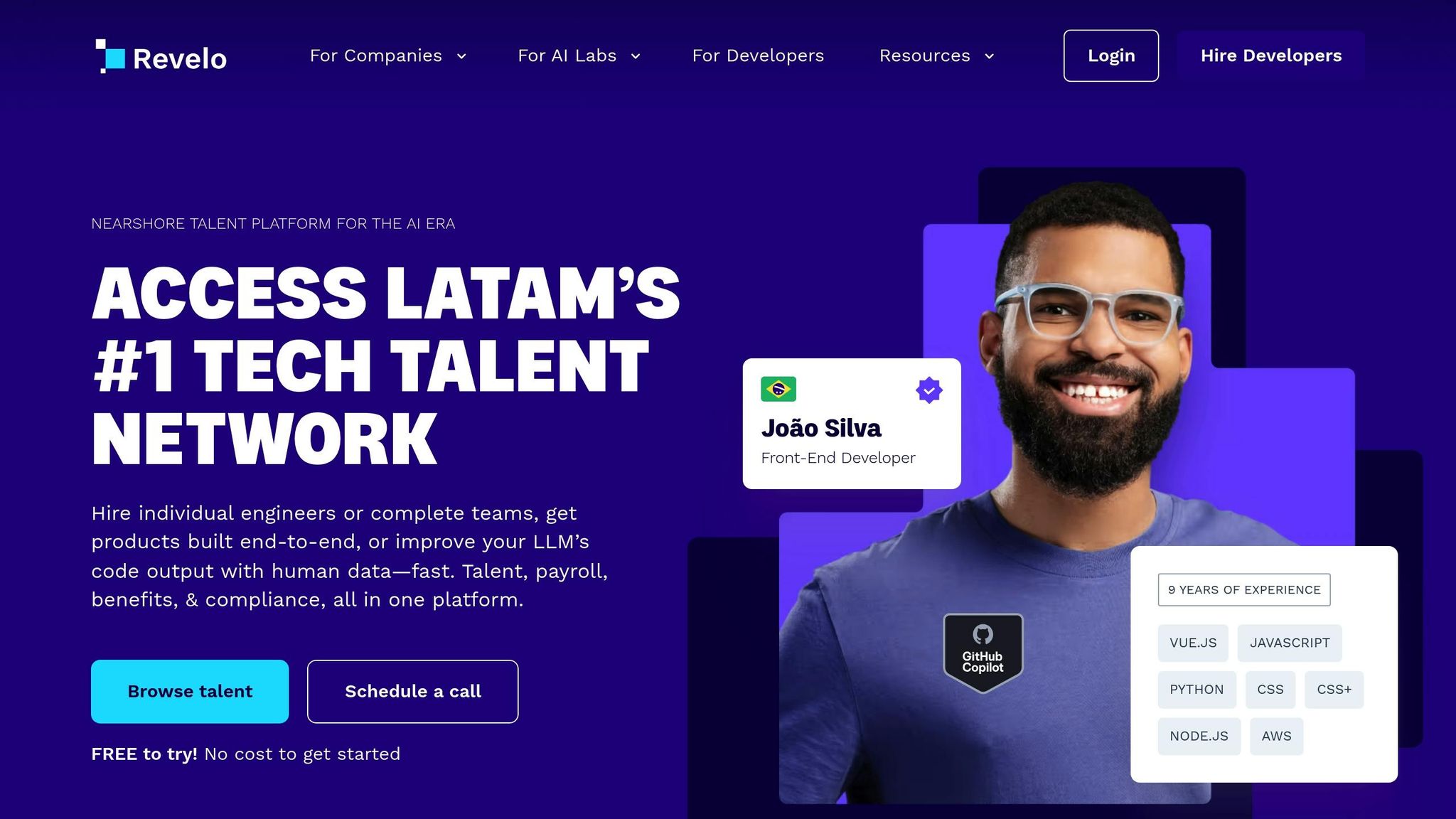
Revelo connects you with a pool of over 400,000 pre-vetted software engineers from top tech hubs across Latin America. By handling the sourcing and vetting process, Revelo eliminates the hassle of sorting through unqualified resumes or spending hours on screening calls. Only the top 2% of developers - evaluated for technical skills, English fluency, and soft skills - make it into the network. This ensures you’re matched with highly qualified talent ready to seamlessly integrate into your team.
How Revelo Simplifies Developer Hiring
With Revelo, hiring is fast and efficient - just 14 days. You provide your specific requirements, whether it’s a React developer, a DevOps expert skilled in AWS, or a machine learning specialist. Within 72 hours, Revelo delivers a curated list of candidates who meet your criteria.
The platform covers over 100 technologies, from widely used stacks like React, Python, and Node.js to specialized fields like AI and large language model (LLM) post-training. This broad expertise ensures you’ll find the right developer for your project, no matter how niche the role.
"Revelo made it so easy to scale my dev team - I was able to get several top engineers up and running in under 2 weeks, and that cut our roadmap schedule in half!"
– Sakshi G, Head of Engineering, Hydrolix
Revelo also assigns dedicated staffing experts who specialize in local labor laws and workplace norms. These experts guide you through the hiring process and help ensure smooth integration of remote developers into your existing workflows.
Why Nearshore Talent Is a Smart Choice for US Companies
Revelo’s streamlined hiring process unlocks the many benefits of nearshore talent. For one, hiring developers from Latin America can save 30–50% compared to U.S.-based hires - all without compromising on quality. The network includes senior-level engineers, with 56% of full-stack and back-end developers having three or more years of experience.
Another key advantage is time zone alignment. Latin American developers work during U.S. business hours, enabling real-time collaboration and avoiding the delays caused by offshore teams working in drastically different time zones.
Workplace compatibility is also a strong point. Developers from Latin America often share similar approaches to work, prioritizing clear communication, agile practices, and proactive problem-solving. With 51% of full-stack developers demonstrating advanced English proficiency, they can contribute to your team’s success from day one, whether it’s during sprint planning or daily standups.
"The quality of engineers in South America is amazing! Really met our needs."
– Heather Townsend, Co-Founder & COO, Cabana
Step 3: Handle Compliance, Payroll, and Benefits with Revelo
Once you've streamlined your hiring process, the next big challenge is managing the legal and payroll aspects of employing remote teams. For companies working across Latin America, this can get tricky. Each country has its own labor laws - Brazil’s CLT mandates severance and vacation pay, while Mexico’s Federal Labor Law enforces strict rules on worker classification. Missteps, like misclassifying employees or missing tax deadlines, could result in fines as high as 20% of payroll.
Revelo takes the stress out of this process by acting as the Employer of Record (EOR). This means they handle all the legal responsibilities for your remote developers, from drafting localized contracts to ensuring taxes are filed correctly across 20 Latin American countries. They simplify payments too: you pay in USD, and Revelo takes care of paying salaries in local currencies while managing deductions like social security. This approach ensures compliance and smooth financial operations for your remote team.
Manage Legal and Tax Compliance
Revelo’s legal team stays on top of ever-changing labor laws. For example, when Colombia updated its pension requirements in 2026, Revelo automatically adjusted contracts and payroll systems. This proactive approach reduced non-compliance incidents by 95%. They also conduct quarterly audits to ensure everything stays in line, helping you avoid lawsuits and penalties.
"Everything that keeps your LatAm dev team running smoothly is built into the platform. No Googling labor laws at 2am or wrestling with cross-border tax forms."
The results speak for themselves. A US fintech company that scaled a 50-developer team in Brazil using Revelo avoided $150,000 in potential tax penalties, cut administrative tasks by 70%, and reduced payroll errors to just 0.1%. Companies working with Revelo typically save 40–60% on administrative costs and can get up and running in as little as two weeks, compared to the usual 3–6 months. This efficiency allows your team to focus on what matters most: growing your business.
Process Payroll and Benefits
Revelo ensures payroll is processed on time - whether bi-weekly or monthly - with direct deposits completed within 48 hours at a 99.9% on-time rate. They also handle localized benefits, tailoring packages to meet each country’s requirements. For instance, in Colombia, mandatory EPS healthcare covers 80% of medical expenses, and developers receive 15–30 days of paid time off depending on local laws. Optional perks, like a $50 monthly remote work stipend, can also be added.
For US-based managers, Revelo simplifies oversight with a unified dashboard. This tool lets you track PTO, approve expenses, and monitor payroll without dealing with multiple vendors or currency conversions. On the developers’ side, Revelo’s network boasts a 92% satisfaction rate with its USD-equivalent benefits. Their tiered payroll solutions start at $50 per engineer per month for basic management and go up to $300 per month for more comprehensive options, including health and dental insurance administration.
Step 4: Onboard Remote Developers
Getting the onboarding process right in the first 90 days can make all the difference in how quickly developers become productive. This step is especially critical for remote teams, where seamless integration and collaboration are essential. Here’s a key statistic: 68% of companies admit their remote onboarding process needs improvement. And when onboarding falls short, the cost can be steep - over $75,000 in lost productivity per developer. On the flip side, companies with a solid onboarding process enjoy 2.5x revenue growth and 1.9x profit margins.
The goal? Move from "access granted" to "code merged" as fast as possible. Start with pre-boarding: ship hardware, set up access to necessary tools, and share important documentation. This simple step can reduce first-week friction by 80%. Aim to have new developers submit their first pull request (PR) - even something small like a documentation update - within 3 to 5 days.
Remote onboarding works best with clear communication protocols. From day one, set expectations: daily standups, end-of-day updates, and mandatory camera-on meetings during the first 90 days can help build trust. Designate 2 to 4 hours of overlapping work time for real-time collaboration, leaving the rest of the day for focused, independent work. And don’t forget to record key sessions - like codebase tours or architecture reviews - so new hires can revisit them later.
Follow a 30-60-90 Day Onboarding Plan
Breaking the onboarding process into three phases makes it manageable and ensures measurable progress. Here’s how to structure it:
- Days 1 to 30: Focus on the basics. Set up the work environment, dive into architecture, and ensure the first PR is submitted within the first week. By the end of this phase, developers should achieve 70% to 80% productivity.
- Days 31 to 60: Shift to more advanced tasks. Developers should take ownership of features, deploy to production, and work toward 70% of full capacity.
- Days 61 to 90: Build autonomy. Developers should now handle complex features and contribute at 90%+ productivity, while also mentoring newer hires.
| Phase | Focus | Key Milestone |
|---|---|---|
| Days 1-30 | Foundation & Integration | First PR merged; environment mastery |
| Days 31-60 | Acceleration | Independent feature delivery; 70% productivity |
| Days 61-90 | Autonomy | Full productivity (90%+); complex feature leadership |
Track "Time to First PR" as your main metric for onboarding success. To make this happen, assign simple tasks - like fixing minor bugs or updating documentation - within the first 48 hours. Create a developer-friendly "How to Work With Us" guide that outlines coding standards, PR etiquette, and communication norms. Wrap up the first week with a brief quiz to confirm the new hire understands security protocols and team processes.
Build a Collaborative Onboarding Process
Collaboration is key to making new hires feel supported. Pairing them with lead engineers during the first 30 days helps them get familiar with both technical workflows and team dynamics. Incorporate pair programming sessions and have new hires shadow experienced team members. Rotate them through different departments - frontend, backend, DevOps - for a day or two to give them a broader understanding of how their work fits into the bigger picture.
To minimize disruptions, make your documentation self-service. A well-organized knowledge base should include setup instructions, architecture overviews, and operational manuals covering everything from coding standards to deployment steps. Without this, senior developers could lose up to 30% of their productivity while mentoring new hires.
Structured onboarding has clear benefits. It can boost new-hire retention by 82% and increase productivity by over 70%. Without it, new developers often struggle to add value during their first three months. But with a solid plan, they can start contributing meaningfully in weeks. These strategies ensure that Latin American developers integrate seamlessly into your team and deliver results right from the start.
Step 5: Set Up Communication and Collaboration Tools
In 2026, tools that automate tasks, summarize conversations, and generate action items have become essential for remote teams. Yet, 63% of professionals report losing time due to poor remote communication. The fix? Build a tool stack that supports asynchronous workflows while keeping live interactions focused and efficient.
Your toolkit should cover four main areas: real-time messaging (like Slack or Microsoft Teams), project management (Jira or Linear), documentation (Notion or Confluence), and async video (Loom). Together, these tools create what experts call a "single source of truth." As Stratagem Systems says: "If it's not documented, it doesn't exist". When teams store information in searchable wikis and threaded discussions, they can become 4.9x more effective and 4.4x more productive. This setup ensures streamlined communication and improved productivity.
Expect to spend between $50 and $150 per developer per month on these tools. For instance:
- Slack Pro: Starts at $8.75 per user/month, offering AI-powered thread summaries.
- Zoom Business: Costs $21.99 per user/month, including AI Companion features.
- Notion Plus: Priced at $10 per user/month, with an extra $10/month for AI features that auto-write and summarize.
- Loom Business: Available at $12.50 per user/month, helping save 2 to 4 hours weekly by replacing status meetings.
Choose the Right Tool Stack
When working with nearshore talent, efficient communication tools are critical for bridging time zones and maintaining team cohesion. Choose platforms that emphasize integration and AI-driven productivity. For example, ensure updates from GitHub automatically sync with Jira or Slack to maintain a centralized source of information. Look for tools with features like SOC 2 compliance, end-to-end encryption, and automated data export to avoid being locked into a single vendor. Additionally, timezone visualizers can be invaluable for managing the 6 to 8 hours of overlap typical between US and Latin American teams.
| Tool Category | Examples | Best For | Key 2026 Feature |
|---|---|---|---|
| Communication | Slack, MS Teams | Real-time & async chat | AI-powered thread summarization |
| Documentation | Notion, Confluence | Centralized knowledge | Searchable databases and wikis |
| Project Management | Jira, Linear | Task tracking | Automated workflow triggers |
| Async Video | Loom, Yac | Complex walkthroughs | Reclaiming focus time from meetings |
| Visual/Agile | Miro, Figma | Brainstorming | Real-time collaborative canvases |
Review your tool stack every three months to ensure apps are being used effectively and to eliminate any unnecessary tools. Establish a communication charter - a one-page guide that defines which tools to use for specific purposes. For example: use Slack for quick chats, Jira for task tracking, and GitHub for code reviews. This simple framework prevents scattered information and helps new team members onboard quickly.
Balance Synchronous and Asynchronous Communication
Once your tools are in place, strike the right balance between real-time and asynchronous communication. The most efficient remote teams prioritize async-first workflows over meetings. This approach can reduce meeting time by 71% and boost engineering output by 20%. Protect "golden hours" - a 2 to 3 hour window (typically 10 AM to 12 PM EST) reserved for live collaboration, leaving the rest of the day for focused work. Teams with structured communication protocols achieve 4.8 hours of daily focus time, compared to just 2.8 hours in meeting-heavy environments.
Set clear response time expectations: 1 hour for urgent issues, 24 hours for code reviews, and 48 to 72 hours for general questions. This reduces the pressure for instant replies and allows developers to focus on uninterrupted work. Record all live meetings and share them with notes so team members in different time zones can catch up later.
Async video tools, like Loom, are increasingly popular, with adoption reaching 43% by 2024. Use video for detailed technical discussions or resolving conflicts, Slack for quick interactions, and documentation for anything requiring future reference. A practical example? In early 2026, PresenceLearning expanded its engineering team in Colombia by 150% within three months by using automated async standups and leveraging Bogota's timezone alignment with US headquarters. This strategy respects developers' peak productivity hours while maintaining transparency for effective team collaboration.
Step 6: Maintain Productivity and Engagement
Once you’ve nailed down solid communication protocols and onboarding processes, the next challenge is keeping your team productive and engaged. Remote teams can hit a slump if developers feel disconnected or unsure about priorities. The key? Shift the focus from tracking hours to measuring outcomes, and create feedback loops that keep everyone on the same page. Companies that prioritize continuous feedback are 1.5 times more likely to outperform their competitors, and regular check-ins can boost employee satisfaction by 30%. If you’re working with nearshore talent from Latin America, this becomes even more important - 72% of remote workers from the region report high satisfaction with team communication. Building on strong onboarding, clear goals and ongoing feedback are essential to keep your team moving forward.
Define Clear Goals and KPIs
Forget about monitoring hours or Slack activity. Instead, evaluate your team based on the outcomes they deliver - the features they ship and the value they add. Tools like OKRs (Objectives and Key Results) and SMART goals (Specific, Measurable, Achievable, Relevant, Time-bound) are great for aligning teams quarterly. For any task, clearly define the deliverable, its purpose, and its impact on the business.
To keep everyone on track across time zones, use shared project management tools like Jira or ClickUp. A RACI matrix (Responsible, Accountable, Consulted, Informed) can also help clarify roles and responsibilities, reducing confusion and avoiding duplicated efforts. For example, if your goal is to speed up delivery, set a SMART KPI like, “Reduce pull request cycle time from 3.2 to 2.0 days by the end of the quarter,” and review progress bi-weekly. Other helpful metrics include sprint velocity, deployment frequency, bug severity, and code review participation.
Provide Regular Feedback and Recognition
Even with the best collaboration tools, productivity hinges on consistent feedback and recognition. Set up a regular feedback schedule - weekly one-on-ones, monthly coaching sessions, and quarterly OKR reviews. Continuous performance management can improve results by 22%, and linking recognition to growth opportunities can cut turnover by 31%, which is a big deal in an industry where turnover averages around 13%.
"Giving feedback knocks down two of the biggest barriers preventing your reports from doing great work - unclear expectations and inadequate skills - so that they know exactly where to aim and how to hit the target."
– Julie Zhuo, VP of Product Design, Facebook
Strike a balance between public recognition - like a dedicated Slack channel for celebrating wins - and private feedback for more sensitive topics. Asynchronous tools like Loom can be a great way to share quick, personalized video messages across time zones. When addressing areas for improvement, focus on "What" questions (e.g., "What led you to choose this approach?") instead of "Why" questions to encourage reflection without triggering defensiveness.
Lastly, close the loop by acting on feedback from pulse surveys - this builds trust and shows your team that their input matters. Latin American developers often bring a strong sense of teamwork to the table. For example, countries like Colombia (6.09) and Mexico (6.03) score much higher on team orientation compared to the U.S. (3.68), which can foster excellent collaborative problem-solving.
Step 7: Scale Your Team with Dedicated Support
After establishing a strong foundation with clear goals and feedback systems, the next challenge is expanding your team while keeping everything running smoothly. Scaling a remote team means ensuring quality, balancing workloads, and staying aligned as you grow. Dedicated support plays a key role in avoiding bottlenecks, miscommunication, and productivity slumps. It helps ease the growing pains and creates a structured path for expansion.
Use Revelo's Dedicated Delivery Leads
Revelo offers Dedicated Delivery Leads who act like embedded project managers within your team. Their role is to oversee daily operations, ensuring that scaling efforts stay on track. They monitor key performance indicators, streamline communication across time zones, and manage resources to avoid bottlenecks. For instance, in 2024, Sakshi G, Head of Engineering at Hydrolix, leveraged Revelo to scale her development team by hiring top engineers. This move helped the company cut its product roadmap timeline in half.
These leads use tools like Asana or Trello to track progress and conduct one-on-one meetings for focused feedback. They coordinate sprints and align sub-teams, freeing up your internal tech leaders to focus on strategy rather than day-to-day execution.
With dedicated leads ensuring smooth operations, you can shift your attention to strategically structuring your growing team.
Scale Your Team Structure
Scaling isn’t just about adding more people - it’s about doing so in a way that supports productivity and adapts to your business needs. Start by assessing your requirements quarterly. Use tools like Apploye for time tracking to ensure developers maintain a balanced workload, ideally not exceeding 40 hours per week. Prioritize adding senior roles, such as architects, before bringing on junior developers to maintain quality and mentorship within the team.
Bi-weekly reviews with delivery leads can help adjust roles as needed - for example, shifting focus from feature development to maintenance. This flexible approach, combined with clear role documentation and effective feedback loops, can reduce turnover by up to 25% in remote environments. Expand gradually, increasing your team size by about 20% per quarter. Match skills to your evolving goals and include innovation sprints during growth phases to foster creativity. Use project management tools to maintain visibility and prioritize tasks that have the biggest impact, ensuring your team stays engaged and productive as you scale.
Conclusion
Building a remote development team in 2026 requires a step-by-step approach that focuses on clarity, collaboration, and scalability. From defining your requirements to expanding your team, each phase plays a part in creating a group that consistently delivers strong results.
Revelo simplifies the process by tackling the tough parts of hiring, such as compliance, payroll, and legal issues. With their platform, you can hire top-tier talent in just 14 days while reducing costs by 30–50% compared to hiring within the U.S. This streamlined approach removes barriers, making it easier to focus on what matters most - building a productive team.
Time zone alignment and dedicated delivery leads further enhance the experience. Teams based in locations like Mexico or Colombia can work in sync with U.S. business hours, avoiding the delays often associated with offshore setups. Meanwhile, dedicated delivery leads ensure smooth operations as your team grows, and month-to-month flexibility allows you to scale up or down based on project demands.
Revelo's track record with thousands of companies shows how remote workers can evolve into cohesive, high-performing teams. The key lies in hiring the right people, providing the tools they need, and fostering their development. With a reliable partner and a well-structured plan, you can create a remote development team that thrives in 2026 and beyond.
FAQs
What are the main advantages of hiring nearshore developers from Latin America?
Hiring developers from Latin America offers several clear benefits for U.S. companies. One major plus is the aligned time zones, which make real-time communication and collaboration much simpler compared to working with teams in far-off regions. This alignment helps minimize delays and keeps projects running smoothly.
Another advantage is the region's large talent pool of skilled developers with strong technical expertise. On top of that, their similar work culture and communication styles often lead to better teamwork and understanding with U.S.-based teams, enhancing overall productivity. Plus, hiring nearshore developers is generally more budget-friendly than bringing on U.S.-based engineers, allowing companies to stretch their resources without sacrificing quality.
By tapping into nearshore talent, U.S. businesses can scale operations, improve teamwork, and gain access to top-notch developers - all while staying competitive in the fast-moving tech world of 2026.
How does Revelo ensure compliance with labor laws across Latin America?
Revelo makes navigating labor laws in Latin America easier with its all-in-one payroll and compliance platform. The platform takes care of critical tasks like payroll processing, benefits management, PTO tracking, and local tax filings, all while ensuring compliance with the labor laws specific to each country.
What sets Revelo apart is its ability to handle localized contracts and benefits, removing the hassle of dealing with complicated cross-border legal requirements. Backed by in-market staffing experts, Revelo offers customized hiring strategies and ongoing support to keep your operations running smoothly and within legal bounds. This means businesses can confidently hire and manage remote developers across Latin America without worrying about compliance issues.
What are the best tools and strategies to boost productivity in a remote development team?
To enhance productivity in a remote development team, having the right tools and strategies in place makes all the difference. One effective approach is implementing asynchronous communication protocols. These allow team members to focus on deep, uninterrupted work by cutting down on unnecessary meetings. To make this work smoothly, set clear expectations for response times, escalation processes, and proper documentation - this keeps communication organized and interruptions minimal.
Modern collaboration tools are another must-have. Choose platforms that support project management, real-time updates, and asynchronous workflows. These tools help teams stay on the same page, even when they're spread across multiple time zones. Pair these with structured team rituals, like regular check-ins or sprint reviews, to maintain alignment and foster a sense of connection among team members.
By combining effective tools, clear communication guidelines, and intentional team management practices, you can build a remote development team that's not just efficient but also highly productive.
Related Blog Posts