

Hiring remote developers can be challenging, but with the right approach, it’s manageable and efficient. Here’s a quick guide to help you find and onboard skilled talent, especially from Latin America, where time zone alignment and cost savings make it an attractive option.
Key Steps:
- Define Your Needs: Identify the technical skills, tools, and experience required for the role.
- Source Talent: Look for pre-vetted developers, particularly nearshore talent from Latin America.
- Screen Resumes: Focus on proven remote work experience and technical achievements.
- Conduct Technical Interviews: Use live coding platforms and test problem-solving skills.
- Evaluate Team Fit: Assess communication skills and compatibility with your team.
- Check References: Verify past performance and ensure alignment with remote work expectations.
- Onboard Effectively: Provide resources, clear instructions, and a structured onboarding process.

Platforms like Revelo simplify this process by connecting you with pre-vetted developers from a pool of over 400,000 candidates, saving time and effort. By following these steps, you can build a capable remote team while avoiding common pitfalls.
Step 1: Define Your Technical Requirements and Project Needs
Before diving into the search for remote developers, you need to have a clear understanding of what your project requires. This starts with outlining the specific technical skills, programming languages, and experience level necessary for the role.
Next, identify the technical stack your project relies on. Whether your focus is on frontend, full-stack, or data engineering, spell out the core skills needed. Don't forget to include infrastructure tools like cloud platforms, containerization systems, and database technologies that are essential for your development process.
When it comes to remote roles, experienced developers are often the best fit. Senior-level talent tends to thrive in remote settings because they can work independently and handle complex challenges without constant team input. Companies frequently lean toward hiring senior developers for remote positions due to their ability to deliver results autonomously in distributed work environments.
Work with Your Team to Identify Requirements
Gregory Galant, Co-founder and CEO of Muck Rack, highlights the importance of team collaboration during this step. His company achieved a 98% retention rate while hiring 35 engineers between 2023 and 2025 by conducting in-depth discussions with hiring managers before beginning the recruitment process. Galant notes:
"Our work starts long before the hiring process begins, via close collaboration with our hiring managers to understand job requirements, including the technical skills and values fit for a particular role".
Engage with your engineering and product teams to define deliverables, project scope, and timelines. This clarity helps potential candidates gauge whether their skills align with the demands of the role. For projects with high complexity - such as those requiring system design expertise - senior developers with a proven track record in remote work are often the best choice.
By collaborating early, you ensure your hiring criteria are well-defined, setting the stage for a smoother recruitment process.
Use Revelo's Platform to Match Skills
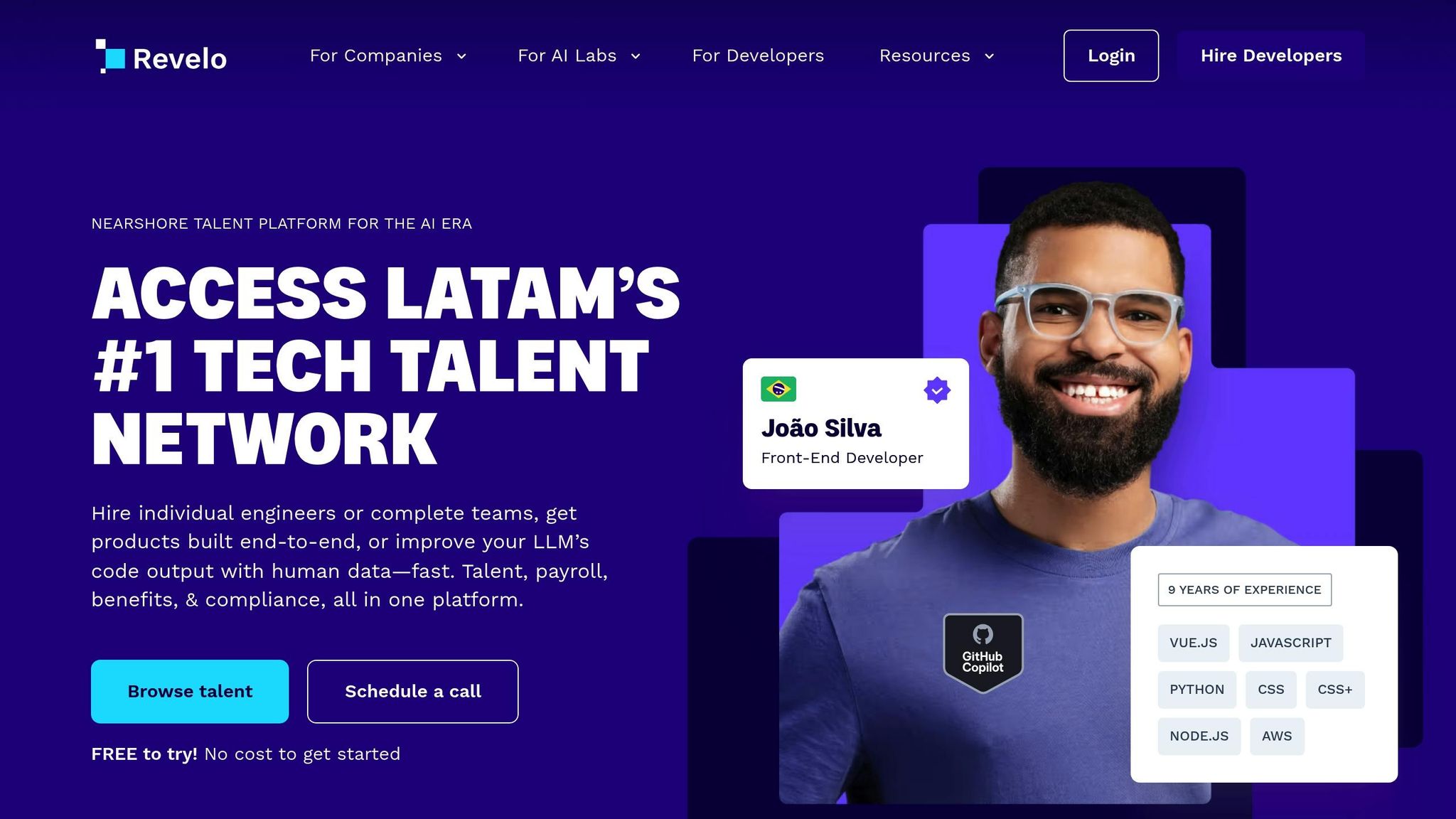
Once you've nailed down your requirements, Revelo's platform can help you find the right talent. Their database of over 400,000 pre-vetted developers allows you to quickly identify candidates who meet your technical needs. In just three days, Revelo provides a curated shortlist of the top 2% of developers who have been rigorously screened. Whether your project requires expertise in specific frameworks, cloud platforms, or niche technologies, this streamlined process connects you directly with professionals who fit your exact criteria.
Step 2: Source Pre-Vetted Talent from Latin America
Latin America is home to 1.5 million software developers, offering 30–50% cost savings compared to hiring in the U.S.. Beyond cost, the region's time zones align closely with the U.S., enabling real-time collaboration and avoiding the delays often associated with offshore teams in more distant locations.
By hiring nearshore talent from countries like Mexico, Brazil, and Argentina, teams can conduct daily standups and resolve issues quickly without the usual hurdles of asynchronous communication.
Write Clear Job Descriptions
To fully leverage Latin America's advantages, start with well-defined job descriptions. Be specific about the type of developer you're seeking (e.g., back-end, full-stack), the required tech stack (like React, Node.js, or AWS), and the seniority level. For remote roles, it's crucial to set clear expectations upfront. For instance, mention if candidates need to overlap at least 4 hours with U.S. EST or attend daily standups at specific times. Include the tools your team uses - such as Slack, Zoom, or Jira - and highlight the importance of strong English skills.
The good news? Many developers in Latin America already have extensive experience working remotely, using agile methodologies, and navigating common collaboration tools. With clear expectations outlined, you’re ready to tap into pre-vetted talent.
Access Pre-Vetted Developers Through Revelo
Revelo simplifies the process of finding top-tier Latin American developers. Candidates in their talent pool undergo rigorous screening, including technical evaluations, English proficiency tests, and behavioral interviews, ensuring they're ready to integrate seamlessly with U.S.-based teams.
Once you provide Revelo with your hiring requirements, they deliver a curated shortlist of the top 2% of candidates within 72 hours, cutting the usual hiring timeline from 45 days to just 14. Sakshi G., Head of Engineering at Hydrolix, shared her experience working with Revelo in 2024:
"Revelo made it so easy to scale my dev team - I was able to get several top engineers up and running in under 2 weeks, and that cut our roadmap schedule in half!"
- Sakshi G., Head of Engineering, Hydrolix
Because Revelo pre-screens candidates for timezone compatibility, remote work experience, and alignment with U.S. workflows, you can skip the initial filtering steps. This allows you to jump straight into in-depth technical interviews with developers who already meet your exact needs.
Step 3: Screen Resumes and Conduct Initial Assessments
The first step in narrowing down your candidate pool is to review resumes for the right technical skills and proven remote work experience. This process lays the groundwork for more targeted technical evaluations in the next stage.
Review Remote Work Experience
Look for resumes that clearly demonstrate experience working in remote environments. Candidates who have worked with distributed teams are often familiar with key aspects of remote collaboration, such as asynchronous communication, navigating time zone differences, and maintaining productivity independently. Strong candidates will highlight specific technical achievements, measurable results, and their ability to work autonomously. Checking GitHub profiles or portfolios can help you assess their code quality and see if they’ve successfully delivered features into production.
Be cautious of red flags, such as unexplained employment gaps, frequent job-hopping without clear career progression, or resumes filled with vague job descriptions lacking concrete results. Given that 95% of data breaches are linked to human error, prioritize candidates with experience in security-conscious development or compliance standards.
Once you’ve identified candidates with solid remote work credentials, it’s time to evaluate their technical skills through targeted assessments.
Assign Short Technical Tests
Introduce concise, focused technical tests that mirror real-world tasks. These tests should take 2–4 hours to complete, balancing respect for the candidate’s time with the need to gather meaningful insights. For example, you might ask candidates to fix a bug in a code snippet, add a small feature, or refactor an existing function.
Platforms like HackerRank, Codility, or CodeSignal can streamline the process of administering and evaluating these challenges. Setting a 24–48 hour deadline not only mimics asynchronous workflows common in remote environments but also tests how candidates manage their time. Offering a small payment for these assessments can further motivate candidates and attract top-tier talent.
Pay attention to how candidates approach the test. Do they ask clarifying questions to address any ambiguities? This kind of proactive communication is a critical skill for thriving in remote collaboration.
Step 4: Conduct Technical Interviews and Validate Skills
Once preliminary assessments are complete, it's time to test technical skills in a live setting. This step allows you to observe how candidates solve problems in real-time and how effectively they communicate their thought process - key abilities for thriving in remote work environments. Interestingly, 72% of technical interviews are now conducted remotely.
Use Video Interviews and Coding Platforms
Leverage live coding platforms like CoderPad, GitHub Codespaces, or CodeInterview to set up interactive coding sessions. These tools enable candidates to write, test, and debug code while you observe their approach in real-time. This kind of hands-on evaluation provides valuable insights into their problem-solving techniques.
Structure the interview into distinct phases. Start with a live coding challenge, then shift to a system design discussion. Use virtual whiteboarding tools like Miro or FigJam to facilitate this part of the interview. For senior roles, ask candidates to design a scalable system architecture on a digital whiteboard to gauge their high-level planning skills. Companies that implement this structured process report a 47% improvement in retention rates for technical hires.
To ensure everything runs smoothly, have backup measures in place, such as automatic code saving and alternative video platforms, to address any technical hiccups.
Test Remote Collaboration Skills
Remote work requires more than just technical ability - it demands strong communication and collaboration skills. During the interview, pay attention to whether candidates ask clarifying questions before jumping into the code. This proactive behavior is essential for navigating distributed workflows and working across different time zones.
To go a step further, consider assigning a trial project. This allows you to evaluate how candidates manage tasks independently and communicate through tools like Slack, Jira, or Trello. It also gives you a window into their ability to deliver quality work without constant supervision. One organization reported a 95% success rate in remote hires by using this comprehensive evaluation framework. Clearly, investing time in a thorough process leads to better long-term results.
Step 5: Evaluate Team Fit and Communication Skills
Technical know-how alone doesn’t ensure success in remote roles. Equally important are strong communication skills and the ability to integrate well into a team. In fact, 78% of HR managers prioritize developers with soft skills like communication and teamwork. Miscommunication is often the root cause of project delays, stress, and even failure in remote environments. That’s why this step focuses on assessing how well candidates communicate and whether they’re a good match for your team dynamics.
Assess Communication Clarity
Start by testing how clearly candidates explain technical concepts. For example, ask them to describe something like encapsulation or an API in two ways: first, for an engineer, and then for a non-technical manager. This "tiered explanation" exercise shows if they can tailor their communication to different audiences - a must-have skill in cross-departmental collaboration.
To evaluate written communication, assign a quick task like drafting a project update email or writing brief documentation. The clarity and usefulness of their response will reveal how well they can communicate without needing constant back-and-forth. During a 30-minute interview, aim for four to six targeted questions that assess their reasoning, tone, and ability to communicate effectively.
In video interviews, pay attention to non-verbal cues like eye contact, facial expressions, and active listening. These small behaviors can make or break rapport in a remote setting. Additionally, ask how they handle roadblocks - for instance, what they do when stuck on an issue. This helps you see if they strike the right balance between independent problem-solving and knowing when to involve the team.
Test Team Compatibility
Your team plays a big role in shaping the work environment, so it’s smart to involve them in the hiring process. Arrange informal video chats between the candidate and current team members. This allows you to gauge how well the candidate meshes with your team’s social and collaborative style. Companies like Shopify use this method to assess compatibility, and it’s proven effective for evaluating how a candidate might fit into the day-to-day rhythm of the team.
Another useful tactic is assigning a task with slightly unclear instructions. This tests whether the candidate takes the initiative to seek clarification before diving in. It’s a simple way to identify candidates who understand that clarity is a shared responsibility - critical for remote work success.
Finally, use standardized scorecards to rate candidates on key traits like "communication clarity" and "active listening" using a consistent 1–5 scale. This approach minimizes unconscious bias and ensures a fair, data-driven comparison of all applicants.
Step 6: Check References and Make Job Offers
Once you've identified promising candidates, the next steps involve verifying their background and extending a job offer.
Verify Past Performance
Checking references is essential to confirm a candidate’s skills, dependability, and ability to thrive in a remote work environment. A great starting point is asking a former employer if they would rehire the candidate. According to AGA Solutions Group, this straightforward yes-or-no question often provides the most valuable insight. If the response is hesitant or negative, it’s worth digging deeper to understand why.
When speaking with references, confirm employment details and evaluate soft skills like communication and responsiveness. These conversations can also reveal whether the candidate is self-motivated and independent - qualities critical for remote roles. As Joan Deitchman, Engineering Manager at Buffer, highlights:
"We look for evidence of initiative and a self-directed attitude, since working remotely can be an overwhelming amount of freedom and responsibility".
With 46% of developers preferring remote interviews and 79% willing to accept a job without meeting their employer in person, it's clear the remote work landscape has shifted. Tailor your questions to the specific role, and watch for warning signs like vague answers or unresponsive references. Cross-check all details with the candidate’s resume to ensure consistency.
These verified insights lay the groundwork for creating a job offer that’s both compelling and transparent.
Offer Competitive Compensation and Benefits
After confirming a candidate’s performance, focus on crafting an offer that reflects trust and aligns with market expectations. Developers value competitive compensation, and rigorous reference checks give you the confidence to make an attractive offer. Hiring developers from Latin America, for example, can save companies 30% to 50% compared to U.S.-based hires. For context, while the average U.S. software engineer earns about $141,205 annually, senior developers in Latin America earn between $62,400 and $127,200. This cost efficiency allows you to offer strong compensation while staying within budget.
Transparency is crucial. Sharing salary ranges upfront fosters trust. As Amina Moreau, CEO and Co-founder of Radius, explains:
"When we start a conversation with transparency, candidates often feel more comfortable to open up about their own work styles and overall preferences, which accelerates the relationship".
Beyond salary, highlight flexibility - something developers increasingly expect. With 77% of developer job postings now offering remote work benefits, perks like asynchronous schedules and results-driven management stand out more than traditional oversight.
To mitigate risk, consider offering a paid trial period, ranging from one week to 90 days. This approach allows both parties to assess compatibility before making a long-term commitment. Additionally, using services like Revelo’s post-hire support can simplify payroll, benefits, and compliance, leaving you free to focus on integrating your new team member.
Step 7: Onboard and Integrate Your New Developer
Getting your new developer up to speed smoothly is crucial for long-term success. Did you know that employees who go through a positive onboarding process are 70% more likely to stay with their company and feel satisfied? Despite this, only 12% of U.S. employees think their company handles onboarding well. A structured approach can help your developer settle in quickly and start contributing effectively. Let’s look at how to set them up for success and how Revelo can help streamline the process.
Provide Required Resources
Begin by ensuring your developer has everything they need to hit the ground running. Ship essential hardware - like a laptop, monitor, keyboard, and headset - at least three business days before their start date. Pre-install critical tools such as VPNs, Slack, and project management software so they can log in and get started immediately.
Make sure credentials for platforms like GitHub, Jira, Slack, Zoom, and your database are ready to go before their first day. To securely share sensitive information, use password management tools like LastPass instead of email or chat. Implement Single Sign-On (SSO) and Multi-Factor Authentication (MFA) to keep your systems secure while making access straightforward.
Kick things off with a small, manageable task during their first 24–48 hours. This "quick win" helps build confidence and gets them productive right away. Companies with structured onboarding processes report 54% higher productivity among new hires.
Use Revelo's Post-Hire Support
Pair your internal onboarding efforts with Revelo's post-hire support for a seamless experience. Revelo’s team handles payroll, benefits, and compliance, giving you more time to focus on integrating your developer into your team. With this backend support, you can maintain clear communication through daily stand-ups or asynchronous updates via tools like Slack or Jira.
Develop a 30/60/90-day roadmap to guide your developer’s progress. For the first 30 days, focus on helping them adapt to your company culture. Over the next 60 days, increase their responsibilities, and by 90 days, aim for them to contribute independently. Assign an onboarding buddy or mentor to answer their questions and provide guidance on company norms. As Ted Goas, Senior Product Designer at Stack Overflow, puts it:
"We now have an onboarding process that spans a new hire's first month, broken out by week. Everyone now knows what's expected from a new hire after their first week, after their second, and so on".
Centralize all onboarding materials in a documentation hub, such as Notion, Confluence, or GitHub. This allows developers to learn at their own pace, even across different time zones. Having everything documented reduces bottlenecks and encourages self-directed learning, which is especially important for remote teams.
Conclusion
Hiring remote developers becomes much more manageable with a clear, step-by-step approach. The seven steps covered here - defining technical needs, sourcing pre-vetted candidates, screening resumes, conducting technical interviews, assessing team compatibility, checking references, and effective onboarding - offer a practical guide to building a capable remote team. Each step is designed to tackle common challenges, from pinpointing the right skills to ensuring smooth integration into your workflows.
Revelo's platform takes this process to the next level by simplifying and speeding up hiring. Within 72 hours, you can receive a tailored shortlist of top-tier engineers, selected from a pool of over 400,000 professionals across Latin America. These developers represent the top 2% of talent and work in time zones aligned with U.S. teams, ensuring smooth collaboration. Revelo also handles payroll, benefits, taxes, and compliance, freeing you to focus on product development while reducing costs compared to U.S.-based hires.
With over 2,500 companies relying on Revelo to scale their engineering teams, the platform has earned a 4.7/5 rating on G2 from tech leaders. By following this structured approach and leveraging Revelo's resources, you can confidently grow your remote team. Start by defining your needs, rely on pre-vetted talent, and prioritize effective onboarding to set your team - and your remote developers - up for long-term success.
FAQs
What are the advantages of hiring remote developers from Latin America?
Hiring remote developers from Latin America offers U.S. companies a smart way to grow their teams efficiently while keeping costs in check. The region boasts a pool of skilled technical talent available at competitive rates, making it an attractive nearshore outsourcing option. Plus, the time zone alignment with the U.S. ensures smooth, real-time communication and collaboration - something that can be tricky with distant offshore teams.
Many developers in Latin America are fluent in English and well-versed in U.S. work culture and business practices. This reduces potential language or cultural barriers, creating a smoother working relationship. With its mix of talent, affordability, and easy collaboration, Latin America stands out as an excellent choice for scaling remote development teams.
How do I determine if a remote developer is the right fit for my team?
To hire a remote developer who fits seamlessly into your team, it's essential to evaluate two key areas: technical skills and team compatibility. Start by using skills-based tests or practical coding challenges to measure their technical knowledge and problem-solving abilities. These tests can give you a clear picture of how well they can handle the tasks required for the role.
For remote positions, strong communication skills and the ability to work independently are just as important. These qualities ensure they can collaborate effectively and stay productive without constant supervision.
As part of the hiring process, structured virtual interviews can help you determine how well they align with your company’s values and team dynamics. Be upfront about your expectations, project requirements, and budget. This transparency helps candidates understand your needs and decide if they’re the right fit. By combining technical evaluations with an assessment of communication and cultural fit, you can confidently choose developers who will excel in a remote work environment.
What are the best practices for onboarding a remote developer?
To successfully bring a remote developer on board, start with a well-thought-out plan that spells out expectations, company policies, and the resources they'll need. Ensure they have access to all critical tools and systems - like email, project management software, and code repositories - before their first day. This eliminates unnecessary delays and helps them hit the ground running.
Share insights into your company’s values, work environment, and communication practices to help them feel part of the team from day one. Arrange virtual introductions with key team members to foster connections and provide training materials or documentation that clarify their role and tasks. Regular check-ins during the onboarding process are essential to address questions and offer support as they settle in.
By taking these steps, you’ll create a smooth onboarding experience and set your remote developer up for success within your team.
Related Blog Posts