

Choosing between nearshore and offshore software development comes down to priorities like time zone alignment, communication, and cost savings. Here's what you need to know:
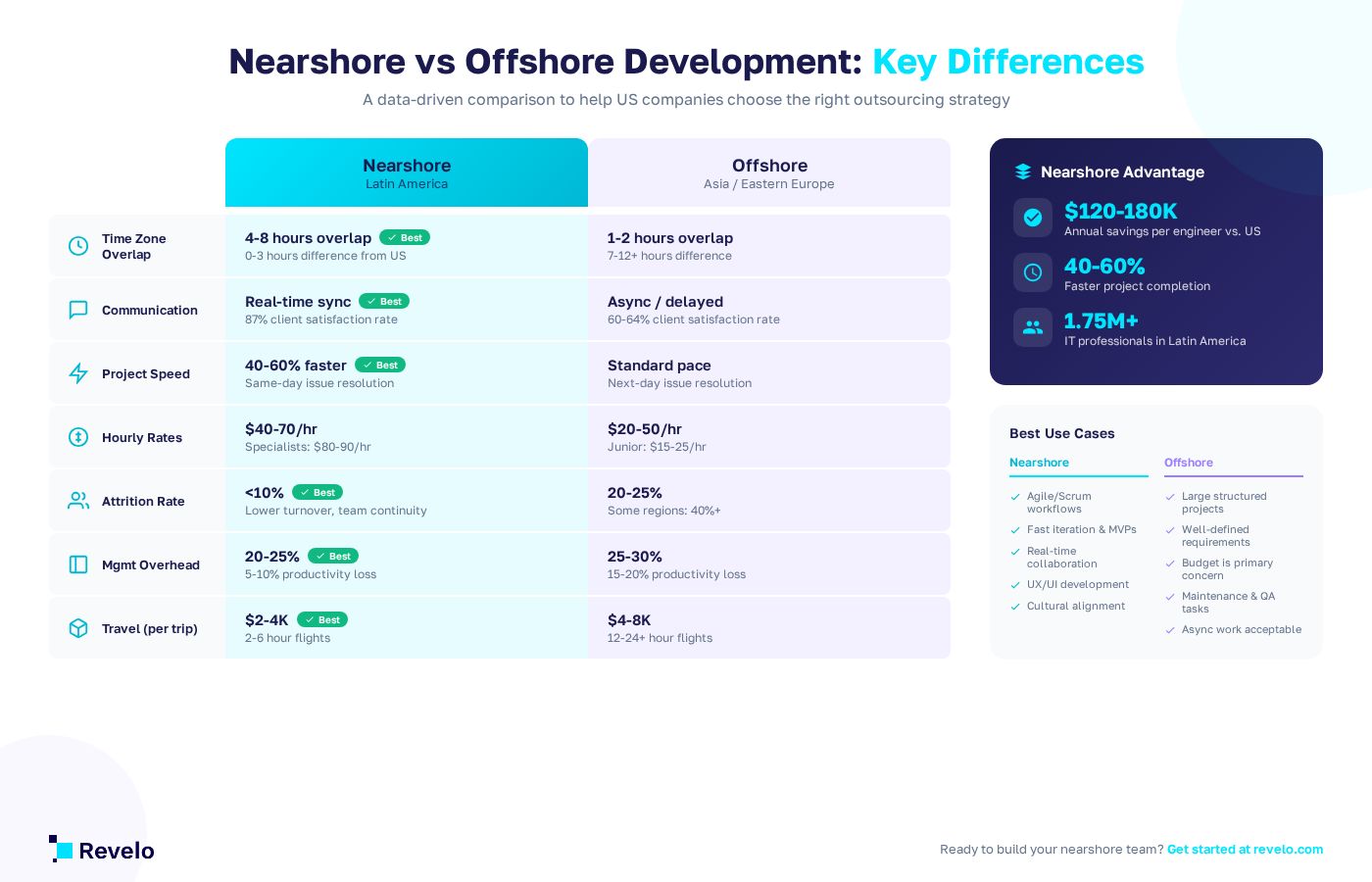
- Nearshore Development: Teams in nearby countries (e.g., Mexico, Brazil) offer better time zone alignment (0–3 hours difference), real-time collaboration, and smoother communication due to strong English proficiency. Hourly rates are higher ($40–$70), but projects move faster with fewer delays.
- Offshore Development: Teams in distant regions (e.g., India, the Philippines) provide lower hourly rates ($20–$50) but face challenges like time zone gaps (7–12+ hours), asynchronous workflows, and potential communication barriers. Best for projects that might have longer development cycles.
Quick Comparison
| Factor | Nearshore (Latin America) | Offshore (Asia) |
|---|---|---|
| Time Zone Gap | 0–3 hours | 7–12+ hours |
| Hourly Rate | $40–$70 | $20–$50 |
| Collaboration Style | Real-time | Asynchronous |
| Best Use Cases | Agile, fast iteration | Large-scale, structured |
| Attrition Rate | <10% | 20–25% |
Bottom Line: Choose nearshore if you need fast, real-time collaboration and Agile workflows. Opt for offshore for budget-focused, well-defined projects that can handle asynchronous communication.
Offshore vs. Nearshore Hiring: Which One Is Better?
Time Zone Alignment and Collaboration
Time zones play a big role in how teams communicate, resolve issues, and deliver features. With nearshore teams having a small 0–3 hour time difference and offshore teams often dealing with a 7–12+ hour gap, the timing of responses can make or break productivity. For example, a question that could be answered in minutes during overlapping hours might take an entire day to address when schedules don’t align. This difference in time zone alignment sets the tone for how communication and collaboration unfold.
Nearshore Time Zone Benefits
Developers in Latin America often work within time zones that closely match U.S. business hours. For instance, Mexico City operates on Central Time, and São Paulo is only 1–2 hours ahead of Eastern Time. This overlap provides 4–8 hours of shared work time, allowing for real-time collaboration.
This alignment makes it easy for teams to resolve issues quickly. A product manager and developer, for instance, can hop on Slack or share screens to tackle a problem immediately. As Deloitte points out, "A nearshore model can help eliminate the time-zone fatigue inherent in coordinating handovers during daily endpoints". This shared schedule is particularly helpful for Agile workflows, enabling teams to iterate faster - projects can often move 40–60% quicker compared to asynchronous setups.
Offshore Time Zone Challenges
Offshore teams, commonly based in regions like Asia or Eastern Europe, often operate on schedules that are vastly different from U.S. business hours. This time gap can turn quick questions into next-day responses and push Agile ceremonies like stand-ups or sprint planning into odd hours. Such misalignment can lead to time-zone fatigue and make collaboration less effective.
That said, offshore teams can provide benefits through a "follow-the-sun" development approach. Tasks such as QA testing or infrastructure updates can be handed off at the end of the U.S. workday and completed overnight. While real-time collaboration may be limited, this model ensures that progress continues around the clock. The table below highlights how time zone differences impact collaboration.
Comparison Table: Collaboration by Time Zone
| Factor | Nearshore (Latin America) | Offshore (Asia/Eastern Europe) |
|---|---|---|
| Time Zone Gap | 0–3 hours | 7–12+ hours |
| Workday Overlap | 4–8 hours | Minimal or 1–2 hours |
| Communication Style | Real-time and synchronous | Asynchronous and delayed |
| Issue Resolution Speed | Typically resolved same day | Often delayed until next day |
| Agile Ceremony Participation | Live during normal hours | Often outside regular hours |
| Best Use Cases | Rapid iteration, UX/UI development, evolving requirements | Maintenance, QA, structured builds |
| Travel Time for Onsite Visits | 2–6 hour flights | 12–24+ hour flights |
Communication and Language Compatibility
Effective communication is the backbone of any collaborative effort. It speeds up bug fixes, ensures clear requirements, and accelerates feature delivery. On the flip side, misunderstandings or unclear documentation can slow projects down and lead to costly errors. How naturally a team integrates into daily workflows often depends on whether communication flows smoothly or requires constant clarification.
Language and Communication with Nearshore Teams
Developers from Latin America often bring strong English skills and communication styles that align well with U.S. business norms. Argentina, in particular, stands out as the top country in the region for English proficiency, with Costa Rica and Mexico also showcasing impressive language capabilities. This isn't just about holding conversations - these developers excel in technical discussions, writing clear documentation, and grasping nuanced feedback during code reviews.
Their exposure to U.S. media and business practices also helps ease the transition into Agile methodologies and direct communication styles. This alignment translates into measurable results: nearshore teams complete projects about 40% faster, face 75% fewer communication challenges, and achieve an 87% client satisfaction rate. For comparison, Eastern European and Asian teams report satisfaction rates of just 64% and 60%, respectively.
These communication strengths shine in everyday workflows. Developers can participate in stand-ups, ask insightful questions about feature specs, and quickly act on feedback - all during overlapping business hours. Real-time collaboration minimizes misunderstandings and speeds up problem-solving, keeping projects on track.
Communication Barriers with Offshore Teams
While nearshore teams excel in seamless communication, offshore teams often face challenges that can slow progress. Teams in Asia or Eastern Europe may have solid technical skills and adequate English proficiency, but differences in communication styles and documentation standards can create friction. The issue often stems from varying approaches to problem-solving, feedback, and workflow structures. For instance, in some regions, cultural norms around hierarchy and directness can lead to delays in escalating issues or misaligned priorities.
Asynchronous collaboration further complicates matters. A question sent at 5:00 PM Eastern Time might not get a response until the following morning, turning a quick five-minute clarification into a 24-hour delay. This lag impacts everything from bug fixes to feature discussions, often requiring more management oversight to keep things moving. To address these gaps, companies working with offshore teams typically rely on tools like JIRA, Confluence, and Loom, alongside highly detailed documentation. While these strategies help, offshore models tend to work best for projects with clear, structured requirements where real-time interaction is less critical.
Cost Comparison and Savings
When it comes to managing budgets, hourly rates often take center stage. However, the real value lies in what you get for your investment. For instance, U.S. developers earn an average salary of $155,000 as of 2024, making local hiring a costly option. Both nearshore and offshore outsourcing models can reduce expenses, but each comes with its own set of trade-offs. Understanding these differences is key to making a smart investment decision. This section builds on earlier discussions about time zones and communication to help you weigh your options.
Nearshore Cost Structure
Nearshore developers, particularly in Latin America, usually charge between $40 and $70 per hour. Specialists in high-demand fields like AI or cloud architecture may charge $80–$90 per hour. These rates translate into annual savings of $120,000 to $180,000 per engineer compared to hiring locally in the U.S. For a typical five-person agile team - three developers, one QA engineer, and one tech lead - the monthly cost ranges from $35,000 to $65,000.
What sets nearshore teams apart is their ability to deliver projects 15–25% faster due to real-time collaboration. This efficiency can help offset their higher hourly rates. However, nearshore teams require 20–25% in management overhead and may experience a 5–10% productivity dip due to time zone coordination. Offshore teams, while offering lower hourly rates, come with their own set of cost considerations.
Offshore Cost Savings and Trade-Offs
Offshore development typically offers much lower hourly rates, ranging from $20 to $50 per hour, with junior roles starting as low as $15–$25. For example, a 20-person offshore team charging $35 per hour could save around $166,000 per month compared to a nearshore team charging $55 per hour. These savings make offshore outsourcing an attractive option for large-scale or well-defined projects.
However, lower hourly rates often come with hidden costs. Offshore teams generally require more oversight, with management overhead reaching 25–30% to address communication challenges and time zone gaps. Productivity losses due to asynchronous collaboration can climb to 15–20%, leading to delays even for minor clarifications. High attrition rates - exceeding 40% annually in some regions compared to less than 15% in Latin America - can further inflate costs by increasing onboarding expenses and eroding institutional knowledge. Additional factors like travel costs ($4,000–$8,000 per trip), knowledge transfer efforts (10–15% of project time), and the need for rework also complicate the total cost of ownership (TCO).
Comparison Table: Cost and Hidden Expenses
| Cost Component | Nearshore (LATAM) | Offshore (Asia) |
|---|---|---|
| Average Hourly Rate | $40–$70 | $20–$50 |
| Annual Total Cost | $95,000–$145,000 | $65,000–$100,000 |
| Management Overhead | 20–25% | 25–30% |
| Productivity Loss | 5–10% | 15–20% |
| Recruitment Cost | $5,000–$10,000 | $2,000–$5,000 |
| Travel Costs (per trip) | $2,000–$4,000 | $4,000–$8,000 |
As the table highlights, while offshore rates are lower, the additional costs and challenges can significantly impact the overall budget. Nearshore teams offer faster collaboration and lower attrition but come with slightly higher hourly rates. Both models have their strengths, and the right choice depends on your specific project needs and priorities.
Talent Pool and Expertise Access
Once cost considerations are addressed, evaluating the talent pool becomes a critical step in selecting the right outsourcing model. The size and quality of the talent pool directly influence your hiring strategy. Both nearshore and offshore regions bring distinct advantages, whether you're looking to bring in senior developers or scale up specialized projects.
Nearshore Access to Skilled Developers
Latin America boasts a workforce of over 1.75 million IT professionals, with key hubs in Brazil (750,000), Mexico (700,000), Colombia (150,000), and Argentina (115,000). This region offers a combination of talent size and high-quality expertise. Platforms like Revelo connect companies with the top 2% of pre-vetted developers, skilled in over 100 technologies such as React, Python, Node.js, AWS, and emerging fields like AI and data engineering.
The rigorous vetting process significantly reduces hiring friction, cutting the time-to-hire from the typical 6–8 weeks down to just 14 days. Businesses gain access to a network of over 400,000 vetted engineers, with more than half having three or more years of experience. For instance, in 2025, Hydrolix successfully scaled its engineering team in under two weeks, slashing its product roadmap timeline by 50%.
"Revelo made it so easy to scale my dev team - I was able to get several top engineers up and running in under 2 weeks, and that cut our roadmap schedule in half!"
- Sakshi G, Head of Engineering, Hydrolix
Nearshore developers also bring strong cultural alignment and Agile expertise, making them particularly effective for projects requiring real-time collaboration and quick iterations. Argentina, for example, has developed a thriving AI ecosystem, with expertise in tools like TensorFlow, PyTorch, and AWS SageMaker.
Offshore Talent Market and Specialization
While nearshore teams shine in speed and cultural compatibility, offshore regions excel in scale and specialized expertise. Countries like India, China, and the Philippines offer access to vast talent pools numbering in the millions. For comparison, while Brazil has over 500,000 software developers, the scale of talent available in offshore hubs across Asia is even greater.
Offshore teams are ideal for large, modular projects or highly specialized tasks. However, this scale often requires more rigorous quality control and vetting to identify the right candidates. Additionally, offshore collaboration typically operates asynchronously, which makes these teams better suited for projects with clear specifications rather than Agile workflows that demand constant real-time feedback. In 2025, many companies adopted a hybrid outsourcing approach - leveraging nearshore teams for critical, real-time tasks while relying on offshore teams for large-scale development that could progress independently.
| Feature | Nearshore (LATAM) | Offshore (Asia/Africa) |
|---|---|---|
| Talent Pool Size | ~1.75M professionals | Millions of developers |
| Vetting Access | Top 2% via pre-vetted platforms | Requires more intensive screening |
| Time-to-Hire | Around 14 days | Variable; longer for niche skills |
| Collaboration Style | Real-time, synchronous | Primarily asynchronous |
| Best Use Case | Agile projects, rapid iteration | Large-scale, modular projects |
Ultimately, the choice between nearshore and offshore talent depends on your project needs. For speed, seamless collaboration, and cultural fit, nearshore regions provide pre-vetted talent that integrates well with U.S.-based teams. On the other hand, if your focus is on scaling for large projects or accessing niche expertise, offshore markets offer the depth and specialization required to meet those goals.
When to Choose Nearshore Development with Revelo

Nearshore development is an excellent option when you need real-time collaboration, rapid scaling, or specialized expertise without the headaches of complex international hiring. If your team follows Agile or Scrum methodologies - think daily standups, quick feedback loops, and rapid iteration - nearshore teams are a natural fit because of their time zone alignment. For companies working on tight deadlines, such as launching an MVP or meeting aggressive product release schedules, having overlapping business hours can make all the difference by eliminating long delays in communication.
Your internal resources also play a big role in this decision. Handling international payroll, tax compliance, and legal contracts across multiple countries can strain HR and legal teams. If your team is already stretched thin, partnering with a platform that takes care of these operational burdens is a smart move. Nearshore development is particularly effective when language and cultural compatibility are critical, such as for customer-facing products that need a deep understanding of U.S. market expectations. These factors make a dedicated partner essential for success.
How Revelo Supports Nearshore Development
Revelo simplifies the process of building and managing nearshore engineering teams. From sourcing to ongoing operations, Revelo has you covered. Their platform connects you with a network of over 400,000 vetted software developers across Latin America. Only the top 2% of candidates make it through their rigorous technical and behavioral screening process, ensuring you get access to skilled professionals.
But Revelo doesn’t stop at talent matching. They also take care of payroll, benefits, and legal compliance across multiple Latin American countries. This means you can scale your team without worrying about setting up international operations. If you need more than individual developers, Revelo offers a Software Development model that provides a full team, complete with a dedicated Delivery Lead. This lead oversees the delivery process, manages risks, and ensures clear communication with U.S.-based stakeholders.
Revelo’s billing model is straightforward and predictable. Their capped hourly rates include everything - developer salaries, operational costs, project management, and quality control. For mid-size companies, this approach offers flexibility while keeping budgets in check. U.S. businesses typically save between 30% and 60% on total engineering costs compared to hiring domestically, which translates to about $70,000 in savings per engineer annually.
Best Use Cases for Nearshore Teams
Nearshore teams shine in situations where speed and constant collaboration are key. For example, companies launching MVPs or pushing to meet tight product deadlines can benefit from the faster iteration cycles that nearshore teams enable, as they avoid the delays of asynchronous communication common with offshore models. Case studies show that nearshore teams can significantly reduce project timelines.
One of the biggest advantages of nearshore teams is their seamless integration into Agile workflows. If your development process relies on daily standups, sprint planning, and real-time problem-solving, nearshore teams operating in U.S. time zones fit perfectly. In fact, nearshore projects are completed about 40% faster than offshore ones, thanks to 75% fewer communication issues.
Nearshore hiring also provides access to specialized expertise in cutting-edge technologies. Whether you need skills in modern frameworks like React and Node.js, cloud platforms like AWS and Azure, or advanced fields like AI and Machine Learning, Latin America has a deep talent pool. The region boasts over 1.75 million IT professionals, with Argentina emerging as a hub for AI development. Developers there are proficient in tools like TensorFlow, PyTorch, and AWS SageMaker. Revelo’s network includes developers skilled in over 100 technologies, with more than half having three or more years of experience. This makes it easy to find senior-level talent ready to lead complex projects from day one.
Finally, nearshore development offers long-term stability. Attrition rates among Latin American nearshore providers are below 10%, much lower than the 20–25% typical in offshore markets. This stability ensures continuity for enterprise projects that require sustained collaboration, reducing disruptions and retaining valuable project knowledge over time.
Conclusion: Making the Right Choice
When deciding between nearshore and offshore development, your business goals should guide the choice, not just cost considerations. Nearshore development offers benefits like real-time collaboration, minimal time zone differences, and smoother communication, while offshore options may involve asynchronous workflows despite lower rates.
If your project requires daily standups, quick iterations, and close teamwork, nearshore development makes more sense. The 0–3 hour time difference with Latin America allows your team to collaborate in real-time, making decision-making and execution more seamless.
For mid-size and enterprise companies, nearshore development offers a practical balance between cost savings and quality. As mentioned earlier, nearshore teams can reduce development costs significantly compared to domestic hiring while granting access to a talent pool of over 1 million skilled developers in Latin America. These professionals are fluent in English and proficient in modern frameworks, ensuring high-quality results.
To make the process even easier, Revelo simplifies international hiring by managing the operational challenges that often accompany global workforce expansion. From sourcing pre-vetted talent to handling payroll, benefits, and compliance across borders, Revelo takes care of the complexities so you can focus on scaling your team efficiently.
FAQs
What are the key benefits of nearshore development compared to offshore development?
Nearshore development brings some clear advantages for U.S.-based companies, making it a strong alternative to offshore development. One standout benefit is time zone alignment. Since nearshore teams are often based in Latin America, their work hours tend to overlap significantly with U.S. business hours. This overlap allows for real-time collaboration, quicker feedback, and smoother daily standups - challenges that can arise when working with teams in distant time zones.
Another major perk is cultural compatibility. Nearshore teams tend to share similar approaches to business, communication, and work ethics with their U.S. counterparts. This compatibility reduces the chances of misunderstandings and makes it easier to integrate teams seamlessly. This is particularly helpful in agile development, where frequent communication and flexibility are key.
Finally, nearshore development boosts communication efficiency. Being in closer proximity and sharing working hours allows teams to address issues faster, leading to quicker problem resolution and more streamlined project management. For companies aiming to scale their software initiatives while maintaining strong collaboration, nearshore development is a smart choice.
How do time zone differences affect collaboration in nearshore and offshore software development?
Time zone differences significantly influence team collaboration in nearshore and offshore software development models. Nearshore teams, situated in neighboring or nearby countries, usually share overlapping working hours with U.S. businesses. This overlap allows for real-time communication, quicker issue resolution, and seamless coordination, keeping projects on track with fewer delays.
On the other hand, offshore teams, often located in faraway time zones, might have minimal or no overlap with U.S. working hours. This can result in asynchronous workflows, where communication relies on written updates or pre-scheduled meetings. While this setup can lead to delays and added complexity, offshore models often provide cost savings and access to a broader talent pool. However, bridging these time zone gaps calls for careful planning and strong communication practices to keep projects running smoothly.
What should I consider when deciding between nearshore and offshore software development?
When weighing the options between nearshore and offshore software development, several key factors come into play: time zone alignment, language and cultural compatibility, and communication efficiency.
With nearshore teams, working in similar or overlapping time zones allows for smoother real-time collaboration. This alignment can help reduce delays in communication and decision-making. Offshore teams, however, often operate in time zones that are hours apart, which can lead to slower response times and potential scheduling challenges.
Language and cultural alignment also matter. Nearshore teams usually share closer cultural ties and linguistic similarities with their clients, making collaboration easier and reducing the risk of misunderstandings. Offshore teams might offer lower costs, but this can sometimes come with hurdles in communication and coordination due to cultural or language differences.
The right choice ultimately depends on your priorities. If seamless collaboration and efficient communication are at the top of your list, nearshore development might be the better fit. On the other hand, if cost savings take precedence, offshore development could be the way to go.
Related Blog Posts