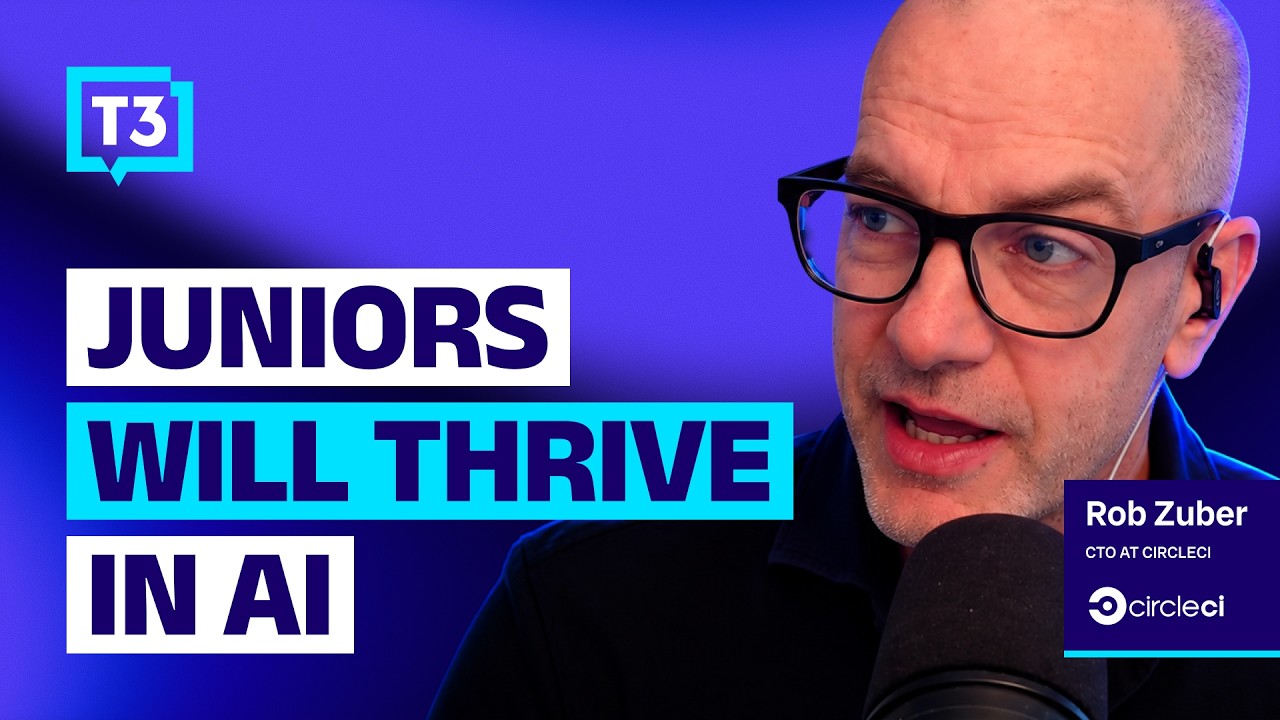
CTO @ CircleCI | Why He Is Still Hiring Juniors When Everyone Else Stopped
CircleCI's CTO says the AI moment is a leveler that makes junior hires easier to justify, not harder.
Rob Zuber has been CTO at CircleCI for just over 12 years. He came in through an acquisition, shipped a PR that took down production in his first week, and now runs an engineering org of a little over 100 people while still writing code most days.

With
Rob Zuber
CTO
CircleCI
Guest
Host

About this episode
Rob Zuber has been CTO at CircleCI for just over 12 years, came in through an acquisition, and runs an engineering org of a little over 100 people. He also sits inside a small team day-to-day, writing code himself, specifically so he can feel how the tools work and feed that back into product strategy.
The main topic is junior hiring. A year ago Rob was publicly skeptical about it. Now CircleCI has a program built specifically for new grads. His argument: the job itself is changing fast enough that senior engineers don't have a stable shape to mold juniors into anymore, which removes the usual objection. New grads who have no prior habits to shed can just take direction and run, while experienced engineers are still mid-transition.
Rob also gets into the friction AI adoption creates inside an org when half a team is moving fast and half isn't. He describes stopping himself from deleting the agent's extraneous comments once he realized those comments improved the next generation of output. He talks about code readability shifting from a human concern to an agent concern, and says what great agent-readable code looks like is something the industry will discover rather than design upfront.
The conversation closes on ambiguity management. Rob frames it as a gap between how much ambiguity exists and how much a person can handle. His two levers: reduce the ambiguity, or raise the person's tolerance for it. With the market moving as fast as it is, he says the first lever is mostly out of his hands, so he's spending most of his energy on the second.
The amount of change is kind of a great leveler. People are openly saying, 'I don't actually know. Let's sit down and figure it out,' as opposed to, 'Come along, little one. Let me teach you about these things that you haven't learned yet.'
—
Rob Zuber
CTO
CircleCI
Transcript
Rob Zuber 00:00
I'm the CTO at CircleCI and run engineering. Shockingly, we set up a program specifically to bring in new grads. Historically, we would have molded junior engineers in the shape of seniors and now we're not sure what that shape is. The amount of change is kind of a great leveler. People are openly saying, "I don't actually know. Let's sit down and figure it out." It's a gap between the amount of ambiguity there is and the amount of ambiguity they're capable of handling. And the market has shifted so much that my ability to bring down the ambiguity is kind of outside of my control.
You know who can go through that transition really quickly is someone who's not transitioning through it at all. They're just like, "Tell me what to do." And you're like, "I don't know. Do this." They're like, "That sounds amazing." I was a screen user for up until basically this year. Everyone was talking about T-Mo. I'm like, "I have a tool that's good enough." And then 2026 rolls around. I'm like, "Why do I care about good enough? I've just redesigned my entire approach to software delivery. Clearly, I could change my terminal multiplexer.
I was always the person who spent a lot of time worrying instead of just doing it. And every time I've decided to just do it, it wasn't as bad as I thought it was going to be. And then I was able to get on to the next thing. Learning to adapt, learning to grow, learning to learn. Like, it's an awesome time to be doing any of that, I would say.
Josh Anderson 01:19
Welcome to Tech Teams Today, where we talk with the people building and leading the engineering orgs behind today's most innovative companies. Our guest today is Rob Zuber, CTO at CircleCI. During our discussion, Rob shares why he's leaning into hiring junior engineers and shares the life that so many of us are living through right now, the player coach. Stay tuned until the very end for a few fantastic leadership quotes and book suggestions from Rob. Onto the episode. Rob, welcome
Rob Zuber 01:45
To the podcast. Super excited to have you. We're going to jump right in and the name of the show is Tech Teams Today. So, tell our viewers and listeners about your tech team today. What does it look like? Shape types of roles, all all of that. Yeah, for sure. I mean, first of all, thanks for having me. Super excited to be here. yeah, so I'm the CTO at CircleCI and run engineering shockingly. our engineering organization is a little over a hundred people. and we do have an SVP of engineering who actually runs engineering, if that makes sense.
I just kind of play the part every once. and and then under that sort of a director layer, manager layer, a lot of lot of IC. So nothing particularly odd in the standard description. but because of the time and I think we'll we'll get it like the time that we're in, the amount of change in the market, the fact that we build and sell developer tools. you know, so we're a very technically focused company. I spend a decent amount of my time thinking about product strategy.
We have a product organization that I don't run, but just given who our customers are, I think a lot about what we're building. I within that overall team have a team that I'm working with directly on a day-to-day basis as we, you know, try new ideas, test ideas in the like building and putting product into the market. and part of the mission of that team is basically like push on everything that we thought was the norm and see where it breaks and then figure out how we change our product and our tools, you know, as people doing it every day.
and then we combine that with what we're hearing from our customers and from the market and everything else. So, it's like a an interesting split for me personally of, you know, kind of thinking about the overall organization, but again, we have a SVP of engineering who does most of the hard work at most the scale work there. and then the, you know, really day-to-day nitty-gritty kind of building and and working with a a small team which is an interesting mix of of levels, which I think we'll get into.
but a small team where we're you know we're working every day on product and I not as much as anyone else on the team but I'm doing my best to to really try to build not because I think I'm you know the best person at building but because I I really want that hands-on you know visceral reaction to how the tools work today and what breaks and what works well and where the opportunities are in the market. So it's like this way of getting real direct feedback to think about strategy.
Josh Anderson 04:14
Yeah. I I love companies where they can be their own customer and you can push that and really live the life of your customer and push and challenge. I think those are some of the best companies in the world because because product is just who you are and you can't escape it. It's not at arms length. So certainly appreciate it. Understand the challenge that you have in in working in that space.
So you talked about doing things differently and one of the things that as we prep for this episode that you mentioned is that you're taking a some may consider a contrarian view on hiring more juniors and really leaning into that. There's all this talk about you know the junior engineers like it's a dying breed and you know what's going to happen but but you're leaning into that. Tell our folks
Rob Zuber 05:01
About that. Yeah, I mean we we continue to hire juniors. We set up a program specifically to bring in new grads and kind of ramp them and grow them to be, you know, obviously long-term contributors to CircleCI. But I think you know we're in this age of of rhetoric like AI is the the death of X, right? Like this is I mean AI is the death of CI apparently. I hear that sometimes like we've never been stronger as a business. So I'm not really feeling that one.
like you know just insert whatever it's like a it's like a ad lib or mad lib or whatever that you could use for anything right and junior developers has been one of those things and I I certainly like I'm not going to claim that I haven't struggled with this like you can anyone listening this can go find me speaking a year ago and saying I have no idea how we're going to grow these people I don't know what we would do with them but the reality of the situation is like what I think what we were concerned about and are concerned about is our ability to teach a set of skills that we believe are necessary but are being devalued use less as a result of using AI to build right like just to to kind of name it like if I sit here and I prompt a an agent to build my code then I don't necessarily learn about the code and I read a I can't say I read the post but I saw a headline line go by earlier today where someone was was saying I think it was Adassami I'm not actually sure how to pronounce their name but that this requires much more intentional learning because you can let the agent do the thing and not go through the reps kind of but even that is transitional right and what I think the job itself is changing enough meaning fewer of us are going to be builders of product as engineers and more of us will be builders of tools that build product, right?
Like we're all kind of constructing our software factories, etc. internally. And so the things that you have to learn are going to be different. The skills that you're going to develop are going to be different as a new engineer coming into this space, but that doesn't make them wrong or bad or unteable. And it still means there's going to be people doing those things right at some point in the future.
like as software engineers over the course of our history so far we have automated away a lot of jobs right and and in those industries we've put it I we didn't put them in place but the result has been that there are people operating and managing the automations as opposed to handcrafting the thing right now asterisk there's lots of places where we still love you know I love my handcrafted coffee beans and whatever But like there's a lot of automation in the world. and we sort of finally pointed it at ourselves.
But but in all of these cases, the industry hasn't gone away that maybe the numbers change, maybe the dynamics and the structure change, but there's a new job evolving. And so I think that's a really important point because with a new job evolving, even we like as an industry veteran, I would consider myself not actually experts in how to do the job. We're relearning.
I mean, I said earlier that I'm working day-to-day with the team because I'm trying to understand how the job gets done now so I can build the right product for my customers, so I can help my people internally do the job effectively and go through that transition themselves. And you know who can go through that transition really quickly is someone who's not transitioning through it at all, right? They're just like, "Tell me what to do." And you're like, "I don't know, do this." They're like, "That sounds amazing. Let's go do that." Right?
And so there's like a a different value and I think that's always been true, right?
like but maybe more so now like junior engineers come in with a huge amount of enthusiasm and excitement and fresh ways of looking at things and they say you know every once in a while why do we do it this way and you're like you do it this way because of this and like you'll understand eventually and every and then they say why do we do it this way and you go I actually have no idea what a great question they're like I literally just asked you why and you're like I know but you force me to ask like are we just in a rut you know what I mean are we looking at this from the same old way of just someone coming in and asking or saying, "Hey, I I heard that people do it this way."
And you're like, "Where'd you hear that? I've been so heads down in this company that I haven't been looking at what everyone else is doing." Right? And so I think one, you know, a huge amount of energy and opportunity and excitement to sort of moldable, but historically we would have molded junior engineers in the shape of seniors. now we're not totally sure what those seniors like what that shape is, right? And so we're trying to figure that out and that actually gives a little more freedom.
And the other thing that I'm finding really interesting in this in this particular team but across the organization as we're seeing it is that is like the amount of change is kind of a great leveler. Do you know what I mean? We were just talking before we started about titles and the impact of titles and whatever, but people are honestly openly showing up and saying, "I don't actually know. Let's sit down and figure it out." Right? As opposed to, "Oh, come along, little one. Let me teach you about these things that you haven't learned yet." Right?
It's literally like, "How fun would it be for us to sit down and figure this out together?" And I think co-working in that way is is something that builds trust and builds relationships with people, you know, for the long term. And it's happening across much bigger like level gaps in a way that I I'm hoping I mean I'm not a junior, so I'm just, you know, talking to them and getting feedback, whatever.
but hoping it's reducing some of the the the fear kind of the imposttor syndrome of of juniors coming in and saying I hope no one figures out that I don't know anything right when honestly we're like none of us do don't even stress about it like not that we don't have skills to bring to the table but that we're all actively trying to figure out how things shift how to optimize in this new world how to use the tools that we have and those tools schools are changing every day, right?
So, I I think I think it's just like a really exciting time and a great way to bring in fresh perspectives, some people that are and because as you said, it's a little bit contrarian like there's a lot of great talent out there. a lot of folks who are, you know, highly educated, super motivated, and, you know, the world has kind of said, "Oh, put the brakes on. We're not sure what we would do with those folks, so let's not hire them right now. and I'll just be honest, like if you're listening to this, they're out there.
I mean, they're out there in droves, and they are super pumped to get to work and really contribute. and we've we've just had amazing results.
Josh Anderson 12:12
Yeah, it's great to hear. I I'm I'm a believer in problem solving is the definitive skill and AI automates a lot of things but there's it also creates more problems to be solved along with there's a neverending array of problems that need to be solved. so what I try and do is I try and assemble problem solvers. And to your point, some of the junior folks that are just voracious are fantastic at just solving problems because they don't know and they have to figure it out and they're willing to do whatever it takes to figure it out.
And I find that that diversity when you do take that the new folks with the experienced folks, you mix it up. And you make a really great point about the moment in our industry being a leveler of the playing field where everybody's figuring it out. And I think you're and it sounds like you're really seeing it in daily life that we're all trying to figure it out which gets all the best ideas out on the table because there's less fear of like, hey, like no one knows, so we're going to figure it out together. And I think that's a fantastic space to be. Yeah.
Yeah, I mean I've done a lot of things in my career. The most fun I've ever had is just working in small teams where you know I like startup entrepreneur whatever for a long time where none of us knew. And it's it's exciting, right? It's exciting to be in a collection of people where you're all working hard to figure it out. Like no, it's not that no one knows anything. People bring things to the table and then you kind of like work together to find a solution.
and I do think, you know, you can you can stagnate a little bit to where it becomes like, look, there's a hierarchy. That person knows everything. You just have to get enough time with them so that you know the things that they know, right? And it's like that's not really very interesting to me. It's not an environment that I particularly enjoy. and so I I think this has yeah, it's changed things in a way that it's kind of kind of flattened that in even in some of those organizations.
Right now the interesting thing is in those organizations where you're used to that very I don't know if traditional is the right word but like a very structured hierarchy right can they adapt to let in the information that's coming from sort of all angles right or are they waiting for the person at the top to figure it out and sort of hand down the instructions through the org. you know that'll be I think that'll be an important transformation for a lot of organizations.
Yeah, unlike you, I find a real joy in chasing the incomplete or the unknown or the can't be done and running after that. Those are just like you, those are some of my fondest memories of like, yeah, we can do this. I don't know how, but yeah, we can do this. How do you how do you figure that out in a person? That's always one of those things of I find the great teams are good at figuring out this person's willing to run into the unknown and say like I got you and we're going to figure it out.
Rob Zuber 15:13
Yeah. I I mean I'm not going to stand here and claim perfection. I don't have a secret quiz in my hiring program. But I think a lot of it is it's interesting because we're talking about juniors and I was going to say like I do a lot I think it's called experiential interviewing like tell me about a time you did this give me an example like like having people talk through the things that they've done and then being able to dig into them.
My there's nothing that says I'm an expert, but my my instinct is if you can go a couple levels deeper, then you're on to something. And if it's like, oh, I did this thing, like it doesn't take long for that to sort of crumble, right?
to witness the difference between I was a passenger and I saw this thing happen and like you just see the the eyes light up and the passion come out about and then we got totally stuck and it was really hard and then we did this and it was amazing and then we did this other thing and like I I do this part of our sort of corporate values we call them guiding principles like I talk to people a lot about failure and learning right if if you're not to me If you're not excited about the things that went horribly wrong, then it's going to be hard to to be that curious person, right?
Like, if you're super protective of the times that you didn't have the right plan at the beginning, you know what I mean? Like, let's just call it failure. But I I've found I throw that word around in ways that make people almost uncomfortable. you know, and culturally actually is something that I I had to pick up on at some point, right? the difference between cultures and how they perceive failures is really important.
So I don't want to just like cast a super blanket statement but you know your willingness to to learn from scenarios where you know where things didn't go the way that you wanted them to go and the enthusiasm about the learning over the concern about the you know the the thing that went wrong or the thing that didn't work out the way that you wanted. we talk a lot about reframing things as hypothesis, right? To kind of make it more comfortable. Like we're just getting more information and we might get the information that we've done something amazing.
We might get the information that the the right things over here, but all we had like what we really need to do is get the information, right? And if you're super tentative. So anyway, I I find that that sort of line of conversation is is pretty telling.
It's not everything, but that's certainly an area that when when I interview folks, I spend a lot of time talking about because it really is it really is in the learning to me and in handling those I'll gently call them the things that didn't you know they didn't go the way that you plan because they it's like 90% of scenario. I mean there's always something right. but actually one of my favorite memories. So, we we have a or I've been at CircleCI just over 12 years now. And I I came in through an acquisition, but we went through kind of the standard interview process.
It was a tiny company. They weren't sure what else to do with us. And one of our engineers who still works with us today was interviewing me and asked me about a, you know, production incident. And I was so excited about the details of this. We still talk about it. He's like, "Oh, I remember that. That was a great conversation, whatever." cuz I was so excited about how badly this has gone.
I mean, it turned out I'll share a little bit of it, but I was I was driving down a mountain in a blizzard with my mom who was in the passenger seat and I started getting it wouldn't have been Slack back then, texts or IRC on my phone or something, right? pings and I was like, "That's a lot of pings. Can you can you tell me what?"
And my mom is reading me the like like she's, you know, like she she's mispronouncing almost every acronym and every piece of technology involved in the conversation, but you know, we like run out of memory on this Reddus thing because when it does a backup, it forks and it doubles its memory consumption in a way that was unexpected given the little Linux kernel. Like it was very very deep and like it's a white out, you know what I mean? Like and the driving conditions are totally nuts. But I was so excited about this, right? Like it was a terrible situation.
I mean, we didn't have that many customers, I think, on this platform at the time, whatever it was. but but you know, we still kind of bonded over that moment of just like, yeah, I mean, he had before coming to CircleCI, I can't remember if it was directly before had worked at Amazon. So, I'd seen some like very very large scale things and some large scale issues, right? I mean, if you work on systems that are big and complex, you're going to have big complex gnarly, you know, incidents or whatever.
and and I think again it's like you see people light up over what they took away from that and how much how much better they are as a result. and then some people some people don't, right? And to me, that's that's a big thing.
Josh Anderson 20:07
Yeah. That journey as a leader to threading the needle on failure I think is a interesting one. I know I fumbled that early in my career and I was trying to get people to celebrate failing and then the team like okay cool Josh wants us to fail so we're going to fail. It was like and we didn't win anything. I'm like hold on folks like I'm not saying we don't want to win but like we're okay extending and trying things out.
And so it took me a couple of quarters to learn how to just as you said figure out the culture and how to talk about failure and make it healthy and we're going to rebound and we're not afraid. I think your cultural point is really interesting. I'd love to hear how you've had to walk that line and if you've had any missteps along the way and just some advice that we could give to viewers and listeners out there that might be figuring out how they do that as a leader.
Rob Zuber 21:00
Yeah. So I I would say both internally and externally like the thing that was on my mind as I was saying that is I I don't we I have a podcast from CircleCI confident commit and I we did a whole season on failure and I was asking guests like tell me about your most interesting failure and some of the stories were just like mindblowingly awesome right for someone who loves you know learning from this stuff and I got a I got an email from someone I've never met in my life that was just like I think you should know that in my culture.
and I I don't want to name the culture because I think I'll probably get it wrong, but I think you should know that in my culture like this is not accepted. We don't use this word like it's it's like shame, you know, basically it's a cause of shame to fail. And that's when I really started thinking about like how can we talk about this in a way that sort of separates, right? Because I'll just I'm just like fail fast, you know, like we have all these expressions in tech, right? Whatever. It's like doesn't even occur to me.
and then so that's when I really sat with it for a minute and just like, okay, how can we reframe this in a way that still pushes us, right? Isn't about guarding, right? Because the thing you're trying to avoid is we're afraid that we might be wrong, so we're going to take more time to think about it. I mean, like that's waterfall, right? We're afraid that we're going to build the wrong thing for the customer, so let's spend as much time as possible planning and discussing and documenting. And then we still build the wrong thing.
It's just we took way more money to build the wrong thing, right? Like the entire evolution of our industry is about to me acknowledging that we don't know the answer, but we know how to get the answer, right? Like let's build the thing that probes like we get call fast feedback, right?
But like that probes customer interest, evaluates whether we're on the right track and then allows us to adjust which is very different from saying we're all in on this and if it doesn't work perfectly then we're bad people right so like hypothesis a bet like we're making a bet right and I have a portfolio of bets that I can make and I know upfront that I'm placing a lot of bets because they're not if I knew that they were all going to be right I would put you know, more wood behind fewer arrows.
I'm trying to pick the right expression, but like that why would I make so many bets? Because it costs a little bit to make those bets, but they're probes, right? I'm testing this and testing this and testing this and testing this with the assumption that I'm in roughly the right area, but I don't really know how customers are going to respond, whether I've understood what they've asked for, what, you know, whatever that might be. It could be brand new product and I'm just guessing. I mean, I often say there's one Steve Jobs and then there's the rest of us. You know what I mean?
Like there's this mythical aura around startups in Silicon Valley or pick your way of describing it that you know all the best founders just have this like single-minded vision and they build that thing and the world just shows up and buys a billion of them, right? It's not how it works. It's not how it works at all.
like we we have to like work our way through the process and try things and test things and and so I think just again finding different bits of language I think you know Eric Reese's work and the lean startup just like it's a lot of when I talk about bets I'm often talking about Annie Duke which is great I also love like metaphorical stuff from other analogical whatever from other domains you know whereas like that's the only way you could operate and once you get comfortable with that being the only way you could operate then it's all statistics and probability, right?
And like as humans, we're not particularly good with that, which is a interesting tie back to AI. Like non-determinism is really challenging for us in engineering and software, which is weird because none of our systems are deterministic, right? There's a reason that like large scale distributed systems are hard because they don't always do exactly what we expected.
but yeah, sort of again like there was a lot in there, but you know, reframing the language a little bit, not to back down or make people feel more like like they have to be right, but rather to structure it in a way that it's obvious that we're we're testing ideas, right? And and then and then celebrating you you mentioned celebrating failure, right? Like however you frame that, just be exced, right? we went and did a thing and now we know more and now we're going to go do this thing, right?
And you know there is an ultimate measure of failure which is like the business but we get hung up on the micro parts of that which are all part of like your whole business is a portfolio of bets, right? And like somebody somewhere in your business hopefully knows that you're making a bunch of bets and some of them are going to work and some of them are going to not work, right? And that's totally totally reasonable. But I I think yeah, just talking about it a lot, telling stories about my own disastrous, you know, I've got a long list of them.
Like my first week at CircleCI, I shipped a PR that took down production. you know, I was like, it happens. Yeah. Luckily, we're a much smaller business there and someone quickly jumped in and fixed it. But like, you know, being comfortable with that, I think is is important and and talking about it openly. But yeah, there was a lot of transition kind of in in words. Yeah. As a CTO, I feel like we're often
Josh Anderson 26:20
The standard bearer of that because we're trying to get the whole organization to be comfortable with that, especially as a technology organization like yours where the product is the company and so you need everybody to be comfortable with that and you need the rest of the seauite and the board and your team and your your marketing and sales team to get comfortable with like, hey, we're placing a lot of bets. we're going to win more than we lose. But some of these are bets and as a CTO I find you spend a lot of time working to get the culture of the entire organization there.
I think there's a lot of people that overlook that. So are there any lessons in your journey of working with that or maybe CircleCI they already had it figured it out when you stepped in the role? yeah so I do
Rob Zuber 27:06
Have a cheat code that's not necessarily that which is I mean one we're in the business of continuous improvement right like we can re any conversation we're having with any executive right this is what we do as a business like this is why people buy what we sell them so they have a a good foundation the the other thing I would highlight so I came in through an acquisition our CEO was my partner in the business that got acquired, right? So, we've worked together longer than we've been even at CircleCI. and he is a product thinker and entrepreneur by background as well, right?
And so, like when we work together, he was kind of product and I was technology and we built stuff together. And so, I don't actually have to be the the standard bearer as you described in that that's his way of thinking, right? He's really pushing for that constantly. and so we have a great partnership on that front. It's not like I feel like I'm trying to explain to him like sometimes we have to take risks and you know not everything's going to work out.
I mean he's the one championing that most of the time looking for people to be more comfortable taking taking chances and so you know he owns the board relationship more than I do. and so I get a lot of a lot of freedom to think in that way and it's really about within engineering making sure that people they they get that and that they you know that they follow or you know whatever that they they're comfortable and can can exercise that
Josh Anderson 28:34
Approach. Yeah, that was really part of my journey as I was taking new roles, really understanding how comfortable the rest of the organization was and I and I was looking for a leadership team that had a product background that was already kind of there. Either they were already there or they were partially there and I'm like, "Okay, cool." Like, we're going to be able to close that gap. so let's talk about how your team operates today.
Rob Zuber 28:59
I assume it's vastly different than it was 18 to 24 months ago. has that acceleration slowed down? Has it continued to accelerate or or where are you guys at with just the rate of change? Yeah, I think we're nowhere near terminal velocity, if you will. I would say you we also see a lot of numbers because we have all the data for all of our customers, right? So, we're witnessing a lot of change in the industry, not just ours.
And the one thing that I that I keep flagging for folks is we talk about organizations and where they sit on the spectrum sort of of adoption of tools and adjustment of their process whatever but certainly what we see at CircleCI or have seen at CircleCI and what I see in every organization we talk to is a spectrum within the organization right and that might be there's a million reasons just personalities and comfort level interest and curiosity right some people are like look I got this thing I got to do.
I don't have time to go explore and learn how to like function totally differently right now. And you see different orgs doing you know everything from like you know hack weeks to mandates to what you know whatever it is to kind of like create the space or force people to to start to make changes. I I would say within the or like within our or that was this background we definitely have a spectrum.
part of that is, you know, we operate some parts of our system that are ridiculously critical, right, in terms of if we have any blips in our sort of ability to help other people deliver, particularly as they continue to accelerate and grow, right? that's really bad for us. which is not to say that you can't apply AI tooling to building those pieces or whatever, but we've been more cautious about making sure we have the tooling that we feel we really need to be successful doing that.
Whereas, you know, like the a lot of the stuff that I've been working on has been brand new pieces that sit a little bit to the outside of of what we've built as a core engine. In those places, we have way more room and flexibility to be wrong, to try things, to have something break, to say, "Oh, like same thing. Look what we just learned about how code review should work now or what a good system is to help us get the stuff to production without having to have human involvement every everywhere."
And I do think you to the question of are we, you know, are we at peak velocity or sort of I'll call it terminal velocity.
there's so many more places where we're seeing oh and then it slows down here or then it slows down here or this gets stuck for a minute right so we're you know deep deep into adoption of tooling construction kind of multi- aent sometimes it's multi-agent coordination sometimes it's just like well that thing's working so I guess I'll start something else and I'll start something else and I'll start something else and then we forget how many things we're working on and someone's like hey didn't you say you were going to do that like oh right you're right you know like go through your team sessions and try to find that thing that you're working on.
so construction definitely we have some tooling that we built internally and some of the stuff we're trying to figure out how to productize shockingly for for our customers around you know risk assessment and review and those sorts of things to try to move things along. and then we're, you know, then you start to discover the little pockets where, you know, someone was like, well, we never really had great observability on that. So, we always watch it go to production, you know, and just keep an eye on the monitor, you know, on the dashboards or whatever. Like, well, that's not going to work, right?
If you don't even know that something new has gone to production, which to me would be an ideal scenario. So, you know, we're like identifying those spots throughout, trying to iron them out. so I I still think there's plenty of room to continue to accelerate. but I would say organizationally we're definitely on that path. Like it's it's what we're trying to do every day is find those spots, iron out those pieces, and make it faster and faster for us to get stuff out. And we have awesome customers who tell us what they're doing. We share what we're doing.
So we have like a great community kind of to to think about those problems as well.
Josh Anderson 33:13
Yeah, that's that's that would be nice to have that community of your customers to be able to watch, not only watch, but also have that dialogue. I I'm on the cusp of the multi- aent space. Like I'm not there yet. I I I think it's just my own history holding me back, right? Like I am the example of the non-junior that you talked about that that that will blindly run into. I'm like, whoa, whoa, whoa. I'm not ready for that yet. So, I'm on the cusp of that and and I'm going to figure it out.
Rob Zuber 33:45
Yeah. One of the things Go ahead. I was just going to say I I was very worried about my ability to context switch, which feels ironic given that like as you get higher and higher in an organization, like the level of context switching is completely bananas, right? Like it's it's not this piece of code versus that piece of code, right?
It's like this legal agreement turns into this like production incident which is now like giving a talk at a conference or whatever like like the level of of context switching is is totally out there but but still just can I retain all the different things and I'm being very serious about losing track of bits of work and stuff like that. but you you know you start something going and then you're like I'm just watching this thing work. Surely I could be doing more now. Like right like I haven't actually accelerated like does it type quote unquote faster than me? Yes.
But I haven't really started to realize the acceleration until I'm compounding that right like this computing parallelism or whatever.
Like I think we have lots of software models to describe that but like I'm not really getting maximum utilization of my resources my own mental potential and whatever until I start to and some of it is again sort of coordinated agents right like this one writes and then this one does some review while it's writing the next thing etc etc and some of it is just oh there was that other thing I wanted to fix looks like I have a few minutes while this is running you know why don't I why don't I fire that up too and and there's you know there's a decent amount of tooling becoming available now to you know to help you at least keep track and see where things are and you know like the I was a screen user for up until basically this year I think from the '9s cuz and then everyone was talking about T-Mo I'm like it can't be that hard to learn a new tool but it was like kind of to that senior point I'm like I have a tool that's good enough right right and then you know 2026 rolls around I'm like why do I care about good enough the whole world is change like I've just redesigned my entire approach to software delivery.
Clearly I could change my my terminal multiplexer and now I'm starting to experiment with another one like you know now it's going to be fast and furious because people are building them like tools to kind of help you manage and whatever. and and so to me that's fun like that rate of change is is exciting for a while.
Josh Anderson 36:08
Yeah, I I'm I'm enjoying the do I need to worry about that anymore? like that's like that's where I'm at. And I just had a discussion with the with the dev because it's somebody I worked with for a while and we were always like readability is core. Readability is key. And there was a PR that they pushed back on because Claude had created a variable that was a single letter and like that's not what we do. And he's like, "Hey, like this isn't this is how we roll.
Like this is a readability issue because you know you come back like well do we how important is readability now?
like we don't need to read it but it needs to read it and like what's the right so as somebody who's been doing this for a long time and started back with like Hungarian notation way back in the day because readability of like knowing what the type was was important you know going way back there and so now just as I shed some of these things I have to do like well do I and so I'm having a lot of mental debate about do I need to worry about that and I think that's something that as a leader of an organization you have to really model that and you have to really model and show like, hey, we can walk away from things that we thought were really important 6 months ago as long as we have a reason and here's that reason.
So, do you see people leaning into that within your organization?
Rob Zuber 37:23
Well, it's so it's interesting if you think about like the the spectrum of teams within an organization, right? or like if you think about it as like a wave moving through the organization as some people are accelerating rapidly and others are not so sure and kind of like waiting for the I wouldn't say at this point the jury's out but like you know we've been through a lot of different cycles. That's a real point of friction, right? Is I put I show up in your repo and I'm like, "Hey, I needed this so I just built it."
And you're like, "No, no, we use Hungarian notation here." and you're like, "No, you don't." Like, "What? Why would we do that?" Like, "Come on, get on board." You know what I mean? And like that that's kind of and then and that can cause backlashish, right? Like not in a really strong way, but this, oh, these people are reckless and I shouldn't trust what they're doing, you know? And so I I would say within our organization we invested a decent amount in getting the right folks excited if that makes sense.
like just like there there was an early p point I would say in our adoption where the people that everybody knew were willing to try anything were like this is amazing you know come along and everyone's like you're going to say that about everything right I'm still trying to clean up the mess from your like introduction of the ledger into our sub that didn't actually happen but like you you get the idea right and then so it it took some conscious effort to say okay like who who actually like who would I trust, right?
Who if they came to me tomorrow and said, "I don't know, Rob. I think there's something here, you know, like who whose opinions really matter and who's going to help us think about how to do this right in our environment." Now, this is I'm going back probably 12 plus months at this point, but that was really important in sort of like then getting more people to come along and and some of those people, you know, have gone through kind of that process that you're just describing, which is like not even a PR, right?
But like the agent writes a thing and I'm like I mean I'll put myself on the list. Yeah. I used to delete all the extraneous comments, right, until I realized those comments made it more successful the next time, right? Because those comments are annoying to me as a human. Speaking of readability, I want to compact as much into my terminal window as as possible so that I can build more context about what's happening in a function or a set of functions or whatever because then I can reason about it more easily visually there on the screen.
and three lines of comment about a function that I can clearly just look at and see what it does is detracting from that, but I'm not the one reading it anymore, right? And so, yeah, making that transition and I I keep saying like readability for the purpose of the agents is going to be an emergent property. Like, I don't think we know yet what great code for agents looks like, but I think we're we're learning and we should probably be measuring, right?
like how long did it take the agent to make the next change and what was the shape of the code that it was working on and was that different like can we optimize for that right basically like maybe they'll just figure it out for themselves it's a little weird to describe it like that but like because the the fight you know I have this book on my bookshelf called the art of readable code or something like that right I'm like well I don't know that I would recommend this to anyone I think it's interesting but it's like almost interesting archaeology ology, you know, at this point like like this is why we used to do this, but those properties are changing, right?
So, if you really think about why we care about readable code, it's like I want to make the next change effectively and safely and quickly. And when something goes wrong, I want to be able to debug it, right? And in the first case, I'm probably not making that change. In the second case, today I might be debugging it in like a production incident or whatever. But then I'm going to ask the question, great, how do I fix that part of my process? Right?
Which is not that I'm going to keep sleeping while agents just magically mend the, you know, the site or whatever, but I'm going to turn to them first and say, "What's happening?" Right? Not because I'm lazy. Like, I think I'm actually pretty good at debugging software, but debugging software like large scale distributed systems is a is pattern matching across enormous amounts of data in an in ridiculously complex like system. Yeah, right. You know what's really good at that? Machines are really good at that, right?
If you can get them the right information in the right way to be able to do it and then applying your human reasoning to say, "Oh, that makes sense. That checks out or it or it doesn't." You know, I think, oh, did you consider this thing over here or whatever? But I think ultimately then you build not just like I throw my production system into an LLM and hope for the best, but you start to build guided practices, right?
and people building these tools around incident management whatever and then the question like is it readable for a human so I can debug it in a production incident becomes is it readable for an agent so it can debug in a production incident and that's probably going to lot look a lot more like readable for an agent so it can do the next bit of coding right like I think the places where we're saying oh but we just need a human right here we should really be asking like how do we make that not true or what would need to be true for that to not require a human anymore.
and the companies that are doing that well are the ones that are accelerating above all the rest. Yeah, Rob, we're at a interesting place. and I think leadership is as hard as it's ever been. I don't
Josh Anderson 43:18
Want to say it's harder than ever because I haven't lived forever, right? But I feel like it's as hard as it's ever been for folks in our position. And there's a lot around player coach. You're you're living in the player coach role, right? talked about that because I think you're doing the right thing because you want to understand what your team's going through. You want to know what the change is like and be able to guide and direct and support and all those things. So, I think that's the right way to do that.
But that also means you're not that you're taking your eye off the ball, but now you're trying to do it's a yes and moment of yes, I'm going to be a great leader and I'm going to help you figure out what the future looks like. And I and I think it's I think it's as hard as it's ever been. does that excite you? Is it a little frustrating? Like where where where are you with that?
Rob Zuber 44:05
It's exciting for me, but I I don't know if that's a but I will at least acknowledge, you know, sort of longtime entrepreneur. That's a lot of what I've done in my career. so these change these moments of like a lot of change and uncertainty are things that I'm very comfortable with and I'm in a position in an organization where I have the the visibility to you know to be comfortable right I know what's going on I know how the business is functioning I know all these things that often IC's don't have great clarity about and in a lot of change can be concerning Right.
And so as a leader that becomes part of the job is like how do I either get people excited about this kind of change get people to see where the opportunity is for them and sort of help and guide them through that and like change management is a hard part of leading and you know we talk about like change quotas or change budgets like how much how much change can an organization handle and at this point it's kind kind of out of your hands, right?
It's not like I'm showing up with all the changes and saying, "Now we're going to, you know, now we're going to try this organizational structure, whatever, like stuff that we used to do cuz I don't know, we were bored." But like the market is changing so fast that I I have no choice, right? And I I mean, I have some ability to try to protect people, but and I I often talk about change discomfort or like how people handle ambiguity. It's it's a gap, right?
When it's a problem, it's a gap between the amount of ambiguity there is and the amount of ambiguity they're capable of handling. And you have two choices, right? You can bring down the ambiguity, which is being very like more specific with people about what you need them to do and how you need them to do it, right? Like different people have different levels of comfort. Or you can increase their level of comfort with that amount of ambiguity. And the market has shifted so much that my ability to like bring down the ambiguity is is being limited kind of outside of my control, right?
And so I'm spending a lot of my time trying to adjust the other the other variable that I have, which is helping people become more comfort. And it's like goes right back to the conversation about being comfortable being wrong, right? Like, hey, the market changed while we were trying to do this thing and that was wrong. And you know, and we we do we look at stuff that we started a year ago and then we decided not to do because the market was headed this way.
And then the market came back around and we're like, we wish we had actually kept doing that and then we spend 10 minutes, you know, wallowing in our regret. And then we're like, okay, but there's nothing we can do about that now except decide what we're going to do next, right? Like it's all water under the bridge or whatever. So, so yeah, I think I'm personally excited because the the change, the sort of opportunity, all of that is exciting to me. It's like that's what you do when you, you know, when you build companies and whatever. but I acknowledge that it's not necessarily for everybody.
And then try to find, you know, the approaches that that get people get people there, make them comfortable, whatever that is. a lot more in this team that I'm that I was talking about which is sort of like the team that I'm actually working in in addition to all the other stuff. I I've said this before every I feel like every standup is a strategy meeting like every morning we talk for 30 to 60 minutes and there might be such a fundamental change in the market from the last time we spoke that we're like a cool what are we going to do today?
you know, what should we do as a result of this? And I I think that can be can be challenging for folks, but typically there's lots of reasons that's challenging for folks. Some people just don't like it, and that's like something you got to figure out, and there's different roles within organizations, you can move people around, all that kind of stuff. but but I think at first people were like, why are we talking about this? Like, what should we do today? You know what I mean? like and now I feel like we're at a point where they're like, "Oh, I totally get it."
And because of this thing we talked about a couple months ago and this other thing like and and now they're they have I don't know that they necessarily have more agency. They feel the agency and say, "Oh, could we go do this? Could we go do this? Like this seems really interesting. I'm going to go explore this thing today and see if that would work because I saw this product that la," you know, like they're bringing a lot of the information first of all.
So we're kind of pulling together what we see and what we know and then asking the questions about like what should we do here, what should we do here kind of thing. And I think there's also a lot of question about traditional if there are traditional roles in like software engineering teams, right? And like the product manager sits in their little, you know, room for the day or at their computer and comes up with a plan like all those bets are off, you know? It's it's sort of like everyone needs to have a real sense of what's going on.
And so going back to like the exciting teams that I've worked in, that's what it feels like, right? When all the participants feel connected to the goal, like they built part of the goal and then are driving towards getting it. You saying like we don't know how to do that, but we're going to get after it and we're just going to see if we can figure it out. and so I think it's creating the opportunity for teams to thrive like that.
It's also creating like this it being these changes in the market some discomfort you know it depends on what kind of team you're in and what kind of organization but I'm excited because I think it's a forcing function to to build great teams or through which great teams will emerge and for anyone that works on a great team I'm excited yeah the to me the superpower that makes great teams great is everybody's going through the same change curve it's just their capability to work through it. Yeah. Faster or with less discomfort or with less complaining or whatever it is, right?
Just just to be like, "Okay, cool. We're on to the next thing." And I think to your point, we are in a situation where it is happening to us and we are not the instigators and just driving, you know, change for change's sake, change is happening to us. And I think a resilient organization is going to come out stronger. So yeah, it's exciting to hear you talk about what you're building there. So kudos to you and the team for making that happen. Well, it's Yeah, it's exciting. It's an exciting time.
And I think if you're not if you can take advantage of the fact I'm trying to think of like younger people, people mid-career, take advantage of the fact that there are no guarantees in this particular market, right? it doesn't feel like anyone's turf is like really solidly theirs, right? A lot of things are changing, then it's a great opportunity to get comfortable with this kind of transformation in a way that will serve you really well in your career.
I think like as as a bit of a metaphor, I I often describe the fact that as an executive in a growing like if you're a CTO in a growing startup, right? No one is managing your ability to handle the next level because the company grows at the pace that the company grows. And when the company turns into a rocket ship and takes off, no one's saying, "I'm not sure you're really ready to be like CTO of this level of company." Right? If you're an engineering manager, someone decides when you're ready to be a senior manager or director or whatever, right?
If you're like a senior engineer, someone else plots out a path to get you to be a staff engineer, right? And they they give you some feedback. And if you're, you know, on the sort of top of the pyramid, if you will, near the top of the pyramid in a growing company, it just happens to you much like this market is happening to us, right? And so, a lot of people struggle through that transition.
they're great at the 10 20 30 person size but by 100 they just don't have the skills to keep up or they can't figure out how to make the transition and like it's a lot of transitions right and so I think again partic if I'm thinking about people who aren't in my position it's a great opportunity to learn these skills in a market that's like exciting a little bit nerve-wracking sometimes but I would say overall exciting and learning to handle change learning to adapt learning to grow learning to learn It's an awesome time to be doing any of that, I would say.
Josh Anderson 52:50
All right, everyone. You heard Rob, lean in. The guy's done it. and he's lived through it, and this is the time to lean in. And, and it really can be an accelerator. So, I certainly agree with everything you're saying. Okay, Rob, you've made it through the easy part. Now comes the hard part. Lightning round. Four or five questions. You have no idea what they are, but they're not gotchas. Don't worry. Maybe this first one.
Rob Zuber 53:13
Yeah, I'm ready. Let's go. This first one there is a animated image format that is widely used across the internet that can be pronounced one of two ways.
Josh Anderson 53:24
GIF. What is the proper way to pronounce it?
Rob Zuber 53:26
It's a GIF. Oh, take on it.
Josh Anderson 53:31
I'm a GIF guy and 80% of my guests are saying it the wrong way. You know, it might be Is this a brand in the US? Jiffy Popcorn. Yes. Do Do you have it? Okay. And it's spelled with a J. It is spelled with a J. Okay. All right. Next question.
Rob Zuber 53:48
Yeah, I Yeah, I I've heard all the very good arguments and I they're all they're all valid, but they don't line up with me. I thought you were going to ask me about some kind of codec when you started that question. I was like, I don't know. No, no, these are all I think relatively simple.
Josh Anderson 54:05
Let's talk about leadership. So, I think you've provided our audience with some good things to think about, good takeaways. Is there one quote or one book or one podcast or something about leadership that sticks with you or is it a like a conglomerate of all of these things? yeah, I I
Rob Zuber 54:30
Read enormous amounts, but the one that I often quote is Extreme Ownership by Jocko Willink and I forget the co-author. I feel really bad about that. my son is the captain of his high school football team. I made him read it like it it applies to to many different aspects of life. Caveat, I always feel the need to say this is very military oriented. If that's not your thing, find another book. but I I read tons. I I like books with stories in them.
and then the other thing when you say quote I the for all of those books that I've read, all of the business books that I've read, I think the most valuable quote that I still carry with me is from a fantasy novel by an author named Joe Abercrombie. and one of his characters says repeatedly, I won't get it quite right, but if you've got a task to do, it's better to do it than to live with the fear of it. And I was like, how many books have I read on leadership?
And at the end of the day, like Logen Ninefingers is the guy that's like just gets me out of bed in the morning like, you know what? Like what? Cuz sometimes you just have crappy stuff that you have to do as a leader, as you know, wherever you are in the organization. And I was always the person who spent a lot of time worrying about it instead of just doing it. And every time I've decided to just do it,
Josh Anderson 55:54
It wasn't as bad as I thought it was going to be. And then I was able to get on to the to the next thing. I will second your love of that series.
Rob Zuber 56:02
Oh. I was wondering if that was Logan. So yeah, I'm right there with you. So definitely
Josh Anderson 56:07
Yeah. Okay. So personal operating system, Mac, Windows, or Linux?
Rob Zuber 56:13
Oh, Mac. Mac. Okay. I I took a Macintosh to
Josh Anderson 56:17
College in 1993. Wow. I was the only kid in engineering with a Macintosh. I was It was a nightmare to get through school. but I was like I was there for it.
Rob Zuber 56:29
You were committed. Yeah, man. That's impressive. Yeah. We bought one in 1984.
Josh Anderson 56:33
Like jeez.
Rob Zuber 56:34
The very first one. My family had one. So
Josh Anderson 56:37
Yeah. Okay. Still going. You're a lifer. Like there's no doubt you're a lifer, right? Yeah. You didn't Yeah. You aren't a Johnny come lately like me. yeah, I was a Windows guy for a long time and
Rob Zuber 56:47
Then got into mobile apps and didn't have a choice. So, all right. So, final question is the first product you ever shipped as an individual or a member of a team or whatever, but that first thing that that that you were part of getting into the wild. Yeah. What was the technology that that was
Josh Anderson 57:04
Based on?
Rob Zuber 57:06
Okay. So, it was called DocSpace Express, I think. So we were building like file transfer, right? Large scale file transfer. Think Dropbox or whatever except it was the late 90s. we were using servlets which is like a early predecessor to you know like super early Java. I saw James Gosling speak actually. We rolled down to University of Toronto and saw him speak in front of an audience of like 20 people. it was you know those were early early days.
and we were using so we actually ran when I first started at this company we were running we were running the servlet engine which was an ISAPI filter. Is that how you pronounce that? Right. So we were using I think so I internet information server right on Windows NT NT probably something. Yeah. Yeah. Yeah. I mean I I haven't and we used SQL Microsoft SQL Server as the as the data store and then I don't remember how we serve files but it was it was not an impressive stack.
I think it ran on a machine under my desk which was using like the DSL in we were all it was a startup. We were all in a house in Toronto and and we were serving the network traffic over like the DSL line into the house or whatever. and yeah, one of my first big projects, we we built out a data center in I don't remember the name of the data center, but we had a bunch of racks in Northern Virginia. we moved everything over to Oracle on Solaris on these giant Sun Microsystems boxes. A1000s I think were the disc arrays.
you probably didn't want this much detail. And then we had a NetApp which at the time we had one terabyte one terabyte of NetApp that was like six racks. I have Where is it? I have a Oh, it's just gone. I have a 512 gigabyte CF Express card on my desk for my camera. Just so like two of those cards, right? Two of those cards which are pretty pricey right now by the way in the memory crunch. But yeah, entire like six racks and then a bunch of racks of Linux boxes.
F5 was our I can't remember that was like the load balancer big IP, right? Yeah. Does that sound right? yeah. All Oh my god, I spent some really sad times in that data center. I got sick every time I went there. I think because like the heat from the machines is blowing on you from one side and the air conditioning is on you from the other side and it was always like we had to fly there. So we like all good engineers massively overpredict what we were going to be able to get done in the window that we had.
So we never slept when we were there. I don't know why we got a hotel actually. We just like laid on the floor of the data center eating like chocolatecovered espresso beans and trying to get the job done. Anyway, wow that's a fun question.
Josh Anderson 1:00:21
Live there. Lived there. So, did you use Visual Source Safe if you were in the
Rob Zuber 1:00:25
Microsoft world? Oh, definitely. Definitely. That was that was we started out on something though
Josh Anderson 1:00:31
Called Java Safe. Okay.
Rob Zuber 1:00:33
Which didn't didn't last very long. And I think it crashed and we lost all our code. which is not a good property for a version control system. and so we yeah we switched we used we used not only visual source safe but you know you would integrate that with your IDE which was Visual J++
Josh Anderson 1:00:57
I will go on record because I don't use Java anymore as saying the greatest Java IDE that has ever existed. It was so good. It was so fast. And then I mean I'm sure like VS Code or something could do more now, but and then they you know Microsoft and Sun
Rob Zuber 1:01:13
Yeah. had a little bit of a falling out, we should say. And and they they just turfed that ID. It was gone. And like we just it was dark times. I started using Vim because I couldn't deal with the idees after that. They just weren't very
Josh Anderson 1:01:29
Good. Yeah.
Rob Zuber 1:01:30
Yeah. I was right there with you. Right there with you. Well, good time, good
Josh Anderson 1:01:34
Chat. Rob, thanks so much. For our listeners and viewers that want to hear more of what you have to say, best way to follow you, LinkedIn or any other social media?
Rob Zuber 1:01:44
Yeah, LinkedIn. This is Rob Zuber on LinkedIn. Easy to find. anything else I do probably gets cross-posted there anyway. So, that's the fast one. and yeah, I said it before, we have a a podcast, CircleCI, called the confident commit, which I host. and so you can find me there, too. But that's also posted on LinkedIn. So if you want one stop, go to LinkedIn. You'll find everything else. Yeah,
Josh Anderson 1:02:04
Fair enough. All right, Rob, thanks so much for being a guest. Loved having you. That was Rob Zuber, CTO at CircleCI. I know there is at least one person in your network that can learn from everything he shared. Go ahead, share it with them. They'll appreciate it. I know I will. Tech teams today is brought to you by Revel. If you're looking to build out your engineering team with worldclass vetted talent from Latin America that's time zone aligned and ready to ship, check us out at revel. com. I'm Josh Anderson. Thanks for being here and I'll see you next time.
Chapters
- 00:00 Intro
- 01:59 CircleCI's engineering org and Rob's player-coach setup
- 05:02 Why Rob restarted junior hiring and what the new-grad program looks like
- 15:13 How Rob interviews for comfort with the unknown
- 20:07 Talking about failure across cultures and reframing bets as hypotheses
- 28:56 How the team operates today and where AI adoption creates internal friction
- 37:23 Code readability for agents versus humans, and stopping himself from deleting comments
- 44:05 The ambiguity gap and the two levers leaders have right now
- 53:06 Lightning round: GIF pronunciation, Extreme Ownership, and the first product Rob shipped
Topics
- Why CircleCI restarted junior hiring while most companies stopped, and what the new-grad program actually looks like
- How Rob interviews for comfort with the unknown using experiential questions and a follow-up that collapses rehearsed answers
- The email from a stranger that made Rob rethink how he talks about failure across cultures, and the shift to framing bets as hypotheses
- The real friction in AI adoption: one engineer deciding another is reckless when code standards diverge mid-transition
- Why Rob stopped deleting the agent's extraneous comments, and what that says about readability shifting from humans to agents
- The ambiguity gap: two choices when your team can't absorb more change, and why one lever is mostly outside a leader's control
- Why nobody manages your ability to handle the next level if you're aiming at the CTO seat in a fast-growing company
More from the show