EVP of AI @ DonerColle | HowTo Transform A Creative Agency With AI
Doug Guttenberg, EVP of AI at DonerColle Partners, on building a AI team inside a creative agency
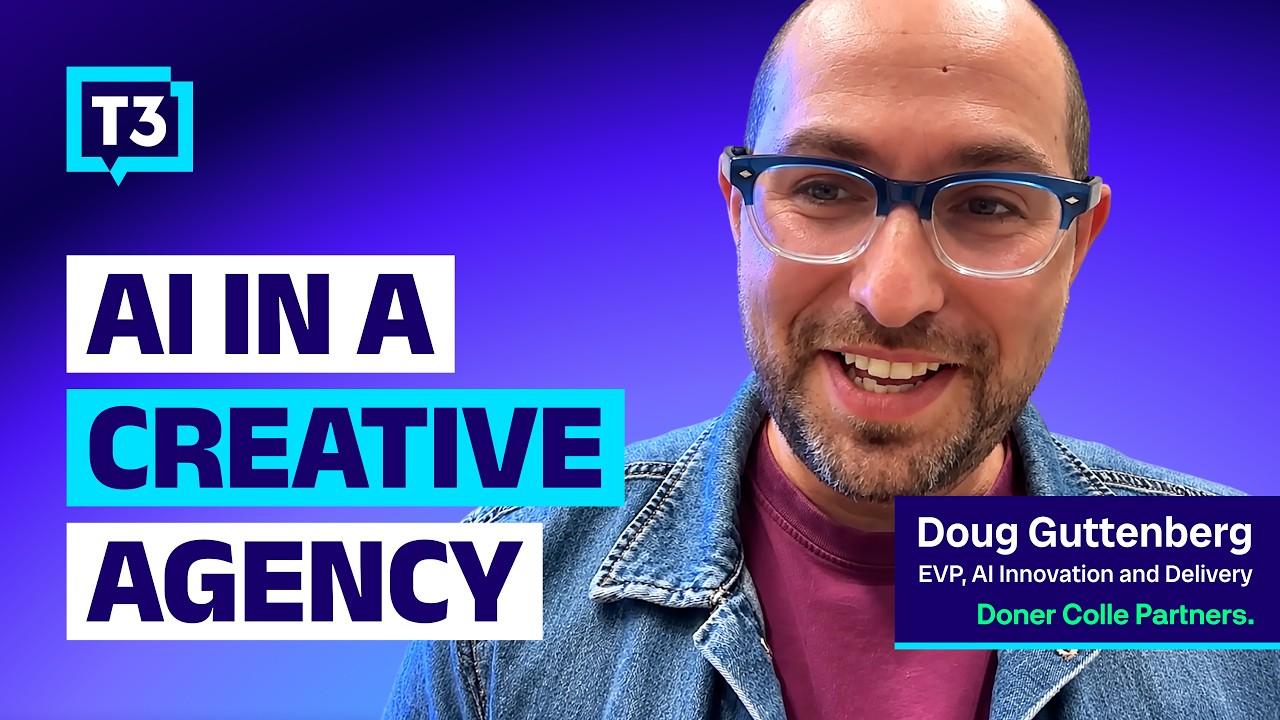
Doug Guttenberg owns AI transformation at DonerColle Partners, a creative agency, and he's never been a developer. Since early 2024, he's built a team of about 15 engineers and creative technologists.

With
Doug Guttenberg
Executive VP of AI Innovation and Delivery
DonerColle Partners
Guest
Host

About this episode
Doug Guttenberg runs AI transformation at DonerColle Partners, a creative agency, and he's never been a developer. He joined at the start of 2024 and built a team of about 15 engineers and creative technologists, most of whom surfaced from an internal task force he started with a small monthly experimentation budget. The team spans front-end developers, video studio people, and folks who work with their hands.
Doug walks through how the task force worked: members took personal or client problems, experimented on a monthly cadence, then reported back. The one rule that kept it productive was that nothing got shown to the broader agency unless it tied to something tangible. The people who stayed most committed became the foundation of the current team.
The conversation gets into a few assumptions Doug thinks are wrong right now. Juniors aren't ahead of seniors on AI, he says; the advantage people assume they have isn't showing up in practice. He also argues that the cost of switching models is mostly mental baggage carried over from switching databases or email providers, and that you can transfer your preferences from one model to another faster than you'd expect.
Doug adds orchestration to Josh's list of discernment, taste, and judgment as the skill that separates useful AI output from statistical average slop. He explains it as giving an LLM context, instructions, and constraints before asking it to produce anything, not just opening a chat window and asking a question. He's building and using MCPs personally and sees context connectivity as the thing that will change how people work together, not just how individuals do their own jobs faster.
Juniors don't know how to use AI any better than seniors do at the moment is one thing that I have been discovering. Not that they're not brilliant and bring different perspective. That's what you bring juniors in for the first place.
—
Doug Guttenberg
Executive VP of AI Innovation and Delivery
DonerColle Partners
Transcript
Doug Guttenberg 00:00
I run technology inside of a creative agency. There is the promise of AI is here. Everybody will be AI.
Josh Anderson 00:08
We need to learn about your tech team.
Doug Guttenberg 00:09
Creative technologists come from all different backgrounds from video studios running developers. Some of them work with their hands and incorporate technology into that process. Like 2 3 4 years of AI is magic starting to come into here's where AI will actually come in and start to solve problems. This is about identifying ways to bring technology where technology has never had a role before.
Josh Anderson 00:35
Discernment, taste, judgment. Those are not easily acquired. Yes, but I think that you're also
Doug Guttenberg 00:41
Missing one.
Josh Anderson 00:42
Oo, okay.
Doug Guttenberg 00:43
Orchestration. This will prevent a statistical average from becoming the norm. Essentially, AI slop.
Josh Anderson 00:51
Welcome to Tech Teams Today, where we talk with the people building and leading the engineering orgs behind today's most innovative companies. Our guest today is Doug Guttenberg, executive VP of AI innovation and delivery at DonerColle Partners. Doug takes us through his organization's path to AI adoption, and he charts the future of where they continue to evolve its use. He also shares his journey into leadership and provides a few tips on how to shed some baggage holding many of us back from stronger AI adoption. I walked away with two suggestions from Doug that I'm putting into practice this afternoon.
I bet you'll find one or two yourself. On to the episode. Welcome to the podcast, Doug. Excited to have you. We're going to jump right in and the most important thing since we are tech teams today is we need to learn about your tech team. So, what's the shape of it? What kind of folks do you have on it? How large is it? Just help the audience understand what you're working with.
Doug Guttenberg 01:40
Yeah, awesome. Thanks for having me. So probably a slightly different angle of technology than you're used to talking about. I run technology inside of a creative agency. So creative agencies who are working in the marketing and the advertising space who are creating brands, ads, experiences, sometime that leads itself to the true digital experience in the traditional product way, websites, landing pages, etc. Sometimes it manifests in different ways. So my team is about 15 people of varying different skill sets. So yes, there's engineers.
We're doing good practice in the digital and development world, but it's evolved quite a bit out of that where rather than traditional engineering department, it has been give me the creative technologists. Creative technologists come from all different backgrounds. They some of them come from video studios, some of them are front-end developers, some of them actually work with their hands as well and incorporate technology into that process. So the team is very diverse. It's kind of split up into figuring out what we need to do bigger than you think it might be. the creative technology that will be used to solve the problem that we're solving.
And then the engineering role is to make it real, to make it scalable, to make it secure so we can properly roll it out not only to ourselves but to our clients and then into the broader world. I love love love diverse teams and I
Josh Anderson 03:16
Love diverse backgrounds. Some of the best teams I've ever built were were from all over the place, like astrophysicists, no college degree at all, lit majors, history majors, and it just got down to and it sounds like you're in that same world of we just get problems and we have to figure out how to solve them and like it's not all it doesn't always look the same. Is that a fair assumption?
Doug Guttenberg 03:38
Yeah, absolutely. I mean, it half of it is operational. If you think of where where the world is right now and where technology is helping any industry, but certainly a creative industry which is thriving on subjectivity, this is a very subjective world and work that we're in. This is about identifying ways to bring technology into parts of business or work or human behavior where technology has never had a a role before. And now there's the promise of AI is here. Everybody will be AI. But what that actually means in principle, that's the heart of what we're really trying to solve.
So it becomes operational, but it also becomes part of the product that you're doing. It's like the throughput of how you get there. So yes, figuring out what it is is much bigger of a herculean task than a discovery about a particular user problem that you're trying to solve. It's much more scaled and broad.
Josh Anderson 04:45
Yeah. One of the one of my new favorite phrases is expectation inflation and how AI has driven that. Do you see that? And we hear about that from executives that are now like, hey, your engineering team should be running a 100x because AI does everything, right? And it's like, well, it's never that easy. So, do you see some of that both internal external? Because I'm assuming you have internal customers and external customers that [snorts] are that have an expectation that now everything's magic.
Doug Guttenberg 05:15
Yeah, absolutely. I think expectation that everything is magic is a great way to say it. And I think that people are learning it little by little more and more. And something that I'm seeing on a macro level inside of the marketing industry is like I work with big vendors like Adobe. I work inside of a larger parent company that has a lot of technology offerings. And then I have the world that I'm running myself.
So these three different levels, I'm starting to see strategic alignment, which means that the market is finally starting to set itself a little bit of here's what AI transformation actually means in the context of the work that you do, which is very first of all gratifying to feel like we're on strategy from a smaller company, but also a little bit of relief of that like 2, three, four years of AI is magic and it's going to solve everything starting to come into here's where AI will actually come in and start to solve problems. So expectation inflation is still there.
I think that's a good term to use. But I think that a big goal for me as a leader in the space is to also be an educator and to help get my organization into the right mindset of what does that mean? What does value realization from AI need from you the human to be able to direct it in the right way? And that's the missing piece that winds up, you know, that you see that creates these expectations. It's just like AI the tool versus AI the enablement layer that allows you to achieve something.
Josh Anderson 07:02
Yeah. How was AI adoption in your team? Was it there was one person that was way out front and it's like hey guys like get on board or did you have some lagards or kind of all of the above? because I it's always an interesting story to hear how it happened. There's sometimes where it's like all at once and there's sometimes where it's a slow burn. Yeah. So, I could talk about my team at a micro scale and then we could spend time talking about the organization because organizational adoption is
Doug Guttenberg 07:32
That's another a whole other thing. But inside of my team, first of all, you get techies together and we're excited about cool things that are technological anyway, right? So that just needs organization and shape. Everybody's naturally in interested for the most part if they've if their career path has led them to not just a technical role but a technical role inside of a creative agency. That's very different than being part of like a large broad digital engineering team, you know. So the curiosity is there. The first thing that we did I've been at DonerColle Partners since the beginning of 2024.
The first thing that we did is found all of the technologists who were kind of hidden in different sub companies or different departments. Ultimately they came together but we created what we called a task force in the moment which was you know in 2024 a lot was available but it was pretty nent in terms of what you were getting value out of in terms of just AI but emerging technology in general. So we made an experimentation budget basically became the skunk works of the agency.
Everyone took personal problems, personal opportunities, maybe something that was client applicable as long as it was safe to use that tech on and then come back on a monthly cadence and just report to each other. Here's what we're doing. Here's the problem that it solved. Here's how it works and here's what it achieved. That ultimately got shown to the agency. As that evolved, it became less about like, cool, you showed me cool tech. you're doing a survey of technology out there. How are we solving our actual business problems?
And then the filter became, we can't show it to the agency or to the company unless we can show how it ties back to something tangible. Then we took the how do I say it the people who are the most interested and most committed to exploring this and that really became the foundation that we built this technology team on. So, a shared process of discovering technology, a road map to get everybody familiar with what we're looking for, how to explore something, what's the kind of the filter that you should be looking at tech as it's coming in. And then that just created forums.
It created natural conversation. As the team became more of an official cohesive team, we start to split ourselves into, you know, our little subd departments that I explained, intake, creative, development, engineering, and and then you get what you ultimately want, which is enough genuine enthusiasm that everyone's waiting to share the next thing with each other. So now there's digital channels, there's department meetings, there's now too much that we want to say to each other and share and be excited about than there is time to do it. So I guess that's a a good
Josh Anderson 10:36
Problem to have with a team like this. Yeah, that's a that's like a heartwarming wonderful place to be, right? Where it's like it's taken on a life of its own and you're like, yeah, they're like we've done it, you know? Man, it doesn't mean that it's easy and
Doug Guttenberg 10:50
It doesn't mean that that that it results in a tangible
Josh Anderson 10:55
Deliverable that
Doug Guttenberg 10:57
That that we can be proud of. That's something that takes much more rigor and much more, you know, digital product type of process.
Josh Anderson 11:06
But you're on the path, right? You can see it once you get that inertia momentum and you can see like, okay, we're going to get there. Yes, it's still bumpy. It's still even a little cloudy of what the destination is, but we have what we need to make this happen. And that's always a wonderful time.
Doug Guttenberg 11:22
You know what I think that we're doing a really good job of is now we kind of have this like discover a new capability, prove it out, think of where it will solve a problem. And then, you know, as a leader, I love that we have this culture because now I'm expanding on my personal learning and getting from different people with different social feeds of what they're interested. Designers are getting very design aesthetic kind of things and ways to like I I got tuned into an MCP into Figma to like really control it from desktop. Gamebreaker.
I never would have found it without someone on my team, right? but the practical side of it is that now as we get different problems coming into our department as new opportunities come up client is looking to solve something agency is looking to solve something I've got in my head not just what tools can get applied but more of the the foundational technology the conceptual tech that comes behind it. So, I'm starting to have a much broader tool set and idea set that maps technological opportunity to business opportunity.
I think that's my role as a leader is to connect those dots and to be able to define it, speak to both sides in a way that everybody can understand so the thing can take off properly.
Josh Anderson 12:54
Yeah. So expanding on that role you have within the organization as the tip of the spear for AI adoption, when I speak with other folks in your position, you end up being the de facto, hey Doug, we're going to kind of expect you to lead the rest of the organization into adopting AI. So now you already have a hard job and now it's like, hey Doug, do this other thing. Has that fallen on your shoulders or have other parts of the organization taken on or like what's
Doug Guttenberg 13:22
That shape look like? Yeah. So inside of my mandate is AI transformation for the organization. So we've been talking about one lane of that larger broader picture. You know to me the most fun and most important lane is the technology team that can take raw tech or tools or whatever it is and shape them to opportunities. It's really the point of my technological organization, but also learning and development. Also getting the right access at the right time for the larger organization at hand.
Also our connection into a larger company that we're a subsidiary of and making sure that we're inheriting the right tech and staying up to speed on it. All those are part of the role and it's all part of a larger transformation initiative that everybody is after right now. You know,
Josh Anderson 14:23
Have you had any token surprises where you get a surprising bill or has that all just kind of like not been an issue? There are some people where like like I talked to someone at Webflow and they're like we got out of left field like a 50k bill in one week because OpenAI changed the default model that they were shipping. So everybody was unknowingly using the biggest model. Have you had any issues like that?
Doug Guttenberg 14:50
[clears throat and laughter] personally I've been an offender of it. I would say I don't think that it's gotten to we're not a large enough engineering organization that it becomes like a major organizational P&L issue especially at this moment in time but like yeah I've burned through stuff personally like I got everyone has their OpenClaw story but I created my OpenClaw ecosystem and like burned through 200 bucks in 36 hours which is obviously small potatoes but I'm like what why
Josh Anderson 15:25
And then you go back and trace why and then certainly at work I
Doug Guttenberg 15:29
Will use AI and sometimes one time I accidentally you know left myself on Fable without remembering and then burned through those credits and started it but yes token maxing is a thing I'm probably the biggest offender which is good I think from the larger organization level if I'm the biggest offender then
Josh Anderson 15:48
Then I think we're in a good spot speaking of models and options. Has has your team settled on, hey, we're a Claude organization or like there's this group over here that finds that this model is better for them or has that sorted itself out yet? Are you still in discovery mode?
Doug Guttenberg 16:08
Well, I want to say that we'll always be in discovery mode. I want to always be in discovery mode personally and with the rest of the team, but in the way that I was explaining the task force, which was like, you know, a small monthly budget so we could have personal licenses to things and try them out and then eventually maybe promote them to be larger scale solutions. We also need to be understanding of the reality that we work inside of an enterprise with sensitive data and sensitive client data and sometimes even PII and that means that we need to stay within an approved stack.
So Claude and Microsoft are like the core mo like the core harnesses that we can use. Model switching is certainly something that happens under most harnesses at this point. So it gives us some flexibility but in terms of like the ecosystem that we're living inside of technology team is very heavily into claude though I've seen in my personal world like a lot of improvement in the chatgpt world as well and you know Codex into ChatGPT work.
So that's something that I'm really interested in and I'd like to be able to have you know more diversity for the team and right model right harness for the right
Josh Anderson 17:35
Problem. Yeah, I I think whether you like it or not, you have to be in the mode that you want to be in where you're in constant discovery because it is changing. Like I have some peers that that are in my ear about you got to use Grok. Yeah. Like you need to be leveraging Grok for what you're doing. I'm like, man, like and it's hard because it feels like I feel like I'm just getting good. Like I feel like I'm hitting a groove with
Doug Guttenberg 17:59
Claude and like okay cool.
like Claude and I like we're kind of talking the same language now and it's like this thing comes in but there's a real fear at least for me there's a fear of if I don't keep up then I'm going to get lapped and as a technical leader that's a scary thing I I think you're right and even inside of the Grok world now there's Grok Bot and then that's going to and that's getting closer to multiplayer AI usage which I think is the next big frontier that that we're hitting And I think that it's easier to switch than we're all collectively given credit for.
I think that we're holding on to some some like migration cost baggage that especially technology people can like kind of wrap their head around. I know what it's like to switch a database. I know what it's like to switch my email provider. But really, you can download pretty quickly all of your idiosyncrasies. If there's anything that I've learned like about my personally of using AI, it's that, you know, I'll give myself some credit. I have some intelligence. I have a good way of like connecting tissue and solving problems, but I'm not that special.
And for the most part, I can export my preferences and experience in from from one model into another and one harness into another. And it's way easier than I even would like to think that it is, which is, you know, it's
Josh Anderson 19:31
It's a big opportunity in some ways. I am going to take your advice and accept that it the old switching costs aren't the new switching cost. Like to your point, what's the cost of pointing a new model at your software project and saying like, "Hey, I want to build this feature." Basically zero. Just swapping the model. Yeah. Like just Yeah. but yet I have to your point I have some like legacy baggage of like, boy, that's going to be a big lift, but it's not right. And so I think that's that's a lot of what I've been learning is I'm having to retrain myself.
And actually, there's some leaders that I've spoken with in the past that are that are doing the opposite of what people are saying and they are heavily investing in more junior people because they have less baggage just like I talked to just just like my baggage I'm talking about where they're just like, you know boldly running in all these directions without fear where whereas I have just like, you know, I've got this fear built up over 25 years of doing this like, oh man, I'm gonna shoot myself in the foot. But like, you're not right. To your point, you're not.
So I think that's that's a great point that our audience needs to hear is switching is easier than ever.
Doug Guttenberg 20:50
Yeah. And I think you've also brought up a point that from my like organizational design mind really like yes I am a leader in the technology world but the conversation's going to keep going back to like operational design because it's another one of my passion areas. And you hit on the role of a junior and there's so many different schools right now. Part of it is like, yeah, I don't need any seniors. I'm just gonna get juniors who know how to use AI.
First of all, juniors don't know how to use AI any better than seniors do at the moment is one thing that I have been discovering. not that they're not brilliant and bring different perspective. That's what you bring juniors in for the first place. But then another one is I'll never hire any juniors again because my senior people can do all the work now and I can just have them do 8x work. And for some people who are like really into it, they actually are like getting huge increases in productivity.
I'm certainly one of them, but it's also not something that I've seen as a reasonable expectation of every single person on your team. So where we're all trying to completely redefine the mix of junior to senior and who's in where, I actually don't think that it's evolving as much as we really think it is. We still want to have a regular pipeline of new thinking coming in and that's very important. And then you still need people who know what they don't know, who can train them and teach them and lead them along the way and bring whatever you're in.
If it's a creative business, bring, you know, taste, judgment, and understanding that pure creativity is sometimes at odds with business reality. If you're in a technical world, it's like, I've been there. I've seen what your strategy is going to create. Let me save you a big headache right now.
Josh Anderson 22:39
Yeah. So it's it it's the the classic scenario of what is an unknown unknown to somebody is a either a known known or a known unknown. And so you end up getting that acceleration of let me help you out, let me help you out. But also with those juniors, there's that boldness of like, okay, sure, maybe I can't do that, but maybe I can, you know, with these new toolings and whatever. And so then like, yeah, I'm going to give it a shot. Whereas some of the more senior folks have be like, "Yeah, I've shot myself in the foot like six times doing that.
I'm not going to do it again."
Doug Guttenberg 23:14
Right. Yeah. Exactly. But then you wind up like overconfidence with AI can certainly be a thing as well. And I think that like me as somebody who's never been a developer, but has always been technically involved, technically adjacent. You can call me product management or strategy or whatever it is. I now all of a sudden have coding tools that allow me to create things that I've always had to write a really great brief for.
So all the things that everybody who's listening to this podcast knows, you know, yes, you could prototype faster, yes, you could try more things, but for me that meant that I could believe that I was making something at a fidelity that I actually wasn't building it at. And that's my real fear for juniors to know as they're coming into and maybe it's the role of seniors to show them the same the same relationship where like it's led me to learn much more technical concepts than I had ever known.
It allows me to know something conceptually so I can explain it to an engineer who understands what I'm saying and can translate that into their technical terminology to I actually have to know the technical terminology if I'm going to do this thing right.
Josh Anderson 24:33
Yeah. Evolution that I've been working through myself as a heavy user of AI in the coding space is coding has been solved. check. The theory was that engineering hasn't been solved. That you're not going to get a well-engineered, easily maintainable, scales without issue product that AI hadn't gotten there. I'm actually seeing that it's starting to get there with some of the more traditional technologies. Now, if you use a one-off tech where it's not trained as well, you know, there's less to be trained on. So, the likelihood that's going to nail it there. But but I do feel like they're building better products.
It's getting the architecture right more often than it used to. So it really is an evolution. And back to one of the things that you brought up about juniors not knowing how to use AI better than seniors. I think the reality is like no one knows and we're all figuring it out and it's even more impossible to figure out because it changes every six weeks.
Doug Guttenberg 25:34
Yeah. Right. So yeah, I think like fundamental principle that I've been living through and really trying to change myself and my habits so I can not only speak about it fluently, be an authority, but lead by example. the way that you use it, it just it must be about context and it must be about curiosity and going layers and layers deeper. And I think that's like the direct antithesis to where we started, which is we're going to wave a magic wand and AI is going to solve everything.
The truth is is that we're going to work really, really hard and probably read several novels over the course of a week in order to achieve these miraculous amazing things. So, we are moving forward and we're moving forward at a at a speed that I don't think that we've never seen before. But the rigor and the methodology that goes into it is the reason that juniors can't just come into a senior role and start doing it immediately. You need to develop that and right now it's very personal.
I try to share that and this goes into also like learning and development for a for a large organization. How do you teach that? That's not learning a tool in the way that like I've implemented MIS systems before. A lot of workflow management. It's like you click here, this is what a record looks like, then you click here and then you're done. And I think that there's a lot of safety in that, a lot of like feeling of control of there's a right and a wrong answer.
But when you're staring at like a at a terminal window or you're looking in your, you know, your chat GBT chatbot window, it's completely up to you of how you want to run the thing. And that's I mean, I think it's awesome. I think it's terrific, but it's also a big part of the education to my team, the broader company. And I'm sure that that is very repeatable across many industries and many realities of different company structures and sizes. Yeah. I'd say the
Josh Anderson 27:52
Term that gets thrown around that I think speaks to what you're trying to put a label on is discernment, taste, judgment. And those are not easily acquired. Those require reps to evolve that taste, that judgment to be able to look at a response from an LLM and say h maybe not like let me let me ask another question versus like let it ride. Yes, but I think that you're also missing one and it's or orchestration. I think that even above well not above taste and judgment and creativity. I've been saying there's kind of two angles of this.
What you said which is the human element that only
Doug Guttenberg 28:41
A person who knows what they want can bring in. This will prevent a statistical average from becoming the norm. Essentially AI slop. Then you have what are you trying to how do you control the conversation in order to get to a point where you're giving a reaction in the first place? Because there's a big difference between I have a podcast later today. What should I say? And I have a podcast that is going to be focused on these things. Here's where I'm at right now. You also have context from everything that's happening in my world from subsequent, you know, chats and projects on the side.
Let's think about how we can organize all of the thoughts that are swimming around in my head so I am prepared for this conversation. In hindsight, I wish I did that for this conversation. But that's what I mean by orchestration. It's context. It's instructions. It's what to do. It's what's not to do. And that's something that it's very subjective, but it's also very structured in a way. And I've developed my own kind of personal cadence for it and I've been sharing it. But I suspect that that will remain very intimate to the relationship between person and LLM for
Josh Anderson 30:01
For the next you know bit of time. Yeah. That's the final frontier for me is I keep my LLM usage in a box and I haven't opened the floodgates.
I haven't done the OpenClaw thing where I give it access to my entire life or claude is now in that same space where like hey we have connectors and MCPs so so we can read and we can give you the morning brief on what you should be doing and and and and I've stiff armed that for a while partially because like privacy concerns and things like that but then there's times where it's like you know they have my data already why don't I put it to use right you know so like that that That's that last thing that I haven't been able to put a clear why not why I haven't unlocked that capability.
so that's a thing that it'll be interesting to see if I ever take that leap. So is that something that you've done or you're thinking about? Where are you on that?
Doug Guttenberg 31:03
Yes, I feel like I fairly aggressive in my risk tolerance with this world with my personal world anyway inside of the professional world.
I keep the box whatever I have approved to use from an enterprise perspective and that's in conjunction with an IT department and with you know the larger organization but no I'm making MCPs I'm using MCPs I'm trying to connect different systems together because I think that context is I'm I'm getting it context keeping context available and the right context in the right moment that's what's going to make this not an IND individual using a coding tool to do their job better and create a better or faster version of the same, but to transform the way that people work together.
I think that you need the connectivity. It can't live inside of a box. And so, again, I'm trying to become the proof of that. And in the process, I'm learning a lot along the way. So, I don't know if you can not tell, I'm psyched about it.
Josh Anderson 32:12
Yeah. I mean, I I like having Iron Man's Jarvis would be amazing, but I'm still stiff arming that. Like, I'm still like, "Hey, you stay over there. I'm not ready for that."
Doug Guttenberg 32:23
See, I grew up on I grew up on a a heavy dose of Star Trek. And I was thinking about this as now the chat features are becoming pretty good and better, and I'm talking to AI more. Like, I've been dictating for a while, but I'm speaking and having a conversation. And I'm like, man, is so many hours of watching people talk to computers on TV actually reflecting like a my tech optimism about everything that's happening here and b like my actual skill set and capability development because it doesn't seem like I'm in completely new territory.
Someone thought of this already even though it was dramatized.
Josh Anderson 33:08
Yeah. I I've I've recently adopted talking to Claude and it's weird. I what I struggle with is I'm more thoughtful when I'm typing and I feel like I organize my thoughts when I'm trying to get the words to flow out and through a keyboard versus when I start talking. I feel more rambly. And I I think it's another one of those where like it's a me problem. It's not like
Doug Guttenberg 33:37
It can I think this is something that it this is baggage.
Josh Anderson 33:41
Yeah.
Doug Guttenberg 33:42
Like AI doesn't care if you're rambling. And in fact, it's been one of my biggest challenges and most technical people being able to speak in a way that organizes the thoughts and doesn't go too far into some tangent around how one particular thing works where you lose everybody, right? Like that's a people problem and it's a very real people problem and one of my biggest challenges with AI is how do I solve that people problem in getting a very coherent thought out of this complicated thing that I'm and and nent thing that I'm trying to explain.
But in terms of communicating with an with an AI model man that's what it's good at. It's good at taking your ramble and putting it together and organizing it. Like I used to write so many outlines for things. Now I ramble and I'm way happier about it.
Josh Anderson 34:38
Well, Doug, I can assure you that you have encouraged me to alter some of my behaviors in our conversation and I hope I'm not the only one for our audience that has tuned in. So very excited about the discussion we have. And we've got a lightning round at the end of fun questions. You don't know what they are, but they're not scary, I promise. that I'd like to run you through that I run every guest through. So if you're ready for that, we could do that. Okay, first one and what I believe to be the most important one.
Doug Guttenberg 35:08
There's a certain animated image file format that is. GIF and it can be pronounced one of two ways. Which way do you pronounce it? It's a GIF. GIF is too much like peanut butter. Sorry,
Josh Anderson 35:27
Not the answer you wanted.
Doug Guttenberg 35:28
Yeah. No. Well, you know, I think the original guy said GIF, but like I know it's just my my my correlation is too strongly to peanut butter. So, it's a gift.
Josh Anderson 35:38
Yeah, I it GIF is the predominant answer of all of our guests. So, you are
Doug Guttenberg 35:44
Yep. I am the outlier that likes You're a purist. I understand.
Josh Anderson 35:49
I don't No, I don't know. I'm just I don't know. It's what I started saying a long time ago when just, you know, because we're nerds. We fight about silly stuff. Okay. So let's talk about leadership. You've had a interesting journey to becoming a tech leader, right? You mentioned you weren't an engineer but but you became a tech leader. Was there or is there one piece of leadership content maybe a podcast or a book or a quote or anything that helped you figure out you wanted to be a leader or to become the leader that you are today?
Doug Guttenberg 36:21
I don't know if there was any particular thing. I've enjoyed a lot of, you know, supplemental reading o over the course of time like more modern things like Outliers, that Malcolm Gladwell book I thought was really interesting. It's not exactly about leadership, but it is about excellence. even classic stuff. I've been very influenced by Marcus Aurelius and his the meditations compilation which has given me a lot of like underlying philosophy in in leadership. But I don't know.
I think that it's it's something that even from like high school playing sports, being in bands, there was kind of always a make momentum kind of leadership trait which has translated well into the professional world. I think that two things that I try to live by and I certainly hire by when I'm hiring, when I'm trying to find people to, you know, think in the same mold is a sense of curiosity. That needs to be very important for a leader. You can't think that you have really any answers.
You know, that's how you develop enough knowledge to actually have some answers when when you need them. and a sense of urgency, which doesn't mean go fast, but it means create momentum. There's like these in in the flow of getting work done, there's peaks and there's valleys and in those lols, which could sometimes be, I don't know what to do next. I don't know who's in charge of coming up with what to do next. Here's a problem that's really hard to solve. Here's a conflict that needs to be solved.
like to be the person to come in and be the catalyst for that to get solved, even if you're not the owner of the resolution. That's a big leadership trait that I look for.
Josh Anderson 38:17
Yeah, I think that's fantastic. You know, there there's there's smart people, then there's smart people that get things done and they aren't always the same group, right? So I think really great leaders are smart and learn fast but also know how to just like you said they move things forward even when there is no path and they help teams figure out how to figure that out.
Doug Guttenberg 38:39
Yeah. You know my my father-in-law said something to me recently which resonated. Simple but true. He's like success is knowing how to do it, working hard and getting lucky. And you need all three in order to achieve success. and everything else you do is just, you know, the work hard piece of it always needs to stay there. I think
Josh Anderson 39:03
I'm gonna make some assumptions and, you know, assumptions are never good, but given that you're, you know, the world within you work this next question is your preferred operating system, Windows, Mac, or
Doug Guttenberg 39:17
Linux. I've got an assumption. Yeah, I mean, it's Mac. Your assumption is correct. Okay. I could I could play in in in in Microsoft in Windows. I've honestly never opened a Linux operating system, which I know is going to like completely decredentialize me to half of your listeners, but I'm glad that I did it at the end.
Josh Anderson 39:39
I think I think you're safe. I think you're safe. yeah. Okay. So then the final question is the first product that you ever shipped either individually or as a member of a team, what technology was it?
Doug Guttenberg 39:59
You know, the first real product that I felt like ownership of, I helped out with digital products and project managing and things like that, but I couldn't even speak to the technology of where I was in my career in that thing. It was content automation and content automation that worked inside of just like JavaScript and Python scripts and APIs into content creation tools like the Adobe suite. So the first stuff was InDesign automations inside of Adobe InDesign and it was making different versions of banner ads and direct mails and things like that. That was like the the OG tech product for me.
Josh Anderson 40:46
Yeah. And usually those places aren't or by those places I mean those technologies aren't documented horribly well. So I'm so I'm assuming there was a lot of discovery trying to figure that out and how to hack it together.
Doug Guttenberg 40:59
Yeah. Yeah. Exactly. And this really created like my relationship with engineering like objects. So and it also made me understand the value of a creative technologist. So I was very lucky to have a good partner. I was managing client relationships. I was managing the delivery of projects. I was, you know, kind of writing all the briefs and discovering the opportunities. That was really kind of where I came up and started. And I had a counterpart who was much more technical, a studio designer, somebody who has to use the world of InDesign and is a technical expert into it.
Luckily for me, he was also a tinkerer and you know like had experience writing code and was interesting in automating. And so we developed a really good partnership of he kind of embodied what's now evolved into engineer and creative technologist. And I embodied the finder and translator of opportunities from what will make create business value and to be able to explain and understand what that is in a qualitative way and then translate it to here technologist engineer here's something to solve and and and how it maps into systems thinking then I had a partner who could really take that and turn it into a thing.
And then that's like you can see the blueprint of that relationship is the structure of a more modern technology department that I run right now. Now again, AI is allowing me to kind of cross the aisle a little bit more, which is very fun, but I also sometimes go too far and get yelled at.
Josh Anderson 42:53
We all do that. Like that's part of that's part of the job sometimes. At least that's what I tell myself. okay. So, for those of
Doug Guttenberg 43:00
Our audience that have made it this far and they want to hear more or read more about Doug and team, is LinkedIn the
Josh Anderson 43:06
Best place to find you or do you prefer some other social media platform? Yeah, LinkedIn is LinkedIn is great.
Doug Guttenberg 43:12
Okay, cool. I will make sure those links are in the show notes so everybody
Josh Anderson 43:16
Can find Doug. And Doug, thank you so much for being a part of the show. Great conversation and look forward to staying connected. Yeah, thank you for having me. This was fun. That was Doug Guttenberg, executive VP of AI innovation and delivery at DonerColle Partners. I know there's at least one person in your network that can learn from this episode. Go ahead, share it with them. They'll appreciate it. I know I will. Tech teams today is brought to you by Revelo.
If you're looking to build out your engineering team with worldclass vetted talent from Latin America that's time zone aligned and ready to ship, check us out at revelo. com. I'm Josh Anderson. Thanks for tuning in and I'll see you next time.
Chapters
- 00:00 Intro
- 01:26 Shape and makeup of Doug's 15-person team
- 03:13 What it actually means to bring AI into a creative agency
- 05:08 Expectation inflation and where the market is landing
- 07:02 How the internal task force became a real team
- 15:50 Model switching costs less than you think
- 20:27 Why juniors aren't ahead of seniors on AI
- 27:52 Orchestration as the skill beyond taste and judgment
- 35:00 Lightning round: GIF, leadership books, and first product shipped
Topics
- How a small monthly experimentation budget grew into a 15-person tech team
- The one filter that stopped the task force from becoming a string of cool demos
- Why juniors aren't ahead of seniors on AI adoption right now
- Why switching models costs less than engineers think it does
- Orchestration as the missing skill beyond taste and judgment
- Why building and using MCPs is the path to real workflow transformation
- The 2 traits Doug hires for: curiosity and a sense of urgency
More from the show