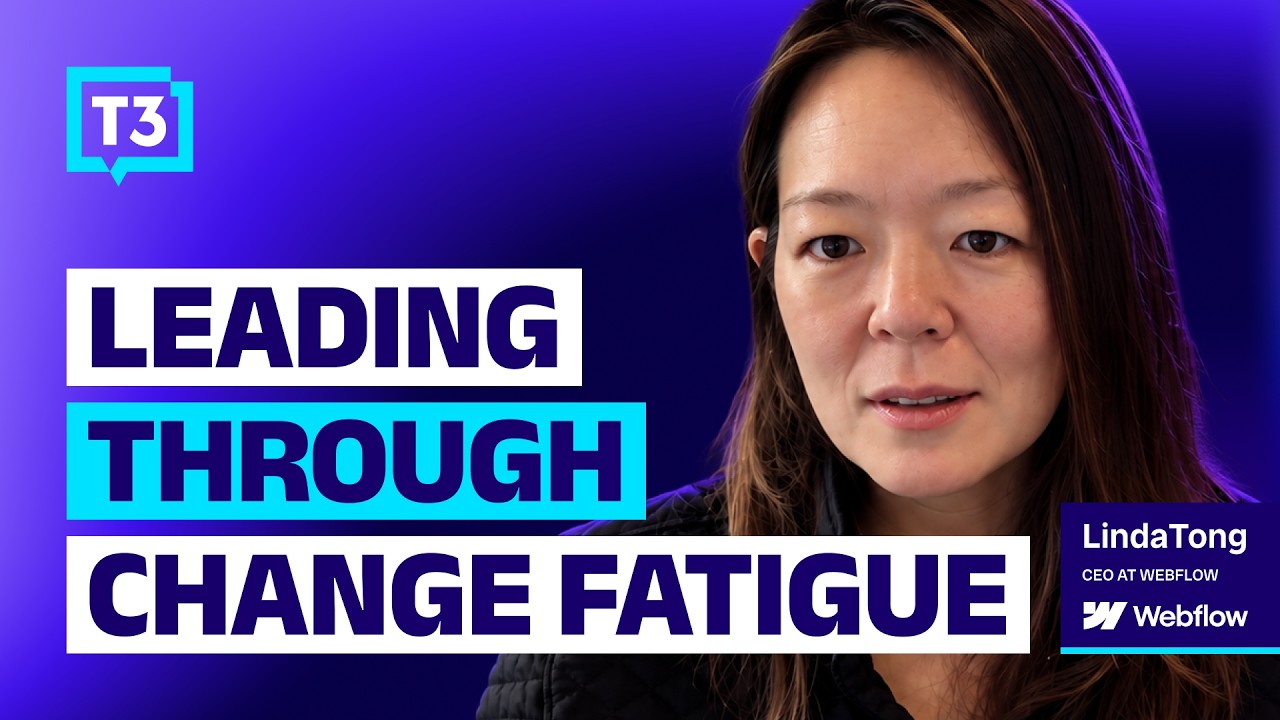
About this episode
Linda Tong, CEO of Webflow, describes turning a website builder into an agentic marketing platform without a single 'go AI-first' moment. Instead, it's been a continuous string of realizations: code generation, then fine-tuned models, then inference routing, then self-learning agents. Each one forced a new decision about where the product should go next.
Her rule for keeping decisions moving: the person closest to the problem owns the call. Waiting for more information is itself a decision, one she calls a 'decision of indecision,' and she has no patience for it. For hiring, she screens for two things above everything else: curiosity and resilience. She tests judgment by asking 'why' five times after a candidate pitches what they'd build.
On what she calls Project Assassin, Linda explains why deprecating a feature is 10 times harder than building one. You have dependencies, migrations, customer relationships to manage, and someone is always angry. That pain is the point: once a team lives through a deprecation, they become far more selective about what they build in the first place.
The data side of Webflow's AI push took roughly a year of unglamorous work. Four people querying the same AI for ARR got four different answers, all technically correct but none specific to how Webflow calculates the metric. Fixing it meant restructuring tables, tagging metadata properly, and encoding business rules so the model returns a consistent answer every time.
- Why Webflow had no single AI-first moment, just a continuous barrage of them
- Putting decisions at the layer closest to the problem to kill analysis paralysis
- Why good leaders say no to good ideas and hold a high bar for great ones
- How four people querying AI for the same ARR number got four different answers, and a year of data work that fixed it
- Project Assassin: why deprecating a feature is 10 times harder than building one
- Treating every team member as a different board game to lead them without going top-down
- Refresh days and builder days as forced structure against burnout
I will wake up at around 4:30 in the morning most days and the first feeling I have is this overwhelming fear of being behind. I have so many things I have to read, so many things I have to test, so many things I have to learn about, and that's exhausting.
Linda TongCEOWebflow
Transcript
Linda Tong 00:00
I will wake up at around 4:30 in the morning most days and the first feeling I have is this overwhelming fear of being behind. I have so many things I have to read, so many things I have to test, so many things I have to learn about and that's exhausting. My hope is that other people in my organization don't feel that way. Like I need to figure out how to handle that.
And I'm constantly working through how can I add as much value as possible to the organization, stay relevant in this time of change, but like find the right balance so that I'm not burning myself out. It's tough being a CEO, but honestly, it's tough being an employee in this industry now more than ever. I think people need forced days off so that they can actually create time to recuperate.
We've built in these like builder days where we give people time to go heads down and build and experiment because I think one of the hardest mental models that people are balancing is there's like this concept of work and then there's this concept of like working on yourself. It is a constant struggle and you know anyone who tells you it isn't I just don't believe them.
Josh Anderson 01:01
Our guest today is Linda Tong, CEO of Webflow. Linda launched her career at Google where she helped ship Chrome and what would become the Google Play Store. She's currently leading Webflow from a website builder to an agentic marketing platform and doing it with her trademark style. During our discussion, we get into how she keeps decisions at the layer closest to the work, why she hires for curiosity and resilience above anything else, and why saying no is the cleanest sign someone's good at their job. And yes, we cover that monopoly game that her family played over multiple years between holidays with their own custom rule sets.
Here's Linda
Linda Tong 01:33
Tong. Welcome to the podcast, Linda. Very excited to have you. I'm going to jump right in and our podcast is Tech teams today and I want to talk about not just your tech team but your tech product because you're leading a transformation at Webflow that's pretty interesting, pretty cool and pretty challenging. So, first things first, I would love for you to center our listeners and viewers on exactly everything that's going on at Webflow. I know that's a big question, but I know you can handle it. Oh, you know, nothing's going on. no, really.
I mean, I think it's a it's such an interesting time to be, you know, in the industry and specifically like to be in tech to be thinking about how to transform your business with AI, but on top of that, like the space that we're in specifically is going through massive transformation. So, like you're sort of like it's this meta challenge because one, you have to evolve the business itself, but two, you have to think about those evolutions with AI and then how do you want to take it to the next level? And so I'll give you a little bit more context on that.
You know, Webflow, we we started as this, you know, website builder and a lot of people think of us as this really fast and easy way to build powerful websites. And we've been evolving that business over the past few years to become an entire digital experience platform that can really support all the things that go with your website beyond just building it. You know, how you publish content, how you manage updates, measure analytics, run experimentation, drive growth and brand awareness. and and that's been a big transformation for us.
And more recently, you know, as we see the the sort of the progress that's happening with AI and with what models can do and how you can start to build, you know, agents and closed loop experiences, we've been building agentic workflows on top of it. And we've really transformed Webflow into an agentic marketing platform. one where it's not just having the software that actually delivers all that value, but agents that run on top of it and and actually do a lot of this work autonomously for you.
Josh Anderson 03:32
I really applaud the boldness with which you and your team have taken a shift. Was there a moment where you or someone in your team or the team said, "Linda, we have to do this and we have to do this now." Was there a magical moment or
Linda Tong 03:47
Was it a evolution? Honestly, it's yeah, there wasn't a moment. It's actually just been a series of moments. and I think it's I think part of it is because of how how fundamentally different this transformation with AI is compared to any other technological leap that we've experienced in the past couple of decades, right? Like there are people who talk about when they went from thinking about desktop to mobile and and like there's this moment where they're like we have to go mobile first on everything. The problem with AI is you don't just be like, "Oh, okay.
This is the moment we're going to go AI first on everything." But rather it was, "Oh my gosh, we should think about AI for codegen." And then suddenly it was like, "Oh my gosh, we should be thinking about building many models." And then you're like, "Oh, how do we think about inference and model routing?" And then you're like, "Oh, how do we create loops and like build agents that are like self-learning, self-healing? And how do we think about like RSI?"
And so I think what's really been happening is over the past few years it is a continuous barrage of moments where we're like we see opportunity open up and every time we have to ask ourselves you know what do we need to do in this moment to think about the long-term outcome of this business and evolve on behalf of our customers to make sure that we are meeting this moment for them.
and so it's, yeah, I can't point to any one moment, but rather I could just think about all these conversations and all these technological advances that made us stop in our tracks and start to think about how we can take the vision and what we're doing and take it further. Well,
Josh Anderson 05:20
And something that people will throw this buzzword around, but I really think you and your company are demonstrating is a bias for action of you see an opportunity and you've been able to create a culture where action is taken as opposed to let's wait and see. So, I want to start talking about how you've created that and fostered that as a leader because that's that's not normal.
Again, people talk about that and they say those buzzwords, but making it a reality and being able to demonstrate it and say like, "Hey, we saw these things and we took action and we continue to do it, that's what makes companies great." So, how have you how have you done that? Is it just I have to model it and then people follow along or I've intentionally built the company in this way? What are some of the thoughts there?
Linda Tong 06:05
Oh, man. I one like Thank you for saying that. is it's like I honestly feel like I don't actually act fast enough sometimes like like my number one regret is always man I wish I did this sooner. and so while we do as a company I would say culturally we do have a bias for action and we do move faster and when we see things we're just like like let's just go. I think the core of it is a a core principle that I've been pushing for quite some time, which is I think decisions have to be made as soon as possible.
And part of it is putting decisions at the right layer of ownership. So the person closest to it needs to have the autonomy and the authority to make a decision. And the speed of decision-m is really important. And the thing that like just grinds my gears as as a leader, as a person, as anything is I hate it when people feel like they need to like keep waiting and collecting more information and like you just get in this analysis of paralysis and you like end up not making a decision, which in of itself is a decision. It's a it's like a decision of indecision.
And I hate that. And so I think that has been a core part of our culture. And where I see the speed of decision-m I think it then leads to speed of of you know taking action and especially in cases where you have to make big pivots or changes you can start to see it visibly. but for me like there's you can always do better and so every day I'm always thinking where can we have more aggressive bias? Where can we move faster? Where can we be more bold? and and that's something I'm going to continuously strive for.
Yeah, that's the job of a leader of chasing perfection when you can never get there. And really great
Josh Anderson 07:42
Leaders like I understand it. I feel it of like I always want to get better and there's times where I've had to really work on celebrating the victories as opposed to just like push push push push push. That's been a thing that I've I've I've crushed some of my teams because I just drove them really hard. One of the things that is a real challenge in bias for action is there's times where the action fails and you as a leader you almost need to celebrate that and say like hey we did a thing sure it didn't work.
Are there any stories along the way where that celebration or being able to highlight or saying it's okay has empowered people to go even faster?
Linda Tong 08:18
Yeah. You know, I think it it's such an interesting challenge with human psychology of like how do you handle failure? And and for us, like there's this fear I feel like naturally people are afraid of failure. They're afraid one, they just don't like it, but two, when they experience it, I feel like they have these like extreme fears of like, oh, I'm going to get fired or, you know, something horrible is going to happen. and the reality is is when we take bold risks and we fail, like we've never fired anyone for that.
we've never, you know, and so I think that the the fear of failure is something that, you know, we have to constantly as just like people work to get over. But what I, you know, hopefully try to do and, you know, what I hope the team would reflect is when we do make mistakes, the question isn't like it's less about being like, hey, great job, way to fail, but rather it's, hey, let's talk about what we learned. This is like a really great learning. And I, you know, I think about my career in general as frankly a career full of failure.
and I just happen to be one that can fail really fast and learn quickly and you know, not sort of crumble under the weight of probably extreme failure. and you know, it's the best teacher you can ever have. I I feel like you learn so much more from failure than you do from success.
and you know, for our teams, like where we do go down a path and take a big risk you know, the number one thing I push our team on afterwards is let's talk about what we learned and like let's talk about what we're going to get out of this and like how valuable this experience was for us.
Josh Anderson 09:49
Yeah, I think that's how resilient teams and resilient leaders are built is a capability to learn quickly or fast. And AI from my perspective has highlighted that even more because not only are you learning from the failures and the mistakes and the successes along the way, but also everything you're doing fundamentally changed. The way you do it 6 months ago is different from how it is now. And it's all happening. So that that speed of learning for me was paramount, but it feels like it's a requirement now.
So yeah, I I'd like to understand as you're hiring people and as you're reshaping teams and thinking about what the future of Webflow looks like, what are some of the characteristics of a Webflow hire in 2026 and beyond?
Linda Tong 10:37
Yeah. I mean, I think it's like the the two most important things you need, especially in this environment where, yeah, you're going to fail fast, like the world is constantly changing. you need people who are innately curious. And the thing is like this has always been on my hiring list no matter what like pre AAI but I think it's more important now than ever is you have to be incredibly curious.
The the like a growth mindset that comes with knowing that there's something to learn, wanting to learn it, going and experimenting yourself that that capability is what allows you as a human to continue to learn and grow especially through a wildly changing environment. And so curiosity is like the top thing I look for. And then the second thing in terms of like the speed of change, I think this is much more relevant for the times, but like resilience. resilience has always been important, but now more than ever, I think people are burning out. They're feeling the sort of just the the weight of change, right?
There's just like change fatigue. and it's, you know, it it is a tough environment right now. It is it's tough being a CEO but honestly it's tough being an employee in this industry and feeling you know one the work that you want to do and the speed at which you want to move and then seeing technology constantly come out every day and you feel like you have to stay on top of that.
resilience is so critical right now and it is you know it's something that honestly I think either you have it or you don't right like you're training it throughout your your life and and seeing how how much you can handle and hopefully building that muscle. That's something that I think is like so undervalued but so critical right now.
Josh Anderson 12:10
Yeah. The term I'm leaning on lately is expectation inflation and that inflation is coming both internally and externally of I feel like I can do more. I feel like I should do more. I just talked to a CTO who said I'm my own worst problem because I'm I'm I realize I can do more. So I'm like wait why am I up at 3:00 a. m. and then the next day I'm a mess, you know? So there's this expectations are rising in an inflated manner that to your point makes everybody's job harder.
How are you managing that and the burnout within your own company and potentially yourself?
Linda Tong 12:47
Yeah, I mean I'm not going to lie, it is a constant struggle and you know anyone who tells you it isn't, I just don't believe them.
But you know it I think for me personally the thing that I fight with is I will wake up at around 4:30 in the morning most days and the first feeling I have is this overwhelming fear of being behind which is like such a bizarre feeling but I wake up and I suddenly see everything that happened in like the hours I was asleep or things that I missed before I went to bed and I'm like oh my god I have so many things I have to read so many things I have the test, so many things I have to learn about, make sure I'm staying on top of, you know, whatever is advancing.
and that's exhausting. And, you know, my hope is that other people in my organization do don't feel that way. Like, I need to figure out how to handle that. And I'm constantly working through how can I add as much value as possible to the organization, stay relevant in this time of change, but like find the right balance so that I'm not burning myself out. and like that is a that's a day-to-day struggle.
from an organization perspective, I'm genuinely worried about, you know, other people who are who are just as curious as me who sort of feel this struggle to to you know just stay in the know on everything or just feel like they can contribute more or do more and you know whether it's talking to people individually and like highly encouraging them take time or you know we still we still run refresh days I you know it started during co but now more than ever I think people need forced days off so that they can actually create time to recuperate.
But the other thing we've built into the organization is you know by different functions we've built in these like builder days where we give people time to go heads down and build and experiment because I think one of the hardest mental models that people are balancing is there's like this concept of work and then there's this concept of like working on yourself and I want to make sure that those things can actually come together and not necessarily be mutually exclusive.
and you know, because we only have so many hours in the day and I worry that people suddenly feel like you know what used to be time to live and and actually like you know let your brain rest is being sacrificed because of sort of the pressure to stay relevant and stay ahead and stay you know be be an expert on you know the latest models or the latest changes or you know whatever.
And so we're trying to create space for people inside the organization to be productive, but also have the right balance of like how they're spending their time, like where their minds are at. You can't be strategic 100% of the day. You can't be working on, you know, learning and growing. Like, you kind of need to have a balance of the activities that your brain's doing. And we're trying to intentionally shape some of those things just to give people a system to to sort of operate within that provides some of that structure for them.
Josh Anderson 15:45
And as a leader, [clears throat] it's so challenging because you feel the weight of being the leader and you're trying to shoulder this burden and be ahead, but also you need to model the right behaviors of taking the time off. And it's like they're counterproductive of like, well, I feel like the best thing I can do for the team is be prepared in all the ways, but also sometimes the best thing I can do for the team is go on vacation and have them see I'm on vacation and know I'm on vacation and not checking email or Slack or whatever.
And it's this duality that I've always found is really challenging. So, it sounds like you're feeling that like like 100%. And I get it and I understand and I appreciate everything you're going through having been in similar roles. So, you got it. The thing is, you're thinking about it. So, again, kudos to you for being on being on top of that.
Linda Tong 16:34
I'm a I'm a work in progress.
Josh Anderson 16:37
We all are. So, one of the things that I want to lean into now is we talked about all of the things you can do. And so, now everybody has the potential to do all of these things. And, you know, the the the hot terms of the day are discernment and taste and judgment. Those have always been important, but now those are the buzzwords in this, you know, in the AI space, you got to have this.
And I think you've always needed to have them, but now because the opportunity to do more is there, you have to also have the skill and capability to say no to things. And in a world where you could technically build anything, how are you shaping your your organization to be discerning and to make the right calls both for the customers and for the company's future?
Linda Tong 17:25
Yeah, you know, it's a it's funny. early in my career someone had told me to be good at your job, and it doesn't matter what your job is. You could be a PM, you could be a bisdev person, you could be a salesperson, you could be a marketer. the one sign that signals that you are good at what you do is you say no more than you say yes. And that has stuck with me my whole career because the power of saying no is having the clarity of knowing what to do, where you should spend your time, where you should focus.
Whereas like people saying yes, it oftenimes comes from a lack of conviction in what you actually need to go do. And I think now more than ever like that's a reflection of taste and conviction and like and and value, right? where in a world where anyone and everyone can build an app. I you know the reason why we didn't have billions and billions of apps that were you know out there and you know each individual didn't have like hundreds of apps that they built themselves was not because humans were like incapable like if you had a really good idea you could get something built.
you could pay for it to be built. Like the, you know, sort of the the friction to actually getting something built was just much higher before. And now that friction's gone, but like it wasn't like, oh my god, I had this great idea and I didn't build it. It was actually you have like mediocre ideas and so they weren't good enough that for you to justify paying someone to build it or learning to code and building it yourself. And that same question of like, is this worth it? Right? People are now saying, well, because it's so easy, I can just go do it.
it that actually doesn't solve the core problem of is it worth doing and I think now more than ever when suddenly you can try anything and you can experiment with anything and you can build anything it's so important to ask yourself is it worth actually building is it worth doing is this a good use of my time and you know a lot of times when we talk as an organization like you still have to prioritize you still have to think about what are what are our focus areas we talk about taking big bets and it's never about saying here's a million things we want to do, let's go do them and and sort of figure out when we can do them by.
But we always say why is it important? What are the things that we want to do and what is the impact? And then you talk about what's the effort, what's the impact, and like why does it make sense for our strategy? And actually having those conversations are so valuable. because it gives people conviction in why what they're working on is important.
And if you and if you go through those conversations and you realize, hey, actually this isn't that important and like I'm doing it because suddenly I think I have like the ability to do it because I could build it or because like now I can build faster or the resources are like much more funible.
that's one of those moments where as an org we'll say hey maybe we just shouldn't do it like and and that's like that's a conversation we have especially when it comes down to things like product management where just because you can do something you know there are a million great ideas like really good leaders say no to good ideas and what it is is they hold a really high bar for great ideas and they make sure that only great ideas are the things that they work on.
Josh Anderson 20:35
That was that was fantastic. Yeah, just working on the great things and discernment and taste and judgment. Those are those are hard to figure out when hiring. There is no checklist. I think we as leaders have enough reps that were able to figure it out. Do you have any hiring tips or approaches or anything? So maybe you want to like yes, I have them. I'm not going to share them, which is fine of how how you build a team of very discerning leaders that can make those calls even without you being there. I mean a lot of it is
Linda Tong 21:07
Just seeing people who are opinionated right asking people what do they build in their free time or what do like what do they think as an organization you should build like I mean just asking for their opinion and seeing do they have conviction right like you know this probably relates the most to like a PM interview but if you're saying hey do you want to come be a product manager on this what would you want to work on what do you think is important and if they come and say I would build this these like 10 features, right? You be like, "Why?"
And you can just ask why like five times and you can figure out if there's actually something behind it or if it's just well because I can, right? Like you can very quickly figure out how how much discernment they have or even how they think through problems and what sort of judgment they apply. and and that will actually like very quickly give you insight into those capabilities and whether they exist or not.
Josh Anderson 22:00
Yeah. One of the things that I see a lot of companies struggling with is when you have the capability to build more or build faster. There's a blast radius. There's an effect that that that happens when software ships into the sales organization, the marketing organization of they might still be playing catch-up with the last thing that you shipped, but now you're shipping another thing. And how how do they keep pace with that? And then also how you effectively pace that knowledge to your customer so they can consume it because maybe they aren't ready for it but yet you need to pace yourselves as an organization.
How are you and your organization dealing with all of that challenge?
Linda Tong 22:43
Yeah. I mean a big part of like when I think about I mean like this is so prominent in enterprise software where you have just like millions and millions of features jammed into some sort of UI. I like one of the projects I started at my last company it was called project assassin because we had like built so many features and functionality it was just god awful to navigate our product and most of it wasn't really used. and so this project it taught our organization quite a few things.
One had a whole team that went and looked at the product and said what are the things that we should cut from the product and the value drivers are one it's like the features aren't being used or they're being used in such like limited amounts it just doesn't make sense to have it there. It's taking up visual real estate. It's code that you now need to test and verify and it's like this baggage that you carry with you every time you're doing a build. And so there's great reasons to actually clean up and remove things like you know Marie Condo your product.
and so we we did that and we found a lot of value in it. And you know what I encourage people to do is like you know they they always think about okay what should we build? often times it's important to say what should we deprecate and actually like you know for any product manager who's done it before will tell you deprecating a feature is 10 times harder than building a feature because like you sometimes have users on it. You have to dependencies on it. You have to like rip it out. You have to communicate.
You have to put together timeline of how you migrate people off of it. If someone's fully dependent on it, you're pissing someone off. It is way easier to like just not build something than it is to shut something down later. And that cost like once you understand it, it makes you that much more discerning as a product manager who's building new features. And you know, we've actually had quite a few features where we tested, we had these great ideas, we put them out there, never quite got them to a sustainable state where they made sense for the business, and we've had to deprecate them.
And it was wildly painful. And we've had customers who've complained about it. And our team is so hyper aware of the pain it's caused not only to shut these things down but like communicating to customers and some of them you know it's never like zero customers are on it. You have a handful and like telling those folks that you're shutting it down is you you erode trust and it just hurts. And so for us like we're that much more thoughtful as we build things and ask ourselves is this something that has to be a part of the future of the business.
Is this thing for a subset of customers or is it for everyone? Is this something that we're going to continue to invest in after we launch? and that's that's such an important conversation to have. that ensures that what you build you're going to continue to build on as opposed to just building something, seeing what happens, and then like moving on. Yeah, you you
Josh Anderson 25:36
Nailed it with the discernment because it can be so reflexively easy to just build a thing and add a button and it does the thing and like hey like I made somebody happy but long term there's a real cost and pain that's associated with that.
the next thing I want to cover is your entire organization is becoming AI native and there was a article that you posted yesterday about your data team making some massive strides where I've seen a lot of companies that have data lakes and they have the data but getting the data out is still a challenge and still takes a herculean effort and there's now oh just throw your data AI and it's always magical. and it'll get you the right answers.
It doesn't always get you the right answers, but it seems like your team has been able to close that gap and has made real strides to help you and your team make better decisions with the data that's needed a lot sooner.
Linda Tong 26:33
Yeah, absolutely. It's, you know it it is so critical to invest in a foundation. You know, AI is AI basically indexes all of your context, all of your data, all of your, you know, information and then synthesizes it and then pops something back to you. If the foundation you have isn't well structured, isn't organized, isn't tagged appropriately, if your metadata is confusing, if it like all the context that goes with it, if it's not properly there, then AI is not going to be able to understand it effectively. And what we found was, you know, we had all these different tables.
We were collecting all this, you know, payments data, customer data, etc. And four of us could like use AI, write a SQL query and just say, "Hey, what was my ARR yesterday?" And we would get four different answers, which is obnoxious. Like it is ridiculous that you could ask something that should be like such a simple question and get different answers. But we found that we would be getting different answers because while they were all correct ways of calculating ARR, they weren't the correct way for web flow.
And what we needed to do was actually structure our data and make sure it had the right context and put the right guard rules in place and actually put the the the rules and like the conditions in place that could actually that AI could understand to say this is how we calculate AR. Here are the nu nuances of our business. this is why certain things fall in it and why certain things don't.
So that anytime someone asks that question, they're actually getting the same answer and we're moving forward as one business with like everyone moving forward with the same data and same insight versus everyone's wild interpretation because you know whatever you put in sort of into an answer engine black box like who knows what comes out. And so investing in that foundation is critical and it took a lot of time.
It took us like the past year frankly to go clean up all of this like multiple data tables like really thinking about the structure of these things putting like golden rules in place of what are our core metrics and how should they be calculated you know making sure that AI conforms to it.
that that was a massive investment, but it's one that now allows us to actually unlock the superpowers that come with AI versus before it was just like, you know, you're like, I'm getting somewhere close, but I know it's not accurate, and like actually I don't even know the answer to these things, but look how fast I wrote this query. you know, that was it was fun, it was exciting, it was a magic trick, but now now it's like
Josh Anderson 28:57
Real value. And the danger with AI is it always comes back confident like, "Hey, here's your answer. I got your answer."
Linda Tong 29:07
Yeah. And that's what's worse is they literally will say, "Oh, here's your answer." And I'll be like, "It's wrong." And here's like, "Here is why." And I'll be like, "Oh, you're right. I can't believe I missed that. I'm so sorry." And I'm like, "We'll never do that again." It's like noted. And then like a week later, I'll ask another question and makes like another mistake.
And so there is a yeah you need to know that the foundation and the data that AI is actually going and consuming has a lot of those you know you have to have a harness that's like truly like informing and teaching and guiding in a consistent like predictable way so that you can be confident that the answers that come out are in fact correct.
Josh Anderson 29:42
Yeah. I I went through like a three-month journey with Claude where Claude would very often say you're absolutely right. that's the last thing I want to hear from you Claude. So I certainly understand the challenge with the confidence there. Okay. Final
Linda Tong 29:57
Turn for us is leadership journey and I want to talk about yours because you've had some sizable product roles. CPO for Tapjoy, VP of product and innovation for the NFL. Those aren't, you know, those are those are pretty sizable roles. And product is always a winding road of how people end up in product and then what they do after product or they stay in product. So how was your how was your journey to becoming a product person? What does that look like? Yeah, it actually you know my my product journey started when I was at Google. I was I was in marketing.
I was working on first Chrome and then Android. And Google had this thing called 20% time. And all of us joked internally, it's like 120% time because really you're just like working extra. and in my 20% time, I would flex as a product manager. I flexed on Android Market, which is now Google Play. I flex on our revenue tracking system. And the thing that I'm most proud of that I built was the sports one box at Google. I I worked with the team to make sure that you know if you search for like for example last night like the Bills you know played the Lions.
If you search like Bills Lions score you know sort of in that area right below the search box you you see sort of this you know scoreboard ticker with a live score and some stats like that's a sports one box and you know building that was one of the joys of my career. and like the team I got to work with and the the lead PM that I worked under ultimately was the guy who brought me to Tapjoy. but it was the best experience because for me the products I got to build or even just you know work on they're things that I genuinely loved.
They're things that I wanted to work on. And so like the best way to describe my product journey is I'm a selfish person that wants to build products for me and has strong opinions of what those products should be like. and that's sort of what drove my career. I mean, when I was at Tapjoy, I was building games and I was building an advertising platform that I could use to you know, actually play these games. and, you know, I was one of our top users. And then, you know, the NFL, I'm a huge football fan. go Bears. We're having an amazing season so far.
But I, you know, I like I built for myself. And like, granted, you should like very rarely do you want to build for one individual, but it's the passion of being a product person. And I, you know, it's one of those things where people talk about, you know, 9 to5 Monday through Fridays, but I'm like, I've been like, you know, I guess they're calling it 007 now. It's like 12 to 12, 7 days a week. I've been 007 my whole career because not because I feel like I have to work 24 hours a day, but because it's something that I'm deeply passionate about.
The products I get to work on are things that I'm building for me. And so I wake up, I live, and I breathe, and I eat these. like I think about it non-stop. and so you know for me it was never a oh I want to be a product manager because like this is the job. It's I wanted to be a product manager because I selfishly wanted to build better experiences for myself. and that led me through different roles where I had strong opinions about what we should build.
And it's a it's probably not everyone's product journey, but for me it's you know I've I've had the blessing of being able to work on some of the coolest experiences in my life and I yeah very selfishly wanted to shape those.
Josh Anderson 33:24
So a couple thoughts there. One, I don't think anybody has the same product journey. That's like one of the challenges and one of the themes I've seen in product as I've led product and hired people in product. Everybody's got to because you don't you don't go to college for a product management thing like exactly you start somewhere else and then you land in product and you're like oh I kind of like this and then you're off and running and everybody's different. So yeah it's a it's always a fascinating story.
Second I find that the best products are built by people in teams that are raid users. I think of Spotify or GitHub historically. Those are built by people that are using the product every day. They love music. They love building code. They love shipping things like that. You, as a football fan, I can imagine the leaps and bounds that NFL took as someone that understood what technology could do and wanted to be able to leverage it to enable your enjoyment to be even higher. Those are those are how great products get built. So, I certainly resonate with that.
next is just being a being a leader, right? There's being good at product and then there's good at being a leader. And those don't always cross paths, but yours has. And I read an article that you published a while back about your journey to understanding the uniqueness of every person on your team. And that was a journey for me as well. So I would love to hear how that shaped the way you lead because I've had those same challenges also.
Linda Tong 34:54
Yeah. You know, I think like one of my core principles in leadership is it it's never it's never like a solo game. It's never you being able to do all these things and suddenly the team is going to accomplish everything. But rather good leaders bring great teams together and takes the individuals and makes the combination of them so much more than anything they could accomplish alone. you know, we always hear about synergies of like 1 plus 1 equals 3 or you know, whatever.
To me, I'm it's just as simple as like if you can get a great group of people together, they can do so much more. They can go so much further. and for me, like forming a team, you can either be very top down and say, "Hey, this is how I lead." Everyone like fall in line. that's just never been my style. What I found is if you treat every person as this as this game, right? as something to figure out, as something to understand, and you can unlock them, and then you can figure out how to unlock every person on the team together.
the way they collaborate, the way they work together, the way that they lean on each other's strengths and skills allows you to create those sorts of synergies. And, you know, I think a lot about it in terms of sports, right? You have people who can play different roles and excel at those at different times. And a great leader figures out how to combine those people and highlight their strengths. minimize their weaknesses and get them to move together. and so, you know, this this theory I've had is if you treat every person like a a almost like a their own board game.
you can first build that connection. you know, I think I think of every human as a different board game. There's a a fixed number of board games out there. You start to repeat patterns as you meet new people. And so, you know, I liken myself to Monopoly just because I love that game. But, you know, someone else might be like shoots and ladders. And the way that you connect with someone is you play a game. Either you play your game or you play their game. And my style as a leader is I believe you should play other people's games for two reasons.
One, that's their game. They know how to play it. They know how to communicate with you. And as someone who's just wildly curious, I would love to learn new games. And every time I learn a new game, it's one more game that I'm adding to my arsenal. And if I can connect with people and play their games and learn them really well, I can actually start to like harness them and harness their superpowers and bring them into the fold.
and if I can connect with each person individually and then figure out a culture that takes everyone and brings them together and celebrates what makes them unique, all their different games and teach people to play each other's games and work well together. That is the superpower of what I want out of a leader and like that's who I want to be and that's how I want to take teams to the next level. so that that's one element of of sort of like my leadership principle.
I think the other one that's really important is you know, a lot of people think about leadership and hierarchy and sort of like who's at the top and and early in my career I used to think that I just wanted to be a leader because I wanted to be the boss. I wanted to make decisions. I wanted to be sort of where I like you kind of dream and you look at the top of a pyramid and you're like I want to be at the top. that's not a good reason to be a leader. And frankly, it's like incredibly superficial.
And when you get that to that point, it it's quite empty. and I I hit that early in my career. And then I fell from grace and I had a lot of like realizations that I wasn't ready to be a leader. and that that kind of like destroyed any and all ego that I had. and suddenly I went back to a world where I needed to build those skills and rebuild who I was as a person and figure out how I fit into an organization.
And the mentality I approached all that with was I wanted to be someone who added value into a meeting and or in a conversation or in a room. And all I wanted to do in every environment was be someone who was adding value. So if everyone was looking around the table, they wouldn't question why is Linda here or they wouldn't like instead my hope would be they'd be like man like Linda should be in this meeting because they knew I would add value.
And as I moved to that mental model and as I shifted to just trying to add value and support the team and make the company better and that was my priority and it was no longer about like how do I get the next job or how do I get promoted or how do I get this better title my career just started to take off like suddenly I was given bigger and bigger roles because everyone's like oh well like you're so helpful and we want you into the room and every thing you do is like adding value to the whole.
it naturally propelled me up into leadership roles and it was completely unexpected and it's funny because when all you want to do is add value suddenly everybody wants you in these bigger roles and it just it's such a backwards you know way of of of growing your career. but that for me has been been my journey.
Josh Anderson 39:43
Yeah. I've run into some non-intuitive moments like that where the classic you hear it growing up you're going to get more by giving more. And so you certainly demonstrated that as well. A thing that I want to circle back on and highlight is how you learn from those diverse number of people that you're working with and how that enabled you to be a better leader by the number of different people, a number of different games that you learned along your journey.
And that undoubtedly has empowered you to be a better leader because of all those lessons you've learned from all the different games that people were playing that you had to learn. And so each time you added a skill and so I resonate with that very greatly because early in my career I force everybody to play my game. And you can imagine how that went. It didn't go very well. Once I changed my tune and took your approach, I saw a similar growth growth pattern.
But that's something I want to make sure that people really hear is the lessons you learn just by investing in people and how that changes who you are as a human and who you are as a leader and really empowers you to be more impactful. And so I would like to hear how that's how that's helping you and supporting you as you're driving this transformation of web flow across the entire organization because not only are people different but parts of the organization different.
So sales is different than engineering and marketing and accounting but everybody's going through transformation which means you have to understand how to lead in all those directions. So how's that supported you in this path?
Linda Tong 41:22
Yeah, I mean I think one is the mental model of thinking about everyone as as a different board game has helped because it's a one I force myself to explicitly recognize what it is that I'm learning and two it's I look at folks as as folks as sort of opportunities to learn and grow, right? Like when you build a relationship, I don't know how many times you go into meeting a person thinking, "Oh, what do I want to learn from this person? What can I get out of this conversation? What can I do better?"
or you know what what like what what experiences am I going to have? Often times you just meet people be like, "Oh, I just want to meet them and see what's up." And you very quickly determine like, "Oh, I like them or I don't like them or, you know, I can hang with them, I can't hang with them." But I go into every conversation with, "What can I learn from this person?" And if you have that mindset, every person has something to teach you. And you can find joy in in that experience.
And but you just want to be explicit with it because then you walk away from a conversation and you're like, "Wow, I learned this thing or I built this skill or you know what, this is how this person works or engages or talks. This is how they like to be talked to." I can now like remember that for future experiences. But like the other thing is is there's not an infinite number of board games out there. You know, you start to see repeats. And what's been great is because I've had such a long career. I'm aging myself.
But like you start to find people where you're like, "Oh, you know, I've worked with someone like this before." And if you've taken the learnings away prior, suddenly you're like, "Oh, I know how to play this game. I don't need to go learn the rules again. Like, I know exactly how you like to be communicated with. I know exactly how you think. So, let's just get down to business." and the speed at which I can build new relationships with people and connect with them is so much stronger because I've actually had years and years of experience connecting
Josh Anderson 43:12
With others. So, I want to wrap up our conversation and stay on the board game topic because in doing my research, I stumbled upon a little fact that you may have published somewhere that talked about your family's passion for Monopoly and the fact that you have your own rules. And everybody plays Monopoly a little bit differently, but you dropped a hint somewhere that you guys have your own special flavor of rules. What's the What's the craziest thing that you and
Linda Tong 43:41
Your family do? Oh my gosh. Well, so we had this long running game. I So my I used to live in Chicago with my like my my family's in Chicago, my cousins were in Chicago. So around Christmas or New Year's time frame. We'd always get together, you know, for the holidays and celebrate and we'd have this game of Monopoly. And you know, my my cousins, my brother and I would always play and we never wanted to finish the game.
And you know, you get to these points where you're like sort of buying up properties and you're paying for stuff, but if you have infinite money, you can just keep going around the board. So, we started creating new denominations of money. we started creating new ways to uplevel the properties cuz like, you know, the the biggest thing you could get in at the time was like a hotel. You're like, "Oh, I bought the properties. I put houses on it, then I'm putting hotels." And I'm like, "Why not put estates on it? Why not put like resorts? Like, why not like completely uplevel it?"
So, we started upleveling the property types. then we started adding our own chance and community chest like cards. and so these games would go on indefinitely. And so we would actually play them. We'd write sort of like get to a stopping point. We'd write down like everyone's money, what they had, and we would like essentially log it, and then we'd pick it back up the next year, and we'd just be playing these for years on end.
but probably the craziest thing we had created in it was you know the properties are you there's sort of like four sides of this board and so we created extra value if you owned an entire side of a board. There was sort of a multiplier in value. and you know we got to the point where each of us like owned one of the legs of the board and you know we we started putting like additional growth on like the railroads like these random spots that you can stop at.
and then jail, like when you know when you go to jail, you could like always buy your way out. We made it like incredibly difficult to get out of jail. but the like it was just such a fun evolution of the game. I think we ended up finishing, you know, maybe like right before I I got to high school. But it it was one of those things where we've been playing for years on end and at some point we're like, "Okay, we got to stop like cutting up paper and making fake money. like this is so obnoxious.
Like we were in like a millions and millions of dollars like type of you know sort of property rentals when you like landed on a property and at some point you're like we we should just like calculate how much someone has and call it a day. Yeah, that is fascinating and amazing.
Josh Anderson 46:16
So job well done there. And certainly I think it, you know, one of those little things in your journey as a human that probably lined you up to be successful and you didn't even know it, you know, in your teens. So, all right, last section. These are five what I call the leadership readme questions. You've not heard them, but don't worry, they aren't scary. they kind of tell people kind of how how you're wired.
So first one, what I believe to be the most important one and also the most controversial one is there is an animated image format that is used on the internet widely that is spelled GIF.
Linda Tong 46:57
Mhm. How do you pronounce that?
Josh Anderson 47:00
So look, I know I know the proper pronunciation is GIF, like the peanut butter, but like let's be real, it's GIF. It has like it's an animated GIF and I just feel dirty saying GIF. It just sounds wrong. Oh, I am so outnumbered. About 90% of the people that answer that question answer it the way you do. So, I get a little bit sad every time, but that's okay. Everybody has their own ways. okay. So, next one is
Linda Tong 47:30
What's one of maybe not the more impactful pieces of leadership content that you've consumed that sticks in your head? It could be a book, a podcast, a quote, anything, but something that just like lives with you wherever you go. You know, I I would in general, I would tell people read the book Ender's Game. I reread it every year. and while it's like it's about six-year-olds essentially battling to save planet Earth from like, you know, an alien species, there's actually really good leadership sort of like parallels in there that are so fascinating. and I I get something new from it every year.
And it's not meant to be a leadership book, but it's I think in my own like psychotic way, like it's a leadership book. so I would totally recommend that. The other one that I would actually I love you know our CPO actually recommended it to me and I just started reading it and I finished it last night is a book called Floating Mountains written by Joe Rohde.
He's you know was a Imagineer at Disney you know Walt Disney Imagineering Foundation for over 40 years and it talks about creativity and how teams really come together as like these explorers and you know they form an ensemble that can like create together and you like you leverage the strengths of them and it was just so powerful reading this book. There's like so many things I was just like, "Yes." Like I was like like highlighting and underlining. so for anyone who wants like a real like traditional leadership book, it it brand new literally just came out like a month ago.
But Floating Mountains by Joe Rohde is amazing. I will add that one to my list. Yeah. Being an Imagineer is one of those like bucket list things that I think that would be cool to do. So I'm gonna ask a potentially painful question. did you watch the Ender's Game movie? Oh my god, it was the worst. Like, okay. And they they made it and remade it so many times. Like, I remember all these rumors of them making this movie and who was being cast for it. And what ultimately came out was just it was terrible.
Any anytime I tell people to like read the book, I'm like, please just promise me you won't watch the movie. Like, just don't watch it. It's not okay. It doesn't No, you just can't. Someone has to make it. I have been able to avoid it and I feel okay with myself that I haven't watched it yet because just just given what I've heard from so so many people. So Ender's Game, love the book. Agree a million%. I've never thought about it like that.
So now I want to reread it and look at it through that lens which that sounds kind of exciting because it is a great book.
Josh Anderson 50:10
Okay, so let's talk about your operating system of choice, Mac, Windows, or Linux. How do you roll?
Linda Tong 50:16
Mac.
Josh Anderson 50:17
Mac. Okay, gotcha. That's pretty pretty consistent answer. Okay. You hinted at this a little bit earlier, but I do want to center on it.
Linda Tong 50:25
The first product that you ever shipped, be it you personally or as a team, what was the technology that that was built on?
Josh Anderson 50:34
So first product technically that I worked on that helped ship was was Chrome. which you know one it was actually the first product at Google that shipped across all like Mac, Linux and Windows at launch which was kind of unreal. we did in 52 languages but like you know if you think about Chrome it like the the there's so much technology behind it right it's a it's browser but what was really unique and what I think was the core technology of Chrome was the VA engine that allowed you to run web applications faster than anything else.
I mean like now people don't really recognize how like innovative it was at that time but you know the web was splitting between websites and web apps and apps really required a fundamentally different amount of compute and RAM and like and memory like on you know on your like laptop and and via your browser to run effectively and Chrome was the first product that did that. you know and it was really sort of the I think the advancement of you know web applications on on the internet.
Linda Tong 51:41
You win for strongest flex on first product I ship. So I got lucky. I got lucky. I I landed at Google and they placed me on that team. I had zero zero input into that and I'm just I'm grateful for the opportunity.
Josh Anderson 51:56
I understand what you're saying, but I also believe that luck favors the prepared. So yeah, I I'm sure it was a little bit of luck, but I'm sure it was a little bit of Linda there. So, job well done. Okay, last last thing is for everybody that's listened and would like to learn more about you, what's the best way for them to follow you? Is it LinkedIn or do you prefer a different social media channel?
Linda Tong 52:19
LinkedIn is probably where I post the most. X is probably the place where you'll hear a lot of my football ramblings and then every now and then a post about something. so yeah, probably I would say check out LinkedIn.
Josh Anderson 52:32
All right, Linda, thanks so much. You've been a fantastic guest and as always, it's been a joy.
Linda Tong 52:37
Thank you. Thanks for having me. This is so fun.
Josh Anderson 52:39
That was Linda Tong, CEO of Webflow Tech Teams today is brought to you by Revelo. If you're looking to build out your engineering team with worldclass vetted talent from Latin America that's time zone aligned and ready to ship, check us out at revelo. com. I'm Josh Anderson. Thanks for being here and we'll see you next episode. Heat. Heat. N.
More episodes
Leading an engineering team? Come tell us what you’ve learned.
If you lead an engineering or talent team and have lessons that only come from doing the work, we want to hear them. Josh hosts a relaxed 45-minute conversation about the decisions that shaped your team. Here is what you get:
- 01A real conversation, not a scripted Q&A.
- 02A produced episode page with video, transcript, and your profile, plus short clips cut for LinkedIn.
- 03An audience of engineering leaders working through the same problems you are.