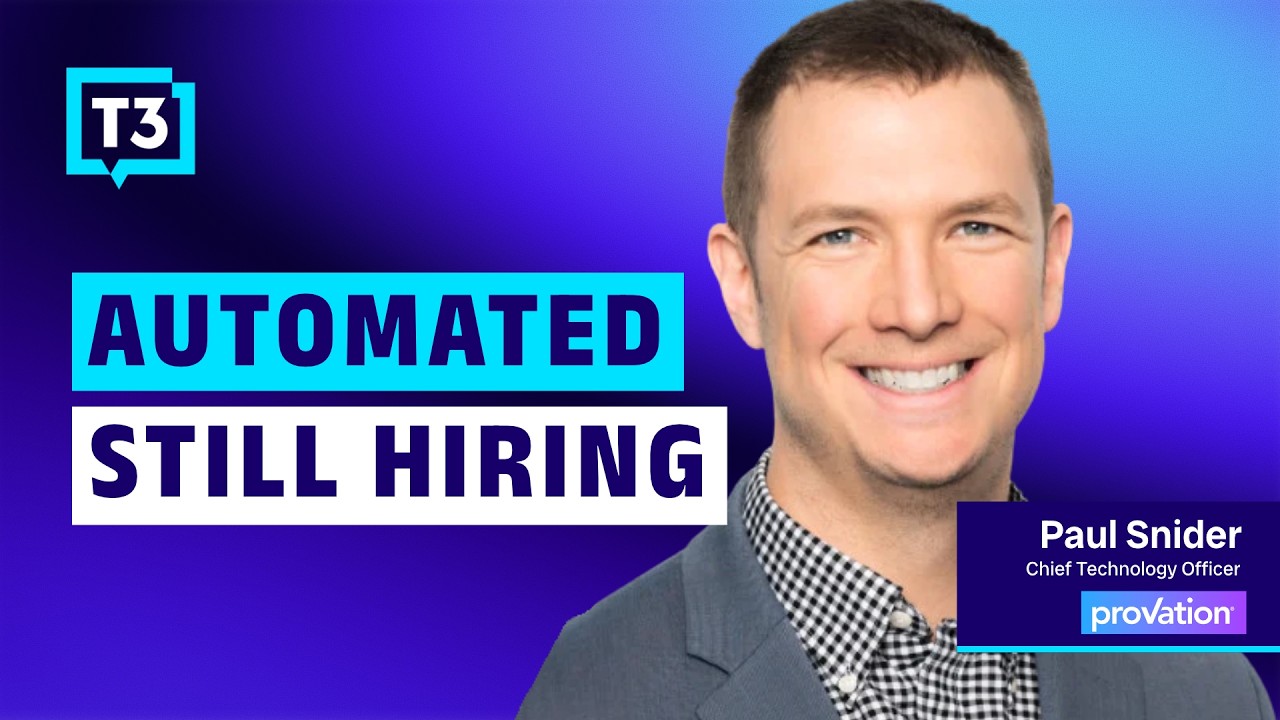
About this episode
Paul Snider is the CTO at Provation, a healthcare documentation company in about 3,000 hospitals serving roughly 50,000 clinicians. He walks through the software factory his team built this year. A Jira ticket goes in, agents handle requirements, design, code, QA and security, and a pull request comes out with compliance evidence gathered at each step.
The pipeline is built on GitHub agentic workflows, with a shared collection of MCPs and skills underneath. Paul says his team started on internal tools, then pulled pieces into production, with autonomous vulnerability fixes as the first example. On the incident side, an Azure SRE agent investigates an outage and proposes a remediation before a human opens the ticket.
Paul explains where humans step in. Early on the factory just piled up PRs, and reviewing them was the bottleneck. Now it stops at the requirements stage when a ticket isn't buttoned up and sends it to a product manager. He also covers regulated-industry quality, the champion network and weekly AI wins bulletin, and how OpenTelemetry cut the cost of the AI pipeline by about 90% before they turned it back on after GitHub's move to consumption billing.
Josh and Paul also talk about the change curve for skeptical engineers, expectation inflation around running seven agents 24/7, and Provation's team growth. The Bangalore office went from 9 to 50 associates in nine months, and Paul calls the factory a lever for growth.
- Why Provation stops its AI pipeline at the requirements stage and sends the ticket to a product manager, so bad specs don't pile up as PRs
- How a Jira ticket becomes a pull request through requirement, design, code, QA and security agents running 24/7
- How an Azure SRE agent investigates an incident and proposes a fix before a human opens it, then hands off to GitHub agentic workflows
- How Provation cut AI pipeline cost by about 90% by instrumenting OpenTelemetry before GitHub's consumption-based billing started
- Why Paul treats the factory as a way to add engineers (9 to 50 in Bangalore in nine months) and not a way to cut headcount
- How the factory produces test matrices and evidence trails at each step for a regulated healthcare release
- How a champion network and a weekly AI wins bulletin spread adoption into finance, sales and customer success
This absolutely would not be possible without the colleague and associate base that we have now, and it's a lever to help us grow.
Paul SniderChief Technology OfficerProvation
Transcript
Paul Snider 00:00
If I start with a Jira ticket, how can I take a Jira ticket and pass it through those sets of agents that we'd already been working on to produce a PR? We were able to do that. That stuff would just work 24/7. Everyone likes to cook, but no one likes doing the dishes. So, how can we get AI to do the dishes? It can't be just something that someone write codes in their basement that we can go take to production cuz the demo looked good, right?
Based on the level of complexity, based on the level of checks, let's just stop it in the process of the requirement side and say, "Hey, this isn't buttoned up." Goes and that to a product manager and at that point, they'll be able to review that, remediate it, and then get it going through the factory again. This absolutely would not be possible without the colleague and associate base that we have now, and it's a lever to help us grow.
Josh Anderson 00:58
Welcome to Tech Teams Today, where we talk with the people building and leading the engineering works behind today's most innovative companies. Our guest today is Paul Snider, CTO at Provation. His team's built products handling clinical documentation in about 3,000 hospitals for roughly 50,000 clinicians. This was the year of the software factory for Paul and his team. He shares the story of how a Jira ticket goes in, agents handle requirements, design, code, QA, and security. A pull request comes out with a compliance evidence already gathered at every step. Here's the best part. They automated the pipeline and grew their team at the same time.
Yes, you can do both. Paul, welcome to the show. Very excited to have you. We are going to jump right in. And as you know, our podcast is Tech Teams Today. So, the first thing our viewers and
Paul Snider 01:45
Listeners need to know is what does your tech team look like today? Yeah, thank you. I appreciate the invite, Josh, and excited to talk to you and all of Tech Teams Today. My team, I work at Provation. We are in medical IT and we represent a very thin broad slice of healthcare documentation. We're in about three 3,000 hospitals. We serve about 50,000 conditions specifically in clinical documentation. And my team comprises, I'm Paul Snider and the CTO and my team comprises of an engineering community as well [snorts] as DevOps. And we're located throughout the throughout the United States as well as internationally with a big presence.
We just spun up a new office in Bangalore, India. We grew from just about nine associates to 50 associates just in the past nine months. So a lot of a lot of growth there as well as continuing to grow our team here stateside.
Josh Anderson 02:51
Nice. So that's that's some exciting growth. So let's talk about execution with all those folks and AI, we know AI dominates everything. There's the traditional approach of AI doing the code generation, but I know that you have some some talks coming up. We're going to talk about there's a lot more beyond that and can can you share with everybody what that means to you and your and your
Paul Snider 03:15
Teams? Yeah, we talk a lot about AI enablement and how we can provide the set of tools, resources, platforms available to our colleague and associate base from an AI enablement perspective. I think there's kind of a maturity model and growth model to how you think about AI and how you outfit entire teams and organizations with AI. You know, I think you start with what are those approved tools? What are those what are those things look like? You know, I think the audience share a lot around cloud code, code X, GitHub. A lot of There's a lot of AI tooling, right?
But I think it's up to the organization to figure out what those are. We use GitHub Copilot a lot. And then I can dive into the specifics there, but there's a talk coming up at GitHub Universe that I'm really excited about, and that's actually talking about AI factories where you take that, you know, approved AI tool and kind of put it on steroids to really think through your entire SDLC. But it starts with tools. I think the next thing as we think about maturity goes into integrated workflows.
and what that means is how can you have AI paired alongside of your colleagues, your associate base, your population into the tools and data universes that you use today. So, that could be connecting into Jira, that could be connecting into Confluence, it could be connecting into those ticketing systems, right? So, you have your approved tool and you start getting those tools connected, securely connected into those appropriate knowledge universes. And all of a sudden you can start answering a lot of questions. What that means is I can take a Jira ticket and you say, "Hey, who's who's familiar with this?"
Or there's a new project with specific sets of terminology that you can get answers from based on the those tools. and the next thing we spend a lot of time is really our harness. What I mean here is it's shared context across your approved AI tools. So, this is where your NCPs live. This is You know, a really good example of a skill would be PowerPoints that you need to create with your a specific brands, your skill sets, right?
and it's pretty night in a shared repository that all of your associates and all of your employee population has access to, so you can kind of standardize your workflow, your processes. and the next thing is really building agents, right? So, that's where there's been a lot of I think, you know, 2026 has been the year of agents. But how do you standardize that and create those sets of agents that everyone has access to on, you know, software development?
Those are things like how do you get your requirements done, how do you get your testing done, obviously implementation, obviously design, but really defining those agents and, again, putting that back into your harness. And I think the the other thing I like to think about is how you orchestrate all [snorts] of these different agents that people are creating to, you know, perform a workflow, especially if you think about, you know, what we do in in software development is: starting at a point of requirements all the way to/CICD and deploying that code and validating that code.
What are those sets of steps and then how do you orchestrate it across those agents? And then the last thing is really where the GitHub Universe talk is going to feature, which is how do you do some of those things autonomously, where you can orchestrate an entire workflow into end to accomplish a set of tasks within your AISDLC without obviously having points in time where you have human in the loops to review specific criteria, maybe a set of complexity; but that's really how I kind of think about AI in general as it grows and matures and really starts to embrace it across the organization.
It's not It's not like a code completion tool or writing tool anymore. You can really think about it in a period of scale of autonomous execution of your SDLC. Something we talk about a lot here is we want especially in health care, we always want our physicians, our clinicians to work at the top of their health care license. They've spent a lot of time and energy at school. We want them to spend, you know, we want them to spend their time with patients.
And I think you can take that same mindset and apply that to your engineers, your product managers, quality assurance of: how do you get how do you get your colleagues to really work at the point, at the top of that license? And that's by removing toil, extra steps and we we. we we say a lot like, everyone likes, likes to to cook, but no one likes doing the dishes. So how can we get AI to do the dishes?
Josh Anderson 08:06
Yeah, exactly. So software factory is something that's been the concept has been around in the industry for a while and it feels as if it's a reality in 2026. How did that evolve for you? Was it hey, we're going to dip our toe here and here and here and oh look, we can connect these dots or was it an all at once of I think we can make this happen. Let's just go try it. What did that look like for folks that are chasing exactly what you've already built? Yeah, I think
Paul Snider 08:35
It's a lot of safe experiments of where you can experiment safely but then you also have to create with the end in mind of how you're going to get these things running in production. So this all started with a question back in February had to one of our cloud partners there was this product at the time called OpenClaw which was you know kind of sold as this opportunity of an entire and complete software factory. However, you know, it's it's not enterprise grade. It's not something that can be used in enterprises but I started asking you know cloud providers how are we thinking about this?
This is definitely a signal in the market that we can start using to actually think through this. And out of all the folks I reached out to, GitHub actually had an answer with what they call GitHub agentic workflows. And the beautiful things about this is they went from a security first approach, and it's using a lot of the familiar tools within GitHub that we are already we were already using. So, using things for GitHub actions where you can run things on a schedule or you running tasks and and basically events within within GitHub.
And as we learned about about GitHub agentic workflows, we went all in in terms of like how could we automate, you know, the entire process. And we really took that parness that I referenced so that's your set of shared MCPs, set of skills, where all of your shared process lives and we lifted that up into GitHub agentic workflows and just said, "All right, if I start with a Jira ticket, how can I take a Jira ticket and pass it
Josh Anderson 10:15
Through those sets of agents that we'd already been working on to produce, you know, produce a PR?" And we we were able to do that. We're actually able to do that where you could take our our product folks and take a meeting just like this, record it, diff it against our our stack and create a set of Jira's where it could then pick it up and work on those things autonomously. But again, this was kind of a safe environment. We were doing this a lot of internal tools, which if you think about, you know, especially in healthcare, there's heavily regulated. I I tell a story.
I was lucky enough I have I have three beautiful kiddos. They were all born in software that my teams helped create, and there's nothing that, you know, connects my work back to holding your child in your arms and connected in the systems that you built. But if you think about, you know, the the the duty and the stewardship there, again getting back to where we started, like let's go take care of some internal use cases and some internal automation. So, the the the software we're creating were really internal
Paul Snider 11:23
Tools at that point using GitHub agentic workflows to orchestrate those results. And then we're peeling back various parts that work in our production stack. An example for that is vulnerability management. So, you know, we, as [clears throat] we as vulnerability stands, we identify particular gap, we'll go put that in the factory, and then we'll go, we'll go solve that autonomously is one of the things we've pulled out of kind of the internal AI as DLC pipeline and lifted up into how our AI as DLC works within our production infrastructure. So, you mentioned early on that you have both traditional software engineers and DevOps.
I'm assuming it was a lot of collaboration between those two groups to put this into
Josh Anderson 12:12
Reality and have it become a thing that you use it on a daily basis. Is that correct? Yeah.
Paul Snider 12:17
We actually have two different stories there, too. If you think about what we're doing from a pure AI as DLC perspective of of the example of let's take a particular feature, let's take a particular bug, and automate it end to end. If you think upstream for that you know, your incident management or management of your infrastructure, we actually used Azure SRE agent to to complete those things. So, up front we have autonomous execution, autonomous investigation happening that will basically as soon as you open that incident in front of your face and say, "Hey, here's the investigation I found. Here's the remediation path."
And then once we're there, we can then pass that off to GitHub agentic workflows to actually go, you know, take it through the final mile. And that's been a lot of collaboration through both of my teams. I'd say on the DevOps side they've been really focused in on this Azure SRE agent. And then on the engineering side we've been using a lot of this GitHub agentic workflows, and the two are really married together. But the beautiful thing is again that harness that I've referenced a couple times now, you can go take those definitions and put them between these different platforms. Got you. So,
Josh Anderson 13:34
Human in the loop is, you know, it's become part of the vernacular in our space now. And you mentioned being in health care, everything that goes along with that. Where exactly are you inserting humans in the loop and or or is it that the system raises, wherever it is along the pipeline, it's like, "Hey, we need a human because of X, Y, and Z." What does that look like? Yeah,
Paul Snider 13:58
And we're continuing to mature that. I'll give you a couple a couple stories. So, we first turn first first turned on the GitHub agentic workflows. Basically, what happened was you're just piling up a bunch of PRs. So, the way that it would work would be you'd have a requirements analyst go look at the specific ticket. It would pass it off to a design analyst. It would pass it off to implementation. It would pass it off to QA. It passed it off to security. Eventually, you code it. You have a set of views, and then you did up with a PR, right?
That stuff would just work 24/7. And then, across the industry, you're always saying like, you know, one of the hardest things to do is to review that PR. What we're working on now is to say, "Hey, based on the level of complexity, based on the level of checks, let's just stop it in the process at the requirements side and say, 'Hey, this isn't buttoned up.'" Go send that to a product manager. And then, at that point, they'll be able to review that, remediate it, and then get it going through the factory again.
So, really looking at the point of time where that thing is in the SDLC, making sure you have the appropriate date, the appropriate check, the appropriate evidence, and
Josh Anderson 15:02
Escalating it as needed to the appropriate human being. How does health care make this harder? It's already hard, but I know, having been in health care myself, that just there's additional hoops or hurdles that you're having to jump through. How does this change the way you approach this
Paul Snider 15:18
Problem? Yeah, again, like I think you have to think of health care like, like I referenced before is it's going to impact, you know, yourself, it's going to impact your family, it's going to impact your community. And that is just a, a responsibility outside of all of the regulations that you have to take to heart. And quality is, you know, first and foremost of our mindset. it, this, you know, it can't be just something that someone byte codes in their basement that we can go take to production cuz it, the demo looked good, right?
but from a health care perspective, you have to think, you know, ultimately we are what we're responsible for. And then, you know, secondarily to that there's a ton of regulations that we have to meet, things that we have to attest to. and as part of that, we have tons of process that we documented and we're accountable for. pre and post AI, AI adds another flavor to that. Cuz you think about, you know, the evidence required for specific release or specific quality checks or marks AI can help augment our humans on that as well, right?
So, as part of that process that we've lifted up and that we've done autonomously that evidence gathering you know, the tests are there, test matrix are there, requirements are there; all of those things can fall within our process that we've, you know, we already, we've already had and help augment our engineers. So, the factory's producing that evidence at each one of those steps. Yeah [snorts], I think that operational rigor that is required to stand up
Josh Anderson 16:49
Something up like that, people often overlook the benefits that are created because it, it, like, it, every time it happens. So, you don't ever get to an audit and start scratching your head like, oh, no, I hope somebody did the thing they're supposed to do. It just does it every time. And, and that's a benefit that I think people start to discover as they lean in here more.
Paul Snider 17:12
And it's good to hear that that's happening for you guys as well. Yeah, and, you know, it's not only just the producing of evidence, it's the reviewing of the evidence, it's you know, we're able to add, you know, additional gates in the process we haven't had historically because you know, just the amount of human beings it takes to get that done. So you know, I think again, I can't I will completely highlight quality is the first and and utmost importance here and AI's been able to come in and adjust within our processes and then help review
Josh Anderson 17:47
How we get work done. One of the things that I think is or should be seen as encouraging by many people as everything you've talked about how you've automated the entire life cycle and in many places that would that would be perceived as oh no, jobs are going away. But you just talked about we how you grew, you added 60 people I think was the number in the past yearish that that those are usually messages that people don't expect to like cross the same place,
Paul Snider 18:17
But you're evidence that you could automate and grow, right? Absolutely. I I I think yes, and it goes to the first point of like automating away toil. I think everyone in tech there's there's, you have a higher backlog than you have human beings to execute those. And part of the promise of AI is to get that backlog done. But that, you know, there's especially a company like ours that have the ambitions that we do and the reach that we do; we're using this as a vehicle for growth.
It's one of that toil and the you know, the the other thing is if you look at where we are in the industry, we have you know, companies that we compete with that's you know, 50s 100 x times bigger than us. Now give us you know, as we think about these factors, it gives us an opportunity to compete at some of those same levels. That's how we're we're doing that. I I the other the other thing I'd like to say too is like you can you could say all right, well maybe the works done away. We don't need as many humans.
but my competitors, if they don't take that same that same approach, then we're going to be left in the dust as well. So this absolutely would not be possible without the the the colleague and associate base that we have now and it's a lever to help us grow and we're going to pull that lever with, you know, the amount of the team team that we have.
Josh Anderson 19:41
Yeah, those are the companies that I see that are really taking this as this is a shot in the arm or a boost to where, okay, so now there's things we maybe wanted to do but never could do and now we're empowered and emboldened to do that. I just talked to somebody that they had a a massive consumer-facing website that was riddled with tech debt over a decade and for years it had been, "Yeah, it's going to take us, you know, multiple person years to make that go away."
But with AI and the factory that they've built, they were able to tackle that in just a few months. So, as you look around to the never-ending list of things that you would you and your company would like to do, are there things that historically felt too big that now feel attainable?
Paul Snider 20:29
Yeah, and I think your tech debt one's a really good one because if you think about tech debt, it's something that you know, we're accountable for as engineering leaders. But you know, it's probably a hard sell to your business folks of what you're going to the business value that you're you're going to gain from that tech debt, right? There's there's there's there's the obvious ones. but by, you know, streaking the time of that tech debt, what that's what's allowing you to do is make decisions on that backlog of features, capabilities that you haven't been able to do do previously.
if I look specifically at Provation and what we've really accomplished just this year in the past you know 9 months, we've gone internationally. We've launched into new specialties. We have AI intra-procedure AI where our physicians can communicate directly as they're doing a procedure where documentation is complete when they're when they're done with the procedure. and I think it's been very empowering. We've been able to focus on that and really deliver innovation at the pace and scale that we we haven't been able to see before. That said, we're we're going to keep growing. We're going to keep focusing on that.
But AI has really allowed us those examples that that you referenced I think are good ones and we're seeing that too with kind of our tech debt posture. Specifically the other thing about tech debt is it's generally fairly scoped, easily defined. And because of those things there's patterns that AI can pick up and really help accelerate those things so you can kind of shrink you know your tech debt backlog and focus on some of those product capabilities
Josh Anderson 22:10
That I referenced. Yeah, that's where I see a lot of those are known knowns. It's just like that is going to be a slog to go through and do that. But AI really lightens the load there where you're like okay yeah, we can send some agents off on that and go make that happen. So I do want to roll back something that you talked about and trying to bring it into where you're trying to enable everybody to work at the top of their skill base.
So one of the features that you talked about removes the amount of work that surgeons have to do to document what happened. It's kind of documenting as it goes and I think that's one of those things where you're enabling people again
Paul Snider 22:50
To stay at that top level. Did I hear that right? Yeah, exactly. And we think about that with our customers as well as our our associate basis. How do you how do you really remove the toil? Let AI take care of those things so that, you know, from an engineering perspective, we're focused on innovation, we're focused on delivering business value to our customers. And our customers, same thing.
How, you know, how is our physicians, how is our care teams focused in on the patients, focused in on those value creation items where they're working at the top of their license and not, not burdened by, you know, some of the day-to-day that, you know, software and specific, you know, systems can can, can create for them? So, how do you how do you make that easier? It's that that is questions and things that we are lightning focused on, and you know, both to enable those capabilities from an AI perspective
Josh Anderson 23:42
Internally as well as externally. So, I've been in the industry for a long time and I may have worked with a couple engineers that, you know, we'll say they've been skeptical about new tech. Did you have any of that within your organization? Like, Paul, listen, I hear you, buddy, but this is this is never going to happen. And then, what was the transition from them saying like, oh,
Paul Snider 24:04
Maybe I was wrong. What did that look like? Yeah I we encounter that a lot and it's been ongoing. I don't hear as much anymore and maybe that's cuz you're inundated with the news every single day. but we try to find aha moments. Like, where can you remove the toil? you know, like, where can you go automate a TPS report? Or where can you go automate time logging? Where is there things that can you really help? And you know, we talk about you know tech debt and what that takes.
A lot of times you get the code and the engineering part of that done and the design done, but the hard part is like, maybe that legacy system didn't have a ton of tests. Well, AI can help with that, too. And like, I think a lot of times we'll all, you know, we might automate one part of the process, but then the bottleneck moves down the SDLC to, you know, say test case automation. But AI I help with those things and and generally those are some of the some of the items that, you know, is is is distracting from the the innovation side.
The SRE agent that I referenced as well, those is like that's like one of the number one distractions in our industry. Your phone rings, your page is doing an incident, right? You're stopping everything you're doing to focus to go get to go resolve that particular incident. You bring AI in the picture, it can really collapse those turnaround times and make those, you know, make those engagements a lot less impactful. So again, you're not distracted, you're focused in on what you're, you know, what what you're assigned for that particular iteration.
You know, those are the things that we're really trying to to help our our engineers and our associates with. I talked to you a lot of folks in similar roles and they are not only trying to figure out how to
Josh Anderson 25:53
Leverage AI effectively in their organization, but the greater organization has said, "Hey, you're the tech people. How do we do AI across the board?" Has that fallen in your lap or do you have a partner that you're working with to enable that? What does it look like for you guys? Yeah,
Paul Snider 26:08
We we have an entire AI enablement office that's not specific technology or DevOps. It's across the entire organization. And what we're trying to do there is create flywheels, right? So you have your typical AI office hours, you have your typical education events, but it's really making sure you can demonstrate the value of where AI can do and for folks to have some of these successes within their own organizations. We also have like a news bulletin that goes out every single week and one of the parts of the news bulletin is specifically wins with AI.
So, you know, within our customer success group, various automations that they've created they've been able to connect various systems together with our information to give you know customer telemetry, customer sentiment product telemetry together have holistic pictures on to help you know help our customers that you know engineering didn't necessarily have to spend time on. Well, we we you know we have a champion network within our AI enabled in organization as well.
So, you know folks within finance, within customer success, within sales are kind of outsetted with the the latest and greatest AI the latest technology as well as education that can go help within those organizations to kind of create that flywheel and then bring you know the really hard problems back.
Josh Anderson 27:31
Being a tech leader at the scale that you're operating in has always been hard. It's become more challenging with the pace of change that is happening and keeping up feels for many people like an impossible mission. How are you leading across the board and helping
Paul Snider 27:52
Your engineers feel like we got this, we're okay, we're covered? How's that working out? Yeah. Great question. I think and you hit on it in terms I think an engineering leader and engineering management has a lot of responsibilities. It's you know generally you grew up as a you know it's in the technical world. you're asked to then manage human beings which is a skill that you have to go learn just like you spent full of time learning technology. generally you have to know your business domain and your product also.
you'll you'll have best friends that your product manage product management with but you have to navigate those things as well as you know as well as the business. so now we're in this age of you know AI's moving so quick. You know I think the more time that you're focused on things that is not technology, but you know, leadership or business or product we as leaders lose that technical acumen just by default because you have to wear all these hats.
things that I encourage my teams and my leaders and my executives to really focus in on is continuous learning and, you know, and also enabling your organization to go take on some of those things as well, to create a culture of continuous learning, a culture of sharing across the organization of where some of those wins are. but, you know, podcasts like this and other forums are a way of mechanism I do personally so I can continue to consume the latest and greatest technology
Josh Anderson 29:32
As it as it comes. Yeah, I think some of the things that people might overlook that make a difference. On that newsletter that you talked about, let let let let's highlight the wins that we have across the board. Just shining a light on things like that sometimes just goes so far and there's so many people that are looking to do this like big massive thing when in reality, if you just do a bunch of little things like that, you'd be amazed at the difference that it makes. So, kudos to you and your team for thinking about that.
One of the one of the challenges that our space has is expectation inflation. So, with AI and the hype, there's inflation happening from all directions, both from we think above the board, other executives, or competitors, but also internally. And I see a lot of technology leaders and team members that are creating inflation when maybe they they don't need to. Do you have any members of your team that like I've heard folks that have people come to them as like, "I feel like if I don't have seven agents running 24/7, I'm falling behind." Right? Have you had had any of those those challenges
Paul Snider 30:43
Where where where it feels impossible to keep up, but you've had to coach people through it? Yeah, I see it but you know what? I don't know that that's specific to this era that we're in. think back through web, think back through Agile, think back through cloud, think back through DevOps, right? We've had these eras in technology with similar I'm going to say promises and big changes that, you know, we materially had to go through. I think how I think about this, this is, you know, this is those things on steroids for sure.
But at the end of the day, it's still a change curve, right? And how do you manage from the point of, you know, this is this new thing and like, oh no, I'm not sure I'm not sure about this and and bring folks as quickly as you can through that through the change curve. And we've hit on a lot of those things in terms of celebrating the wins, eliminating the toil. those those are the items you really have to lean in on as you're thinking about, you know, how how you're approaching this within an organization.
Is that you know, fundamentals, what can we learn from in the past,
Josh Anderson 31:50
What are some of those approaches, and I think a lot of it is just change curve management. Yeah,
Paul Snider 31:56
I agree on the change curve and one of the things I've always tried to do is build teams that can
Josh Anderson 32:02
Accelerate through that change. Everybody's going to go through the change, but how do I build teams that can like burst through that? And and there's still the curve, right? There's still like, oh this is horrible, oh I hate this, and then like, oh this is amazing, right? But how do you build and shape groups of people that can whip through that? And and and and you don't want the whiplash, right? But they can get get through it, but that's the that's the to me, you know, you did a really good job of saying I've been through this before. This isn't the first time.
And you're right, it's a little bit faster, but still the fundamentals of building teams that can be both responsive and resilient remains important as as ever, potentially more,
Paul Snider 32:46
Right? Yeah, and you know, I reference like our AI champion network. Those are your early adopters in your typical change curve. But, you know, give them the space to experiment, run fast, share the rest of the group, right? And those are the folks you can lean on within your organization as this starts to grow and scale, as you have new employees looking to say, "Hey, you know, there's six agents running here. How do I How do I get that same level?" Those are the folks you can lean on and start making it safe, right? It's It's a lot of a culture of safety.
and then the other thing is, you know, we a lot of instrumentation in terms of adoption, cost, management of of those things to help you know, help our associate base understand you know, usage, analytics, where there opportunities, those type of things too. Which again is another fundamental thing that we're all familiar with. Have you had any token surprises? I
Josh Anderson 33:46
I I talked to a leader and she mentioned that they were using Open AI and they made a change to default to the newest model. And so it overwrote the defaults everybody had. So now everybody was using the most expensive model. They didn't catch it until the end of the month when the spend was
Paul Snider 34:04
Through the roof. So have you had any gotchas like that? Have you been able to avoid we're a big GitHub Copilot shop and they recently switched I think it was June they switched from seat-based licensing to consumption-based licensing. And I mean they did a really good job of, you know, of saying, "Hey, this is the switch." But the AI pipeline is actually part of my universe talk. We We turned it off June cuz we did not we weren't sure what what the cost was going to be, right? but again, I think if you if you think about cloud and DevOps and FinOps, same approach.
We instrumented open telemetry and we took we reduced the cost of that thing we when we turned it back on we had this thing optimized and actually if we would have had it running and we we saved about 90%of the cost just by looking at tunes, understanding the model, looking at the turns, looking at the output.
but it's all that telemetry that's extremely important that you know, whenever it was a all you could eat we weren't necessarily looking at that from the from the get-go, but you know, I think as part of you know, as part of any systems architecture telemetry monitoring gates alerts, all of those things apply again to to AI. It's no it's no different than you know, what we've what we've done and what we're
Josh Anderson 35:27
Used to with with cloud and an actual large database versus a small database, right? Yeah. I remember those sizing spreadsheets for AWS and trying to get Yeah. Gosh, that was way you felt way harder than it should have been. I'm sure you can ask any agent now and get all the answers you would need and problem solved. So, okay. Well, we've tackled the easy stuff. We're going to get to what I call the leadership read me. So, this is a handful of questions that you have no idea they're coming at you, but don't worry they aren't that scary.
the first one and I believe most important and unfortunately I've been on the wrong side of this about 80%of the time. There's a animated image format widely used across the web that is. gif. It's pronounced
Paul Snider 36:15
A couple of different ways. Which way do you pronounce it? Gif. Dang on it.
Josh Anderson 36:24
I am apparently what over I I you know, it's about 80% people are on the hard G side and I'm one of those like soft G rebels out here, but yeah, okay. Well, such is life. I tally that out. Yep, it's okay. It's I'm I'm getting data, right? So, I'm just learning that I'm wrong again and again and again. okay, so let's let's talk about leadership and some nugget that you've carried with you.
What's the best piece of content, be it a book or a podcast or a quote or something that you keep coming back to that lifts you up when things get hard or maybe you use in coaching as you're growing leaders. Is there anything out there like that? Yeah, and I think it my advice probably differs depending on the person I'm talking to, but I like to tell a lot of new associates and new hires or new folks to the company. there's a quote out there 10 things that require zero talent Mhm.
that I will often refer to and that's that you showing up on time, you have passion, right? Just the the aspects that you can bring on to any task, any team, any objective that you can just show up prepared
Paul Snider 37:49
Can take you so far that not just within technology, but it within any life skill. those are the things I really like to remind folks of. those you know, on intangible items that you can you can bring every day and it's the the 10 things that require zero talent. I can't name all 10 off the top of my head. If I've seen the list. I know exactly what you're talking about and it is a surprisingly simple list of things, but also surprisingly rare that people do all 10 of those things. Yeah. Agreed. Okay.
let's roll the clock way back to the first product you ever shipped. If it was you personally or you as a member of a team. So, do you remember the technologies that that was built on? Yes, I do. It was Visual Basic 6. Nice. I was a VB6 person as well. SQL Server 6. 5. Then we did an upgrade to SQL 7 and it was very exciting. did you also have to operate with Visual SourceSafe? we had our own proprietary source code mechanism that we built from from ground up. Okay.
I I think Visual SourceSafe caused many people to go down that path because it was an absolute
Josh Anderson 39:18
Bear. it was it was painful. But it But it was better than nothing, I think. At least that's what my boss told me. So, I kind of rolled with it. got you. Okay. So, last thing is operating system
Paul Snider 39:30
Of choice. Mac, Windows, Linux, or something else? All right. So, this is a I have a bit
Josh Anderson 39:35
Of a story here. -oh. Here we go. a So, I since I started my career back on, you know, Visual Basic 6, I made it through all of those eras we referenced with a Windows device. And it was generally a large enterprise corporation where you know, things would just work. that that that enterprise would push out. And then with AI, I recently made the switch a year and a half
Paul Snider 40:03
Ago to a Mac. So, I'm now I'm now operating both of those. But historically, majority of my career
Josh Anderson 40:09
I've been I've been a Windows guy. Do you have a personal preference or or or is it just Windows
Paul Snider 40:13
Carried you and now there's this new Mac thing going on and you're trying to figure out do I
Josh Anderson 40:17
Like it more or like what's going on there? I'm still frustrated I don't know the like keyboard shortcuts or what's going on and so then it feels like it is hindering my productivity. Yes. I I've been through that. My my switch came when I started leading a mobile shop and because we ship mobile apps we had to work on Macs to get the iOS code to work and so that that forced me into that shift and I went through all of that, right?
I grew up in the Windows world as well and that was it's a challenge but yeah, what I I've I've made the switch. So My my final straw with Windows is like the you know, just getting CLI utilities set up. I think everything works natively now with all the AI vendors but like CLI utilities on Windows were painful last year though I don't think they are anymore but it just that stuff just worked in well Macs like if you're setting up you know, code CLI and cloud CLI and Yep. Yep. Well, it's good. Progress. Progress. Okay. Paul, you've
Paul Snider 41:16
Done you've answered all the hard questions. Now probably the most important question, how do folks stay in touch with you or get in touch with you and certainly share some more about the talk you're giving? Yeah, awesome. If you look at GitHub universe that end of October. I'll be on the day two session with AI factories with a leader within GitHub as well as another industry leader.
We're going to really tell our AI factory story that I was sharing just a little couple nuggets about and if you want to follow me and big on LinkedIn it's probably where I spend where I have my biggest social presence. I don't really use anything else other than LinkedIn so by all means you can follow me there, message me. Always looking to connect and engage with
Josh Anderson 42:03
The community. I could do well. Make sure all those links are in the description. So Paul,
Paul Snider 42:07
Thanks so much for joining us. Been a a pleasure learning about everything you got going on.
Josh Anderson 42:11
I appreciate it, Josh. Thank you. That was Paul Snider, CTO at Provation. Tech Talks Today is brought to you by Revelo. If you're looking to build out your engineering team with world-class, vetted talent from Latin America, that's time zone aligned and ready to ship, check us out at revelo. com. I'm Josh Anderson. Thanks for being here, and I'll see you next time.
More episodes
Leading an engineering team? Come tell us what you’ve learned.
If you lead an engineering or talent team and have lessons that only come from doing the work, we want to hear them. Josh hosts a relaxed 45-minute conversation about the decisions that shaped your team. Here is what you get:
- 01A real conversation, not a scripted Q&A.
- 02A produced episode page with video, transcript, and your profile, plus short clips cut for LinkedIn.
- 03An audience of engineering leaders working through the same problems you are.