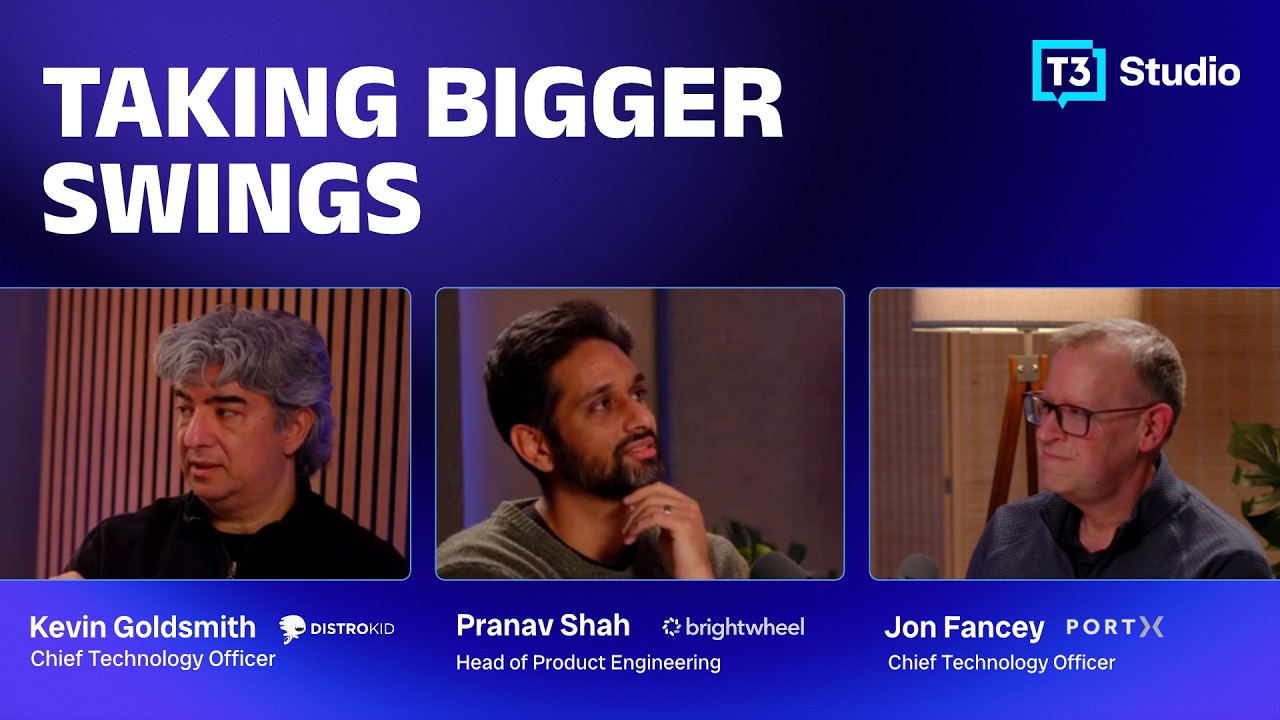
About this episode
Josh Anderson talks with three engineering leaders, each running teams of 60 to 70 people: Pranav Shah of Brightwheel, Kevin Goldsmith of DistroKid, and Jon Fancey of PortX. The conversation starts with hiring. Pranav says Brightwheel stopped hiring dedicated mobile developers and now looks for software engineers who own a problem end to end across backend, front end, and mobile. Kevin repeats a line he heard: engineers used to be T-shaped, and now they're deep in one area and agentic everywhere else.
The middle of the episode covers quality and tooling cost. Jon argues there's less excuse for poor-quality software now. Kevin and Pranav describe agents working through bug and UX paper-cut backlogs, and Kevin explains how he's taking AI to finance and other non-technical teams, including the end-of-month close. The group also talks about token budgets. Kevin doubled his monthly spend and added 10% for growth, and he's looking at hybrid setups that route some work to open-weight models like Qwen or Llama.
On code review, Pranav describes a risk-based framework (modeled on an Anthropic article) where each team sets its own rules for what counts as low risk. Rule changes alone got almost 40% of PRs auto-approved. Kevin's team runs an agent review first, then splits big PRs so five developers each look at two or three files. They also cover product managers who build, shrinking PM-to-engineer ratios, and the security pressure from fraudsters and voice-cloned executives.
The last section covers career ladders and management. All three think the manager who only coordinates tasks is on its way out, and that impact-based levels will replace team-size levels. Each closes with a prediction: open-weight models, new interfaces where agents talk to agents, services that people assemble into personal apps, and AI paired with robotics.
- Why Brightwheel stopped hiring dedicated mobile developers and hires system thinkers instead
- Specialists now spend their time building skills so everyone else can handle the easy work in their area
- How agents work through backlogs of UX paper cuts that never got prioritized
- Brightwheel's risk-based rules that got almost 40% of PRs auto-approved
- DistroKid's agent review that splits big PRs so five developers each check two or three files
- Budgeting for tokens by doubling spend plus 10%, and routing some work to Qwen or Llama
- Why PM ratios are shrinking to about 5 or 6 engineers per PM and PMs need to be technical
Budgeting and proving ROI on token costs can be challenging.
Pranav Shah, Kevin Goldsmith, and Jon Fancey
Transcript
Pranav Shah 00:00
What you can get done in 3 months now is what you could have done a year before. And it's actually quite hard to adjust to that. Let's hire more software engineers, people who really think about the problem, really want to own the problem. We are thinking bigger. We are taking bigger swings just by adjusting the rules. We've seen almost 40% of PRs getting just purely auto approved because people are like, "Oh, this is fine."
Jon Fancey 00:25
I think there's a diminishing excuse for poor quality work. So, it's going to uplevel everything cuz thanks to agents, we're getting bigger and bigger PR reviews. You identify who's the right person to review just this part. You're asking like five developers to go look at like two or three files each.
Josh Anderson 00:42
What expectations are you going to have in a year for engineers on your team? What are they going to be responsible for? Welcome to Tech Teams today. on Josh Anderson and we have three illustrious guests today. We're going to start by learning who you are and what your team size is, the kind of work you do and then we'll jump into the into the meat of the discussion. So Pranav, we'll start with you.
Pranav Shah 01:10
Amazing. nice to be here. I'm Pranav. I lead the product engineering team at Brightwheel. For folks that might know not know about Brightwheel, Brightwheel is the early education space. we're a category leader. We serve millions of parents, teachers school operation, school run their operations every day. company's about 500 people. Out of that about 65 people are on the engineering team. we're growing a ton. So I don't know if you're interested, please come join us. Yes.
Josh Anderson 01:42
Cool. All right. Good deal. Kevin.
Kevin Goldsmith 01:44
My name is Kevin Goldsmith. I'm the chief technology officer at DistroKid. We're a music digital music distribution company. So we work with artists and get their music on Spotify and Apple and all those places. And we distribute about half the music on the internet. and my team is about I represent all technology. It's about 60 something people as well.
Josh Anderson 02:06
Nice. I like her.
Jon Fancey 02:08
And yeah, I'm Jon Fancey. So I'm u from a company called PortX. I'm the CTO there. and we service banks, credit unions, and other fintexs to kind of connect together.
Josh Anderson 02:21
Perfect. All right, Pranav, back to you. We're going to start the tough questions now. So, you mentioned you're growing. You have about 65ish people. You're targeting to grow around 25%. You also are pretty heavy in mobile, but you've stopped hiring like explicit mobile developers. So, what's changed? And when you think about hiring, what's different about what you look for now versus 2ish years ago?
Pranav Shah 02:46
I think you're kind of seeing a trend in an industry. I think you're starting to see a trend towards people who think as product thinkers who are system thinkers and I think AI has kind of generally changed the game in terms of how you can contribute across different code bases, across different services.
I think I think we've all moved up in abstraction and so way the way we're sort of approaching hiring has been to focus on that is hire more software engineers you know people who really think about the problem really want to own the problem can navigate the ambiguity and really want to kind of own it to end and deliver it. we've hired quite a few people more recently. We're seeing it work. We're seeing people sort of come in contribute to our backend systems to our front-end systems to our mobile applications and being really really successful at doing it in parallel as well.
So it's pretty cool. it's an exciting time I think. I think with the technology chains it's an exciting time.
Josh Anderson 03:45
So a more traditional well traditional is probably the wrong word in 2026 but full stack systems thinker is that kind of how you would phrase it?
Pranav Shah 03:54
Exactly. Okay. Yeah. But I think I think you also have to really value product thinking or problem solving. I think you know I I think the the bar is moving up right like you have product managers sort of going towards thinking more of the business problems and so you need people who can come in and say hey here's problem own it end to end think about what sort of solution is going to be net needed for the customers and really kind of put themselves in those sort of product builder roles and kind of go and build them build it out for you
Josh Anderson 04:26
John you've been hiring as well have you shifted your thinking in a similar direction or like we're actually good the way we are.
Jon Fancey 04:33
I think there's a number of things. So we I've forgot to say we're about sort of just under 100 people. My team's about 70 or so of that. So most of it kind of product and engineering. I think things are changing pretty fundamentally and it's I actually think it's really exciting to see what's happening because what you're seeing is kind of this kind of emergence of this kind of product engineering role, right? with somebody who understands the business, understands the technology and understands how to get the business using the technology, right?
So the implementation so people who have the kind of the the mindset of just getting things done and now enabled to do it. You no longer have product people kind of boxed into waiting on engineering teams who have never big enough to get everything done to actually be able to contribute and do some of it themselves. So I agree with you like the lines are blurring a lot between these traditional roles where people just front end and back end and all these other things are just doesn't matter as much as it used to.
Some people still like to focus on that but they no longer waiting on a front-end engineer for the backend APIs or whatever it is. So it's it's changing pretty dramatically I'd say at this point.
Pranav Shah 05:35
I think I saw an article from Lenny's. I don't know if you you guys follow Lenny's jobs like there was an article yesterday that I saw that said mobile jobs are down by almost 50%. If you look at the sort of hiring trends web jobs are similarly down and so I I think the industry in general is starting to move towards this sort of like full stack
Kevin Goldsmith 05:55
Yeah system thinker role. Somebody I wish I'd thought of this quote. I didn't, but somebody I was talking to said, you know, we used we like to hire T-shaped people, so you're like deep in one area and but you can cover a lot of others. But he said, you know, now it's like, no, you're deep in one area, but you're agentic everywhere else. And and certainly for us, a lot of our specialists are now spending a lot of their time building skills so that everyone else can get the easy stuff in their areas done without them.
and then they can just focus on the the hard parts. That makes a lot of sense. Yeah,
Josh Anderson 06:31
I can dig on the like the T-shape still sticks around. You like fill in the gaps with agents. I like that. That's that's that's a good thing. Okay. All right, John. So, you talked about product engineering, product thinking. product's kind of hard, you know, it's and so asking people to be able to know what's good enough. That's a that's a hard skill for people to learn, but it's now a required skill, right? As we've all talked, as we've all mentioned, like that's that's the expectation. So, how are you thinking about helping people learn what's good enough when they're stepping into this new space?
Or maybe they've always had opinions and they're like, I finally get to make the call. Yeah, I don't know. I don't I'm not sure good enough is is enough on its own. I think I think there's a a diminishing excuse for poor quality work. So it's kind of might sound a
Jon Fancey 07:27
Little odd. So let me kind of explain that we've always shipped software and we've always been driven to dates and it's always sucked, right? Because there's always somebody who tells you you're running out of money or you're running out of time or you're running out of something, right? Or resources get reallocated. I think a lot of that again is like it's allowing more focus to get more things done more quickly of higher quality, right? And I think putting up with lowquality software, which has been traditionally the vast majority of software there's no need to put up at that level of experience anymore.
So, it's going to uplevel everything. I think I think you're seeing teams upleveling to the point you were making about people becoming multiddisciplinary in the way they're thinking about it. I actually think one role that's kind of making a bit of a comeback, I'm probably showing my age here a bit, is kind of business analysis, right? There used to be this business analyst role and then then there were kind of developers and they kind of worked together and then the product management kind of came along in the middle of that. But actually having deep domain expertise is super useful, right?
And yes, you can delegate some of that to Claude and everything else to do some of the research for you. But actually being able to be the synthesis of these different disciplines in one person is incredibly powerful.
So I think that in itself uplevels the quality of the team because your point is like you can build skills for the gaps for the other people in the team to plug those gaps and then as a team you can just move faster and more effectively because the gaps don't slow you down because you're not dependent on critical resources you know folks in the team of like tribal knowledge whatever it is across the organization that becomes much more easily sharable. One
Josh Anderson 08:51
Of the challenges is we could we could fix everything like I think OpenAI did something with Linux and they found 790ome bugs and technically those are all fixed now but that those have been around for who knows how long. So because we can fix everything that doesn't necessarily
Kevin Goldsmith 09:12
Mean we should or should we like where where do you guys stand on that? Well, I think I mean the the thing is that that those bugs may have existed for a long time, just nobody figured out how to exploit them. Now we have agents looking for ways to exploit these kinds of things. And so and and they're able to find much more obscure, much deeper kind of issues than humans have found in the past.
And so, yeah, I actually think if we can, we should be trying to fix all the things now just because while it, you know, while we could get away with security through obscurity or we could get away with, yeah, well, that only happens on the when it's the full moon on the third Thursday of a month that starts with the, you know, a J. that's no longer true. Now, we have lots of tools that can exploit that and and find it. So I think we actually do have a responsibility to be fixing all the things we can find.
Pranav Shah 10:06
I think you know you're definitely run teams are running like mito scans to find all the sort of vulnerabilities and fixing them. I think one of the more interesting things that you know when I used to be at square one of the things that we used to have is this massive backlog of just paper cuts UX changes like all these things just just made people's life easier and or made it made the experience better. and we'd never we'd almost never prioritized them earlier because there was just no time because there's so much other work to do.
It's so easy to just have agents running in the background to just take care of these smaller gaps, it just makes the customer experience better. Yeah. They're happier. everyone's happier. I think over time and and when you kind of start getting rid of some of these older cruffier areas as it's fixing it, the agents also make better decisions because now you're improving the codebase and so they have similar patterns to pick from and and sort of build off of topost. So I think in some ways you're kind of helping accelerate yourself as you're kind of going along.
That's that's kind of how I've been seeing it a little bit too.
Jon Fancey 11:07
Yeah, it's always been this kind of hard choice again, right? And now the choices aren't quite so hard because you can delegate to agents to fix the things that you're never going to get to anyway. I mean, anyone who looks at a backlog that stretches out near you more than a year, they know they're never going to get to the end of it because they keep adding things in the middle of it and kind of and prioritizing it. It's just these annoyances like you said, these paper cuts do matter in aggregate, right?
Actually, if you get a whole bunch of them knocked out that actually kind of improved materially the kind of customer experience or user experience, but you never get to it. There's always a frustration and there you can which in itself drives the quality up and you can focus on the you know what may be higher value better opportunity things that you want to work on and let the agents do the things the little things that you know don't matter on their own but
Josh Anderson 11:51
Matter together. Yeah. And so going back to what you said at the beginning around there's no excuse to not have a quality product now,
Pranav Shah 11:57
Right? Because also they found those 793 bugs, but also the hardest part about fixing a bug is like actually finding where it is and what the core issue is. Usually once you know that the fix is one line. Yeah. So so in theory those 790 plus
Josh Anderson 12:13
Bugs aren't that far away from being fixed. They're probably already fixed, right?
Pranav Shah 12:17
So that that's a that's a that's a game changer. There's this one thing that I like to do which is like every week I'll try to pick up like a bug on the side in between meetings and I'll just have it loop and I have like a validation loop that it will fix itself.
It'll verify itself and then it'll you know if there's sort of design questions it'll ask the designer hey do you agree with this and it makes it so easy like I I get a video after I'm done and I can literally go watch the video like did it work like does it look good? What was the before state? What was the after state? I can't I if someone had told me 10 years ago that'd be real that that'd be kind of crazy. So it's it's pretty impressive technology.
Josh Anderson 12:52
So Kevin, we're going to pivot to AI across the entire company. You know, many leaders in our space have had to figure out AI for their teams, but they also get tapped with, hey, you're the most technical leader in organization, so we need you to figure out how to do AI in finance and HR. And so that that's a whole the job's already hard and now it's harder. So talk about how you're going about attacking that massive problem.
Kevin Goldsmith 13:18
Yeah, it's it's it's tougher in engineering. We've been we've been on the forefront because it's been a problem that we've been trying to solve with AI for for a long time now relatively. there are products and tools that use AI that are available to some of the other functions, but that's not necessarily kind of what we're trying to do. We're trying to evolve the whole organization and and help them be more efficient.
So the challenge has been, you know, kind of having to go to each one of them, sit down with them, kind of talk through like what are your challenges and then for a lot of them because they're not in this space, they're not thinking about it the way we are, it's giving them the ideas of well what if we could do something like this or what if like you the end of month close like talk me through end of month close. Okay, like that's a that's every finance team's like most painful process.
All right, let's talk through like how could we automate these parts of it and oh no, you can't cuz it's governance and we have to be super careful. I'm like you're still in control. You're not letting it do everything, but you're taking all the busy work out of it and then you're just reviewing it at the end and making sure it's correct. And so with each each group, it's really kind of figuring out for them there's so much that's painful in all of their jobs and just trying to get them thinking about how do we do this?
And a big part of it I think was getting the exec team all using the tools on a more daily basis and getting them to start thinking like you start everything in cloud you start everything in chat GBT and it may not produce what you want but it may actually and if you're not sure how to use it efficiently you ask it hey I'm trying to solve this problem can you help me figure out how to solve it with you and that was a big thing once they kind of started to figure out how they could use the tools to be more efficient.
They started evangelizing it within their teams, but it's it's a little bit tough. They there's a lot of folks interested in it, but it's not it's hard to point to the examples as it is with engineering,
Josh Anderson 15:23
John. Who who owns AI across your organization? Is that you?
Jon Fancey 15:27
I don't really own it. I'd say I kind of try to lead it. everyone's using AI all the same reasons, various tools, but the tools kind of differ between different kind of groups.
And we we're primarily a tech company which why you know most of the company are the building the stuff not using the stuff but what what I've noticed and what I try to kind of create the spaces to discuss is kind of techniques like we're in the tips and tricks kind of phase with a lot of this stuff right things are moving too fast something that worked a couple weeks ago now somebody's figured out a better solution because what what I get in my team but everyone just runs out of tokens right like but that's typically less the case in teams that aren't kind of you know software engineering teams but you're right like you look at it as a software engineer and there's there's optimizations all over the place, right?
So teaching other parts of the organization the optimizations and and the pitfalls and everything else to get great results out of AI is really where, you know, we're at and what we're trying to do because it's an enormous, you know tool, you know, productivity tool and and and gain if you use it in the right way. But then people seem to think they can seed like this this whole sort of sort of cognitive surrender problem, right, where people just ask God to do their job for them and guess what?
it doesn't really know how to do that, but it'll do a lot of other things that you probably didn't ask it to do. So, there's just lots of ways to really dial in efficient use and effective use of these tools. Yeah, I think effective
Pranav Shah 16:48
Use is key. I mean, I think one of the sort of things that we see this we obviously see the sort of trend are forward deploy engineers everywhere. I think a lot of companies are doing it internally as well, right? You pick a couple of engineers, you send them to a separate discipline, you solve a problem, you give them a goal, right? week, you come back, you say, "Hey, you know what? You could do this. We could help you do 3x of this because we're going to help you be more efficient.
We're going to you could get some time back and focus on the thing that actually matters." and so it's it's like an exciting space. I mean, in some ways, it's sort of what happened to engineers, right? We stopped writing code, so we got a bunch of time back. We're now spending time solving more problems. And so in some way it is the same philosophy applied to different functions as well as what's the coding part of the job that we can take away so you can focus on the sort of problem solving part of your job as well.
Josh Anderson 17:40
Has anybody figured out how to accelerate people through this curve of it can now do a large part of my job. So now to your point I just kind of I I I asked Claude and now I'm a slop cannon, right? I'm just like sending 12page dissertations everywhere and like claiming as my and it's I feel like everybody goes through that but different people like progress through is like okay like that's bad behavior like I shouldn't do that that's
Kevin Goldsmith 18:08
Not you know I think it's the the folks what I've seen in in my company is it's the folks who are persistent cuz you know the marketing team said oh this is great like we can use this to like generate a first draft of copy and they try and they and I worked with them to like build a copy skill in our voice and our brand voice and it then people did and they're like this sucks.
This is never this is horrible and they just gave it it just stopped and then it was just kind of reminding them the tools are getting faster, the tools are getting faster, the tools are getting better, try it again and you know give it a little bit time to come back and what I found is it was that persistence because the tools are improving so quickly.
We were generating 12-page 20page slop cannons for everything and now it's a combination and we were doing it through like Google Docs which is so it had the illusion that it was handwritten but it was clearly not and now what I find is that we're actually just sharing like documents in claude like the claude generated documents that that people are then hand editing to like adjust but it now reads like this is this was something thoughtful. It's not overly long and it's partly people just coming back to it and trying it again and tuning how they work with the tools and and the tools improving.
Josh Anderson 19:27
I think you have to set some level expectations of what who the audience is, what level of AI slop is good enough for human consumption maybe is the best way to put it together. So, you mentioned people running out of tokens and it's budgeting season for a lot of people. How are you guys betting on token spend? Is it per developer? Are you just like we have an enterprise contract and like we're good like what have you guys figured that out yet? Are you still sorting through that? I think my biggest worry is it just
Jon Fancey 20:03
Keeps getting more expensive honestly. I think so. Therefore, it's hard to predict the cost because it is already more expensive than it was.
Kevin Goldsmith 20:10
Yeah. And if you believe a lot of things, it's going to get really expensive over the next couple of years because, you know, this is, you know, we're in a huge investment cycle and things are being given away at kind of below cost and when that changes we're all going to feel it. again going back that's why the optimizations, that's why this sort of efficient use is so critical because you don't already you could be in a world of pain.
So, you know, within that, yes, you know, we kind of try to use the most efficient kind of cost-effective kind of C licenses type model with Claude and I'm sure everybody else does as well. You can go quite a long way with that. It's just annoying when you hit the timeouts, right? So, it's again a moving space. Yeah. And you know, I I last year when I budgeted for this euro and I looked at what we were spending and said, "Okay, well, it's going it's going to we're going to use it a lot more, so I'm going to, you know, apply a multiplier."
And I was still totally off. We're spending so much more than that. And so I looked when I budgeted for next year, I thought, okay, well, we're spending this much per month across the company. I'm just going to like double it and then 10% extra like every month just based on our usage and our increasing usage. But I also know that we're also looking at how to be much more cost effective.
And so we're also starting to think of okay well rather than just use cloud or chat GBT we're going to start actually building harnesses that we'll give to folks and then behind the scenes like you'll be talking to what you think is cloud but actually you're talking to Quinn or you're talking to a llama or something. and as long and we're building the harnesses to to validate the the quality of the results is is equivalent. and that's kind of how we're starting to think of, okay, maybe we'll move to more of a hybrid model to control cost.
But I am in a position like where I'm thinking about like what is the ROI and if we're spending let's we're not but let's say we're spending like 100 grand a month. Okay, so that's you know eight employees. If we can get more than eight employees work out of everyone using these tools, we're ahead of the game. I don't know if I could beat what Kevin
Pranav Shah 22:17
Said. that how we're thinking about it. I think there's like companies like open router that are you know like effectively kind of the sort of like the way I sort of think about this is ideally you get to a state where engineers continue to push and use as many tokens as they need and we can abstract away the sort of right model intelligence that they need to be able to solve the problem. So if that means that the problem they're solving requires a fable level model that should be what it should use.
if it needs sonnet then that's what that's what the outcome should use as well. So I think I think that's sort of the the long game I think is find the right way to route the right query to the right place and get the output that you actually need. I don't think tokens are going away. I think yeah I'm I'm really intrigued by there's a fair amount of folks that are starting to have the worry of the token reckoning of 2728 where to your point prices could explode and so they're already starting to think about how do we use openweight
Josh Anderson 23:17
Models and manage that and and then start to tune kind like you were talking about a model that works for us because in theory we don't need the full fable model that can solve all the world's problems.
we have our known problem set and can we start to dial in towards something that's effective at that now there's still you know a million questions to capability possibility feasibility right like all those things are still unanswered right we are in such an odd place where we as technical leaders are expected to have all the answers when it's really impossible for us to have some of these answers and that's that's the hard part so how are you guys wrestling with that both for your seuite partners and also your your
Pranav Shah 24:03
Team when they come to you and start asking questions could help start us off. I I think we're kind of treating this as experimental, right?
like so we're enabling small experiments of like okay you want to try open Jev do we have any security concerns okay fine you can try it for this use case see how it goes and I think that's ultimately the sort of thing is like do we get value out of it is it going to save us money you also would want to get get to a place where every single person in the organization is using every single thing because it's just creating too much cash out as well yeah I don't know I have a few things to
Jon Fancey 24:39
To think about kind of on top of that we work in a regulated industry banking very high you know privacy concerns as well as everything else it's like customers want to know how the data is being used if they kind of process it through us or use us to solve a problem so you know there's a lot of kind of isolation required and again that kind of you know logically takes you down the path of like well should we have you know smaller models you know the open models that we running cuz then we are in full control over you know the escape mechanisms for these things.
but you know where we're at today in the dime is like but the the the public airlines are so good value right now for how good they are at solving problems that it's hard to justify when you look at like spinning up your own infrastructure or buying your own hardware. It's just doesn't it just doesn't work out. The math just doesn't work out today. but it's still attractive. It's something we are constantly evaluating. I guess it's your answer. It's like you have to like it isn't something you can just like you know just punt for 6 months.
It's just you kind of come out rare and everything's completely changed. So you got to look at this every week because every week there's something new coming along that may help.
Kevin Goldsmith 25:50
We kind we kind of do similar model. We have kind of a paved path that okay everyone this is the way to go today. But then I have, you know, really excited de, you know, a few really excited folks and I am constantly saying, well, maybe we don't need to use open jev right now. Like, let's just like what's what problem? It's always like, what problem are we solving with it? It's just like before we had LLMs, it was I want to try this UI library. I want to try this. Oh, we should build a service in in this in this language.
It's like, well, we could, but what problem? You know, it's always bringing back to the problem. but then letting the folks who can experiment and can do it in a in an intelligent way, all right, go go play with it and come back and tell the rest of us like how it's working and how we could integrate it. So, we let a little bit of folks kind of experiment and then try and keep the rest kind of more focused on just getting better with these tools and using them more effectively.
But it's I mean there's just it's there's just so much happening like you can't you can't lay put your in this hand and just like all right I'll look again in six months and see where we're at as the whole thing always has changed. Yeah. So while we're on this experimentation phase I'm going to apologize to everybody right now for the buzzword that I'm about to use. We're going to talk we're going to talk software factories. So and I know we've talked that means a lot of things to a lot of different people.
Pranav, I know with everything that you're doing, with all the hiring that you're driving as hard as you can to get to a spot where up to 80% of your PRs are auto approved. And that's that's a that's an
Josh Anderson 27:33
Exciting aspirational goal. There's still like how do you figure out what
Pranav Shah 27:38
What qualifies for that? Have you figured that out or is that still like, yeah, we're still experimenting. We aren't there yet, but we have some ideas. I don't know if you've seen this anthropic article that was published about maybe a month ago, but they kind of talked about like how they do code reviews and we've sort of taken a very similar approach to it. It's very risk based, right? Like so you you identify the low risk, the medium risk, the high risk what's going to cause an outage, what's going to impact our customers what are changes that we are comfortable with just approving.
And you kind of start there and you sort of build your way up, right?
you say okay shrinks fine we don't need a second person to look at it approve it right I think over time what we've done is we've actually seen and so we've you know amazing engineer on our team he's kind of built out this sort of framework and so after that each team has been empowered to say control your own sort of rules and routes and decide which ones do you actually want to sort of say these are low risk and so we've let those teams go in and adjust their rules And you know just by adjusting the rules we've seen significant 40 almost 40% of PRs getting just purely auto approved because people are like oh this is fine if something breaks here it's not it's not a big deal and so I think over time we'll start getting to a place where
Kevin Goldsmith 28:59
We'll start looking at the more complex stuff and we'll start you know really start teasing about it's like okay is this really complex what do we need to do to be able to have the confidence to be able to approve it as well. but it's an exciting time. I think I think we're ultimately solving for throughut. right? Like be able to ship stuff. What does that mean? You need to be able to detect something if something goes wrong. You need to have the confidence and the trust in your system to be able to ship something quickly, deploy quickly, revert it quickly.
so that's that's what it feels like is like the basics of FA factory. I think there's like a lot of different ways you can sort of skim the cat, but I think that's what we're problem solving. We're f I mean we're taking a similar sort of blast radius approach risk engine. I think we're a little bit different in that we have a few areas that we've identified that are just high-risisk enough that no this will always have a human reviewer on it or two depending on the specific parts of the codebase. But yeah, a CSS change whatever like what what that fly.
and so we're not quite as where you are at yet. We're we're working our way towards it, but very much the the similar idea. I think the the one thing that we're doing that I I haven't heard about anybody else doing yet that I'm I'm kind of excited about is one of the one of the DevOps lead leads built something now where it'll look at because thanks to agents we're getting bigger and bigger PR reviews and we're trying to decide okay do we do we force the agents to do more smaller PRs or whatever in order to get these reviews done.
what we've started doing instead is when you look at a review, it identifies it may touch all these different things and you identify who's the right person to review just this part. And so that way you're not asking the developer to go, you know, go asking the developer to go review 30 different files that have changed. You're asking like five developers to go look at like two or three files each or something. And that's actually helped us a lot, but has also given us a lot more confidence because the first review is an agentic review.
And and as we find fewer and fewer things that the agents have and and when you get the agent review, you fix all those first.
Jon Fancey 31:14
So the number of things that we find in the human review is going down down down. And once we get to the point where like we're almost never finding anything, that'll be where we probably start opening it up a lot more.
And that that's similar to what we do for similar reasons but a couple of others we have to have somebody approve it because of the compliance kind of posture that we have in the industry and what we've signed up to but there are optimizations within that like the software factory is is an automation model right so so how much can you automate kind of varies depending on what it is but you can absolutely have AI do the first pass of this and focus on what you should be paying attention to because there's some areas that are clearly going to require more scrutiny than others.
So, most of it let it go cuz the thing you're kind of actually fighting with is is all very well, you know, having a process where somebody else has to review it, but they hit the button anyway. You know what I mean? So, actually just putting the first pass in the way dramatically improves the quality right there because because that isn't going to skip the step or or you know, not look at it in enough detail. You're going to catch a lot of things with that. and then hopefully the person who does review it after that has a lot less work to do.
They be a lot more focused in in actually reviewing the things that matter. and and you get the right outcome. Yeah. The agent doesn't have a bad day. Yeah. Exactly. I don't want to look at that code or you know it already knows that code's a mess. It's like I don't want to do that. One of the freakiest
Josh Anderson 32:40
Moments I've had was working on a relatively sizable feature created PR reviews came back with nothing. And I was like, "This this can't be. This can't be." I I spent more time on that code trying to verify that it actually was okay, that all the reviews actually did their thing because I'm like, there's no way this can come back this this clean than it did. And that was the it that was a h have I have I gotten better? Have the models gotten better? Like what's because how do I make this happen again? And I could never make it happen again. It never happened again.
But so PRs, you know, engineers are once they understand the system, they tend to gain this gain the system. I'm guilty of that as well. So there's there's the maybe it doesn't matter that in theory if size and scope is one of those things that gets it auto pushed through, maybe that's a good benefit. Like maybe there's a like is that really a bad thing if PRs get so tiny and like the risk is low on that? We have a cap on how big the PRs need could be that we will auto approve. there's like a
Pranav Shah 33:49
Number of files and number of lines as like the very rudimentary starting point is how in how we started. I mean I think ultimately it kind of boils down to self accountability. No, right? Like if you ship some code, you're accountable for it. That's really why you're you have the job. and so I hope that you've tested it. I hope that you've thought about how you're going to monitor it. I hope you're going to make sure that you understand when the customer impacted and if there's customer impact, I hope that you're going to address it really, really quickly.
And so I think that accountability has to exist and I think
Josh Anderson 34:24
If you have that and if you have some level of confidence that you know what, like we feel largely good about it, I've tested it. I then maybe it's fine to ship it to production. I I do think you need to have the right controls to be able to pull it back, right? See, it's all about giving people the confidence to be able to move fast. ultimately, I do think when we talk about factories though, I think where we're going and the question is how quickly is going to be.
You throw an idea in the front end or at the front of it and then you see it when it's in production. Yeah. On the other side. And like I think that's coming a lot faster than than than any of us would expect. I'm betting. It's funny because I was I was talking
Pranav Shah 35:08
With I was interviewing someone yesterday and they kind of told me that they went to an anthropic conference or something and the presenter was doing like was presenting for a couple of hours at the end of it he he kind of flashed the screen. He said, "By the way, here while we while I was giving this speech, here's all the things that are emerged to production on the side." And so, yes, I totally agree, right? Like, I think that's kind of where the
Josh Anderson 35:30
Sort of world is headed, but you need to have that confidence and like harness your systems to be able to just deploy that way and have work happen in the background. So, when the PR just goes away, right? like you get to a level of confidence where an agent builds the code, reviews it, runs whatever tests cuz that cuz ultimately the PR is just like another quality gate. But if that just becomes
Kevin Goldsmith 35:54
Part of the thing and Pranav gets to his point where 80% of that just kind of rolls through and then you get better and better at it, the models get better, your team gets better, all those things get better, there's a viable future where to your point, it's just there. Well, the I mean these things we created for our proc for ourselves for our processes.
So if a PR exists to ensure quality from human developers and you don't have human developers writing the code anymore maybe the PR is still a good way of gating or the status thing whatever for agents to to look at or maybe it's no
Josh Anderson 36:37
Longer necessary. I think we were talking before before the recording of about you know languages all our programming languages exist for humans to write code and read code and at a certain point like is can we just switch to I you know agents will just write IR or WOM or something and you know and explain the code to us and how it works and that'll be fine
Kevin Goldsmith 37:03
If we can understand it. Yeah, we you know one example, you know, I I kind of like to use to illustrate this kind of problem generally, right? Is is that, you know, self-driving cars. It's like the world we're heading to is the
Josh Anderson 37:15
Self-running cars will no longer have accidents. So why would you let the human drive, right? Will that will that make our governments think about our
Jon Fancey 37:22
Right to drive? Will that be taken away from us? And this is exactly the same thing because if we're the if we're the problem, then we shouldn't probably be doing it in the first place. If we're the ones who introduce the bugs, if we're the ones who have the accidents, then then the right thing to do for society or the company is to not do that thing anymore because you're proven to be you know, fallible basically. I I'm not sure that's where I want to end up. because I think I I still have hope that there are things that only we can do.
particularly more creative things. cuz I think there's the juryy's still out on how creative some of the things really are or whether it's just smashing together 100 other people's ideas and come up with something that looks novel but really isn't. But I think that's definitely the direction we are moving very fast in that direction for sure. Interesting times my friends interesting times.
Okay, so we're going to move on to product and we we we talked about product engineering and that becoming a thing and then I know there's a lot of companies and John product rolls up into you and you have product managers and you've talked about them building features and shipping code and where do you see that going and how do you see these two worlds emerging? We'll start with you and then that's a topic for everybody for sure. Yeah, it is. As I
Josh Anderson 38:37
Said, it's interesting time because what product people often have a lot more of than engineers traditionally is business domain expertise. It's the depth of knowledge and engineers kind of are more task oriented. I'm talking kind of traditionally, right? It's like you're just pulling features off a backlog and implementing them and you get a product manager to explain them if they don't make sense. They were too lazy to, you know, document it at the
Jon Fancey 38:59
Right level to go do it, right? Otherwise, you get the wrong thing. So now you have product managers who are enabled to build their own software and they know exactly what they want and they're actually very good at at directing and steering all of this to be able to do things for themselves.
And I think what you but you're seeing a kind of a cross-pollination you know that my or structure is still very traditional in terms of having product managers over each product and a team of engineers running it but the collaboration is just off the charts compared to what it used to It used to be this kind of handover weird thing, right? And it move backwards and forwards and now the product managers is
Josh Anderson 39:33
The domain expert in the team working alongside the engineers and everybody gets more done. How's product interacting in your works? I I actually have a question as how have you shifted your ratios for product managers to engineers given the sort of changes? So I think the engineering teams got smaller. Yeah. But the number of product managers hasn't changed. In fact, I'm increasing the number of product managers almost for the same reasons. Yes. But more again hiring I hiring technical product managers. So I think I I I used to a long time ago, but like I've always favored product managers who were technical.
And I think now that's kind of my view on this is being
Pranav Shah 40:20
Validated because having people who don't understand the technology and just have the domain space it looks like that business analyst I talked about right it's is not enough right actually being technical and having understanding the reason I always used to think like that is for exact reason I just said is a handoff if you don't explain the problem well enough to an engineer you're probably not going to get what you want so you need to have empathy for the engineers tools that they have available to implement your your idea basically right or your feature.
which means you can't just invent things that are impossible to implement. You need to know what's possible and what isn't.
Kevin Goldsmith 40:55
So it has kind of changed things. So yeah, in terms of ratios is kind of I don't know 5 to1 6 to1 max I'd say at this point. Yeah. Yeah. Sounds very similar. We we are hiring a lot more product managers as well especially as we hire more. It's sort of like shrink the ratios, give teams the sort of same charters, the same sort of width, paralyze with agents, right? But then you need more product managers. And I think over time the should teams continue to shrink and the ratios continue to shrink because ultimately you need a backlog of business cases.
then you give those problems to engineers and then engineers have their team of agents that are actually building solving the problems. that's all there's where we're where I want us to go and then there's where we are. So, I'm I'm going to I'm going to I'm going to live in this. I'm going to wax poetic more so than like acknowledge my actual day-to-day, which is I think, you know, the best teams I've found like
Pranav Shah 41:50
Product manager is a member of the team, right? We're all members of the team. We all work together. We all have our different specialties long before agents entered the picture.
And where I'm hoping where I'm trying to to get us to is the point where just like we have the T agentwide you know your area deep like that becomes part of how the how product integrates but everyone can do product and as opposed to product is a function owned by a single person that provides input to the rest of the team that requires a different kind of developer that requires product thinking developer who isn't necessarily going to understand all the business context of and all the details of everything, but the product manager can set the strategy.
this is the problem we're trying to solve and this is where we're trying to go and rather than spell it out for a bunch of task kind of taking engineers the team works on that and and I bring it back to kind of a lean lean style where like okay we we're trying to improve retention by x%. Okay. So the team starts putting because we can now at a much faster pace and I work in consumer so it's a little bit I I it's a lot easier.
now okay let's put out 10 experiments this week and and each developer is coming up with their own experiments and we're not having to run everything through product but products kind of you know giving that context the the context keeper for the team around the problem. And that way I think we don't end up having to get to because you can imagine as as the number of agents go up we end up with like a 1:1 product to engineering ratio if product continues to do the same job it's doing today cuz one engineer ends up managing eight agents you know all day long.
So that's kind of the way I'm hoping to get it to it. I don't know if my product peer would agree with me on that one, but that's kind of where I I think there's going to be a company that figures that out and it's going to turn into I think it's going to end up inspiring lots of other people. I like that. I think that framing is interesting because like who decided these roles in the first place, right? And it's and a lot of it is down to preferences of people and ended up
Josh Anderson 44:15
Becoming some or structure, right? Like you talk to a lot of people who don't code and they would have found coding tedious, right? Just crank it out one long line after the other. This is annoying. So like you know AI fixes that for those guys. But nobody told people who who are really great at writing code on the engineering side that they shouldn't understand the business problems either. It just becomes a bandwidth problem, right? Like the bandwidth problem is what's getting solved here. we all live in the same world. We all see good and bad, you
Kevin Goldsmith 44:41
Know applications and everything else all the time.
like everyone has opinions on these things but they don't have time to kind of do anything about it and now you can actually focus on where you know the things you're great at which it probably does cross cut these traditional disciplines there's a ton of companies I think are experimenting with the builder roles right the you I was at block right before I joined Brightwheel and one of the sort of push was can we just shrink the company down to an IC role a DRRi role and in a player coach role, right, is all the roles are going to compress.
It might not happen right away, but over time the rules will compress. and that's all that's all you need. At least that was the hypothesis that we were working towards. Well, if you go back to the Lenny's report, that was the 2026 end of year tech hiring status and PM roles were literally off the charts, right, as far as what's being hired. But people are again trying to hire that product knowledge because there's a belief that the tooling enables them to build something.
I still believe we're in a position where engineering rigor is required to get it across the finish line and there's still a gap there. I assume at some point the models are going to close that gap, but I haven't seen many places. Maybe your software factory get you there, but that's that that's a that's a hurdle that I haven't seen a lot of people cleanly jump over yet. I don't have a question there. I'm just making statement. We were going to nod then.
Josh Anderson 46:17
Yeah. Realistically, there's only so many good product managers in the world, right? cuz so you know we're either going to end up with you know a whole
Pranav Shah 46:27
Bunch of mediocre product managers misdirecting agents or we're going to act like everyone else is going to have to start developing some of those skills. We are hiring product managers. Is there anything we're not hiring just like No, I think we're hiring across the board. So please please come. All right. So everybody, we are also hiring. There you go. There you go. We're probably we are okay. All right. So, we are we are part of the problem or part of the solution. We'll we'll we'll come back in six months. We'll figure that out.
so, so I do want to talk about impossible cuz you know a few minutes ago you mentioned probably managers need need to know what's possible. I'm not
Josh Anderson 47:11
Sure that there's really anything that's impossible with enough tokens, right? with with enough tokens it feels like and I felt the same thing where there are things I never would have tackled that I've been boldly launching into like oh I can solve this now whereas before I would have shied away from it because there were a million questions right so so I think that's changing the game as well of there are things that maybe you hesitated on but now you can pull that trigger and it changes the game because of the cost right just just as you mentioned about the cost.
So, are there any things in your organizations where it's been lurking back in the back that like monster in the basement that you guys are like, "Yeah, we could actually go solve that problem now." And maybe you haven't done it, but it's like
Pranav Shah 47:59
That's on a list for us to go do. Does anybody have anything like that? I don't know.
So I think some of this pops up in planning again going like when you look at kind of planning and trying to go through the traditional exercise of you know quarterly planning or looking a year ahead and then look and and the backlog and the kind of how these two things kind of meet somewhere right like I I think these you know all these you know stories you hear about people burning through their backs in you know a week that you know it's pointless right it's almost the same thing it's like yeah maybe there were a bunch of really valuable paper cuts and we quite got to or maybe it was just a bunch of stuff and maybe just a bunch of ideas to make sense in the first place.
The planning thing is more interesting because it because the horizon has moved, right? What you can get done in 3 months now is what you could have done a
Josh Anderson 48:44
Year before. Maybe even in a 3 weeks you can get done what you're getting done in in you know a quarter or 6 months. And it's actually quite hard to adjust to that. So the ideas actually naturally have to be bigger. You have to be more ambitious in how you think about things because I think it's not so much whether things are impossible or not. in the time available with the resources available they become possible.
So, so you kind of have to reframe instead of it just being a kind of a grind of just one quarter after another and you get there eventually, it's like no, that's that's very different now. You can actually be bolder with your ideas with with stronger conviction that they are actually possible in a reasonable time frame.
Jon Fancey 49:24
It's like take bigger, bolder bets less people, more bats. It's you can take on a lot of things, see what works, what doesn't.
burning down the backlog doesn't seem to be no like I haven't seen like I don't think I don't know if there was really a a thing someday we'll be finally build this this crazy thing that's so hard but what I've seen is very directly like the as we got better at using the agent we started get like everyone as you do this you start finding new bottlenecks in your organization and the bottlenecks that started appear were the ones that had never conceivably been a problem they at all.
And what it was and I was trying to figure out why is this all a sudden a problem that's never been a problem. And the answer was was I was realizing that we were just building bigger things and and more complicated things than we normally did. And it was because it was now easier to build more complicated requiring more infrastructure requiring kind of unique types of infrastructure because we'd never even thought about doing that before because we would we were just playing it safer. So now you know we are thinking bigger. We are taking bigger swings and it's not even crazy product ideas.
It's just like, oh yeah, well, we can do this with this new server. You know, we we need a GPU for this. Like normally somebody would say, I don't know, now we just do it. And so that's exciting to me. Like what what are the things we can do? And and some of the big things we tried to do that in the past had taken forever and everyone was like, maybe we should just kill this thing until it finally hit the light of day. And now we're doing those kind of things all the time.
Kevin, you talked about security and concerns and we talked about the Linux and PHP. Like we've all we've all lived in that space over the past month with all of the new threats. how do you especially since you own AI across the board with your company? How do you make sure all those holes are as plugged as they can possibly be? Or is it just you just never sleep and you worry about it forever? You never sleep and you worry about it forever. I I you know it's wild.
I spent some time in fintech as well and and doing ID ID at an ID verification company where I had there was like I had 40 data scientists on my team doing computer vision all this kind of crazy stuff and we were in a a constant battle
Josh Anderson 51:56
Because we would in fraudsters would come up with some new way of tricking us and then we'd invent new models to catch
Kevin Goldsmith 52:03
That and then they would and at a certain point I realized oh that's
Josh Anderson 52:06
Because the fraudsters now have data scientists as and they're using the same tools as we are and so for every you know this is not this is never going to end we're never we're much we're very smart but they're also very smart that was before agent that was before LLM and now you know like probably all of us now like I'm I'm having to think about okay when we hire somebody do I need we're a fully remote company do I need to actually get a employee to that location where they live and meet them in person to make sure they're a real human being because
Kevin Goldsmith 52:42
We've had multiple times of people prot that were clearly not real applying to roles and some of them got you know deep into the thing before we figured it out. though it's across the board. we've had, you know you know, the danger of your CEO speaking out and and and speaking at conference or something is now you can train a voice model on your CEO and now instead of a a text from a random number saying, hey, I need some Apple gift cards.
And now somebody calls you and says like, hey, it's, you know, it's your boss and I need you to do this for me. This has to happen. And companies have almost been had that happen. in the Binance hack obviously that's a major hack. So the money is too good and the smarter we get the again they're using the same tools we are.
So yeah it's a very much training training training you all your employees cuz honestly that's the weak you can that's the weakest part but we're running you know we got access to the mythos security tools and we just did a bunch of work on our own stuff. We found huge holes in some of the libraries that we depend on and we're patching them. But, you know, we have to just be 10 times more vigilant than we ever were. I remember when Quantum was coming. I went to some security conference and they're like, "All your passwords are dead. Everything's over.
There's no encryption anymore cuz Quantum's coming." And it's still it's still coming any day now. But, but I mean, this is almost a scarier problem these days. John, I know your world. this presents some challenges. It does. Yeah. I for a number of for a number of reasons. Yeah. So it's just like that may have got all the money, right? So it's going to be obviously a always a target, right? I think it comes down to vigilance and being actively paying attention to everything going on.
I think but banks have you know not just the kind of the hacking kind of problems and and obviously the vulnerabilities the software that run them but they have problems with you know using AI using agents the biases and things that they can introduce when they're doing kind of you know loan decisioning and other things there's so many so many attack vectors again right like what if that could be exploited what if what if somebody could figure out a way to lean on some of these biases that are in some of these things and cause banks to change their behaviors towards their customers based on these things things get, you know, quite interesting.
It's not just this brute force where somebody just drives a truck into the building and runs away with all the money. It's
Josh Anderson 55:19
Just like there's there far more subtle things and like you say the the people are getting much much more sophisticated have access everyone has access to the same tools and if you and if you treat this like a business and the way you you would run it like a business and that's what people are doing.
and they can go hire software engineers too and they can hire smart people who who know the domain and understand have worked on some of the systems that some of these you know organizations use and that again people kind of become the problem in terms of being the sort of weak
Jon Fancey 55:48
Part of it because they they may already know where to look and they just need to figure out a way in. so yes it's a constant vigilance constant awareness of of everything happening and that's a challenge in itself. It's cuz as you said these things don't sleep. They don't sleep. And that's that's the other as a leader making sure that your teams know that it's not the agent's fault if something slips through. Like Pranav, you you sort of talked about that that ownership and responsibility of you're still shipping the code. Maybe you didn't write every line, but that's a that's a real challenge.
I know in the world that you're in PII with students and parents, that's all very important. Is there anything that you've discovered over the past like couple of months as you've been there of like hey like similar to to to Kevin like hey we found these holes and we've patched them. anything? We've been lucky enough to have Mitos access. So we've been proactive about running it patching anything that we find. I think in general we've also been talking a lot more about how to be proactive when it comes to PR reviews for example.
There's ways to actually bake in some of these guardrails or checks into the pull requests as well. So maybe in some ways this works out in our favor over the long term as you sort of become more automated. you can kind of have productive lens to it as well. So that's generally how we think about it is like how do we kind of get to more of the proactive versus reactive nature because I think that's ultimately the ball game with security, right? Like the more proactive you can be, the better you're going to be set up for success. Yeah. All right.
So we're rounding third heading home here. last last question is more of a and again we live in a world where nobody has the the answers but we're talk about in 6 months like what do you believe will be fundamentally different like a year ago I was starting to believe that these LLMs were going to write pretty good code but I still wasn't sold that's suddenly changed in the last 12 months thoughts and views on 6 months from now, summer of 2027. We can again we can come back in 6 months and laugh at ourselves for for getting all this wrong.
But anybody have any thoughts on like fundamental changes? It's been a year since 4. 5 oppus 4. 5, right? Like if you kind of think about the speed of change if you really get recursive self-learning, you're probably going to see some little accelerations.
Josh Anderson 58:22
I get to go last on my prediction, but to kind of kick us off. Oh, you just But I was sort of just kind of thinking about this is like if if you truly ball game that out. And if I sort of think about it, it's like we're barely starting to think about, hey, we'll use these tools to write code and you put yourself a year now. It's like I can't think of a world where I wouldn't write use these tools to write code or do software engineering in general.
like I would hate my job sometimes if I had to do some of the manual things that I do. And I imagine I think like I'll continue to move up the stack. I think I think we'll kind of continue to solve more
Pranav Shah 58:59
Complex interesting bigger problems. and sort of the things that I do dayto-day will largely be automated for me. That's kind of my prediction. and so maybe we'll need smaller teams. Maybe we'll need you know more problems to solve. Maybe we'll focus on more TAM expansion. Maybe we'll kind of go chase the problems that we haven't really even thought about. that's the exciting part. I'm I'm looking forward to it. to be honest. yeah, that that exciting part and bigger problems. As I think back into my career, I wanted bigger problems, right?
Like I wanted to be handled or handed something larger that I could own and make happen. And so now we have the capability for more people to tackle those bigger problems versus like I got to write this like this component. it's going to take me 3 weeks sit in the corner and do that. Like that's gone now, right? But but now those things that people have always aspired to be able to focus on, we can now focus on that. So I do think there's a ton of exciting things for the craft of building great products.
Maybe the craft of writing code is different, but the craft of solving problems, building products, it is an exciting time. We were looking at icy levels today and we're talking about like, hey, how does this evolve? And I was like, I need to really sit down and think about this. because I think I think that's ultimately what it is, right? Like is like what expectations are you going to have in a year for engineers on your team? Like what are they going to be responsible for? How big is the problem?
Like you know you used to have these old levels of multiple people and large projects and it's like those scales don't matter anymore. Do you just purely tie it to business impact? Do you totally try to just like the ambiguity of the problems? It's like how do you kind of change or sort of structure things especially for higher levels. So it gets all fascinating. yeah, that's an that that I've talked to a lot of people that are scratching their heads on the traditional ladder and the definitions of what like qualified you for the next thing.
And to your point, a lot of those classic metrics just kind of are gone. And so how do you what what is a senior in 2027 2028? I I think it's always been, but I think it's especially now about how you adapt and how you not only grow responsibility on a bigger project or grow responsibility on impacting I thought a lot about in designing career ladders you know your impact on the organization like what size of group and it's oh your team yourself your team your division company
Josh Anderson 1:01:39
Or whatever as you you move up and I think you reframe it. You're right like that doesn't make sense anymore because your team may be just you and PM some point but thinking a little bit about how you take the tools that you have and
Pranav Shah 1:01:54
Apply them in more and more complicated ways born in more to your point I think business impact is a really important thing and I think maybe that is how we start thinking about it. I I like the way you framed it. but we just redid ours ours as well and we put in there really about how do you leverage
Jon Fancey 1:02:19
These new tools rather than try and say like how many agents can you drive at a
Kevin Goldsmith 1:02:23
Time cuz that's that's all going to keep changing instead like how do you take your knowledge apply your skill in ways that impact have larger and larger impact. Yeah, the the the latter the kind of or structure thing is interesting. I think because I just
Pranav Shah 1:02:41
Thinking when you're both talking that I think you know again traditionally people would aspire to be a manager right and I look at myself as a CTO as like I finally made it kind of thing but
Kevin Goldsmith 1:02:51
Like I'm I'm deliberately hands-on because I think the manager side of this is less valuable than it used to be. Managing large teams of people is not the skill anymore. It's being managing smaller teams of people are much more effective. So when I look at like how tech companies particularly have been structured, it's always had like unlike you know non- tech companies have usually had an icy career path as well as a managerial career path with the recognition that some people are just really good at whatever they're doing and you don't want them to quit.
So you have to you know you go to sort of distinguished engineers and technical fellows kind of roles right I think that may be the career path that everybody goes towards and actually the manager career path is less important so it's kind of like a flattening but also a widening of the organization you just have a lot more people who go deep on the domain right and therefore require less layers of management to make sure they're doing the right thing.
they're doing the right thing because they're experts in what they're doing and just it's an alignment problem then which requires it doesn't require six levels of management up to the CEO to make sure everyone's working on the right problems. It's funny. So, we're talking report. Yeah, we were talking about this earlier. and we were talking about
Jon Fancey 1:03:55
Like what block was doing and it's very similar, right? Like it's like if you think about the management layer, it's all about sort of coordination information flow and if you can treat every person as a edge node on a on a model and the center is intelligence and if you have every single data source from every single person in the company feeding into the same source, your decision- making, your sort of prioritization optimization Yeah. almost sort of streamlines itself and and so maybe you don't actually need managers, maybe everyone could be building and and doing or sort of leading you know work streams, projects, whatever.
But it does get get very fascinating at that point. It's like do you need manager? I don't know. I I think yeah, I think the point about managers is really good.
I I I think we we'll still need the manager role whether it's whether it's people are still people and they're still going to need someone to say like what are you doing like or yes I can help you with that or what does your you know how do you get to the next level but the manager as coordinator the manager as assignment to distributor now that goes away and to your point I think the manager as a person who only manages. That's over right at this point. Yeah.
Somebody earlier mentioned player coach and I I I have a deep like path in my life with sports. Like I I believe in coaching and I believe in somebody that can help me get better at my craft and I believe that there that that's still a thing. We are in a very challenging spot where what is the craft? You know, the craft that we grew up coaching people, helping them become better at, becoming rock stars at is fundamentally changed, but sort of what you hit on, Kevin, is like people are still people and there's
Josh Anderson 1:05:52
Still coaching, there's still pushing, there's still challenging, there's still like support that's needed. I don't think that's going to go away. What what those ratios are, nobody knows. And Meta's experimenting with the 50 to1 ratio and all kinds of different things, right? We're we're all figuring this out because we know the old way is the wrong way. We just don't know what the new answer is, right? So that that that's the interesting challenge and some of it depends on how whether the technology keeps developing at the same rate as well or accelerates itself that so we're not in control of that either, right?
So it's going to be a figure it out as it happens to us. And it may be it may be the the title of manager or the specific role of manager goes away because to the player coach or the idea is like there's things managers do that that employees need. Does that have to be a manager or is that something you could distribute across a wide number of roles or peers? Right? So the companies have experimented with that and maybe that ends up being kind of what it is.
So maybe in that rule point like there are no managers but all the important critical jobs a manager does is being done by someone. It's just not necessarily the manager. The the best the most fun visualization I have about this is you have like an RPG game. You know if if you go into a game you have a certain set of quests that you get tokens for. you get coins and every time you complete more complex quests, the next sort of thing unlocks.
If you sort of say like if you purely went in as an engineer and you're like here is my RPG board and I could just pick whatever I wanted to work on. I have a problem board which is the quests. I know how much the reward is. I can join other people for these quests. And if you kind of take that metaphor very far, it's not that dissimilar. Then you have this game board AI control what you work on.
The people can people can still choose you know exact for example still choose and say hey okay this is the right priority for things to problems to focus on but it kind of self-organizes around the problem. Exactly right. Exactly. Exactly. So it doesn't need the same kind of
Jon Fancey 1:08:04
Management anymore. Exactly. It's kind of like a fun puzzle problem piece to solve it and I don't
Pranav Shah 1:08:09
Know if it'll truly play out that way. it'll be kind of interesting to see it in action. All right, I will give you guys a chance to figure out what your hot take is, but I I'm I'm on the openweight model of I think that's going to start to become the norm where because I too worry about token costs and budgeting and proving ROI on token costs can be challenging. Proving ROI on developer productivity has been a thing that's been around for decades and now we have another issue that we're trying to answer that thing as well.
So that's another challenge and I I I have this belief that open models are going to start to become bigger and bigger pieces of what companies are using. There's spaces where with finance things like that, it's nice to have control of everything and know that your data is not getting shipped out and your customers might not want data shipped out, various things like that. So that that that that's my thing and you know we'll come back in six months and laugh at me. So, all right. Who's got the next one? I could take a shot.
I I I think maybe the I the one thing that we haven't really seen yet is the the interface innovations yet, right? Like I think that's probably the thing that will be interesting. Will we see Chad GPT phone? we're seeing these sort of devices like Muse, right? that can kind of come into it where you're like you're going to have to start thinking about agents talking to agents which means you're going to have to redefine how your systems work to be primarily APIs, right?
Like in in some sort of way be able to connect to you know I can ask my Muse agent to talk to your Muse agent and figure out how everything works or what what you're up to and I'll probably never talk to you about about it. and so I I think that sort of interface experimentation is the thing that I'm very fascinated by. I could see a world where that becomes my phone, right? Like I actually one of the things that my wife will complain about is I will I don't text her back and I
Josh Anderson 1:10:10
Just hate texting cuz I look at Slack all day and I look at text messages all day and you know I'm just like I just don't want to type anymore. Like okay but if I didn't have to type and like I could just tell the phone to do it for
Pranav Shah 1:10:22
Me that sounds kind of great. good luck with that and your wife. I wish you all the best. I All right. I have a hot take, but I I I I fear I'm going to be mocked about about it for years to come. Okay. Where I'm put on my futurist hat at the moment. They can cut it out. And yes,
Josh Anderson 1:10:44
Just re-edit this later. Okay. So to your point around interface what I'm finding and I'm not we are not normal people we are we are technical people but the tools that I am gravitating to more and more are tools where I am taking I'm just using the APIs and I'm building my own my own specific to me applications for them. and including stuff like I I I love Nano. I like NanoCloud cuz I make it work exactly for me and it's I would never sell it cuz it's for me and doesn't make sense for other people.
I wonder if applications if platforms and we've went through the API thing and everything was an API and okay and that didn't quite work the way we wanted to. But I think we're we may find ourselves moving back towards there. Not because people are going to direct their agents to build an application that they're going to test or whatever, but because the agents are going to get so good at that. It's going to be like we in that we're each providing services and we're not focused so much on building applications.
We're providing services and people are assembling specific to them solutions using those collections of services. in that whether I know lots of companies are okay they're MCP first now or that same idea whether it's MCP first or CLI
Kevin Goldsmith 1:12:12
First or API first but that we end up instead of building one application for a million people we build a set of services that people built that people end up having their own application that services exactly them that is my take that I I am strong opinion loosely I am I am on board with you right and I'll tell and I'll tell you a couple things why I've I've I've had to make some tooling choices in the past 6 months and I've chosen less featurerich products but they had CLI MCP API all that so I knew I could connect all the things so even if it didn't have a feature I could get the data out and massage it the the other thing is one of the most glorious moments of my life is I realized that I no longer have to build into products like a custom reporting solution that exports to whatever document you want.
Just build an MCP and if whatever data they want just like just ask Claude and if you want it in a Excel file, cool. If you want a CSV, if you want a PDF, that's Claude's problem. That's not
Josh Anderson 1:13:23
My problem anymore. The number of like custom reporting tools I've built in my career that I've lamented building
Kevin Goldsmith 1:13:29
And they never got used, of course, but we had to have them. So that so I'm I'm I think I'm on board with you. So
Jon Fancey 1:13:36
All right convincing. So yeah, I'm now I was concerned you were. So with with all with all the I think there's two very interesting things that that are going to converge and when they do things are going to get much more interesting and that's robotics and AI. I think today they're kind of on separate tracks and they're then they kind of work together, but when they're together together, I think we're going to be in a very fascinating time. Like we're obsessed over model iterations and them getting better every time.
But like when they start when they get out of the box and actually start being able to truly interact with the world and we give them tasks to do and I kind of look at this as like I I kind of like obsessively like home improver and I've done a lot of work on HVAC and everything, right?
But like I look I look at the kind of problems and I just have this time constraint and being able to use AI with robotics to make my own furniture and all these other things that I think like you become a genuine crafts person like again you don't have to settle for poor quality flatback furniture or whatever. You can just get it to chop a tree down and make a pony like this world is not very far away and when it comes it's going to be revolutionary compared with what we are living through right now.
Imagine even the most menial tasks that you just didn't have time to do. Like you just decided to carve, you know, things out of stone. It'll just do it because they don't get they don't sleep. The problems you can solve, the problems that we just don't even solve today. We gave up solving these problems hundreds or thousands of years ago. labor cost and everything else is just like the art has been lost. I think it's going to come back again. I think we'll all become artisans in everything that we do. I love that. I like that. That's really cool. Yeah. Yeah.
The magic of the first Roomba of like Yeah. It just cleans the floors for you. I just want something to fold my laundry. Yeah. Yeah. That's a And that's where we're at, right? Like this stuff can do back flips, but they can't empty a dishwasher, you know? So that's why I say there's there's some rope to travel with, but when we get there, it's it's all put together and
Josh Anderson 1:15:37
Works. All right. That's a that's a fascinating way to end the episode. So, John, Pranav, Kevin, thank you so much for being on the show. And everybody, we'll see you next episode.
More episodes

Leading an engineering team? Come tell us what you’ve learned.
If you lead an engineering or talent team and have lessons that only come from doing the work, we want to hear them. Josh hosts a relaxed 45-minute conversation about the decisions that shaped your team. Here is what you get:
- 01A real conversation, not a scripted Q&A.
- 02A produced episode page with video, transcript, and your profile, plus short clips cut for LinkedIn.
- 03An audience of engineering leaders working through the same problems you are.