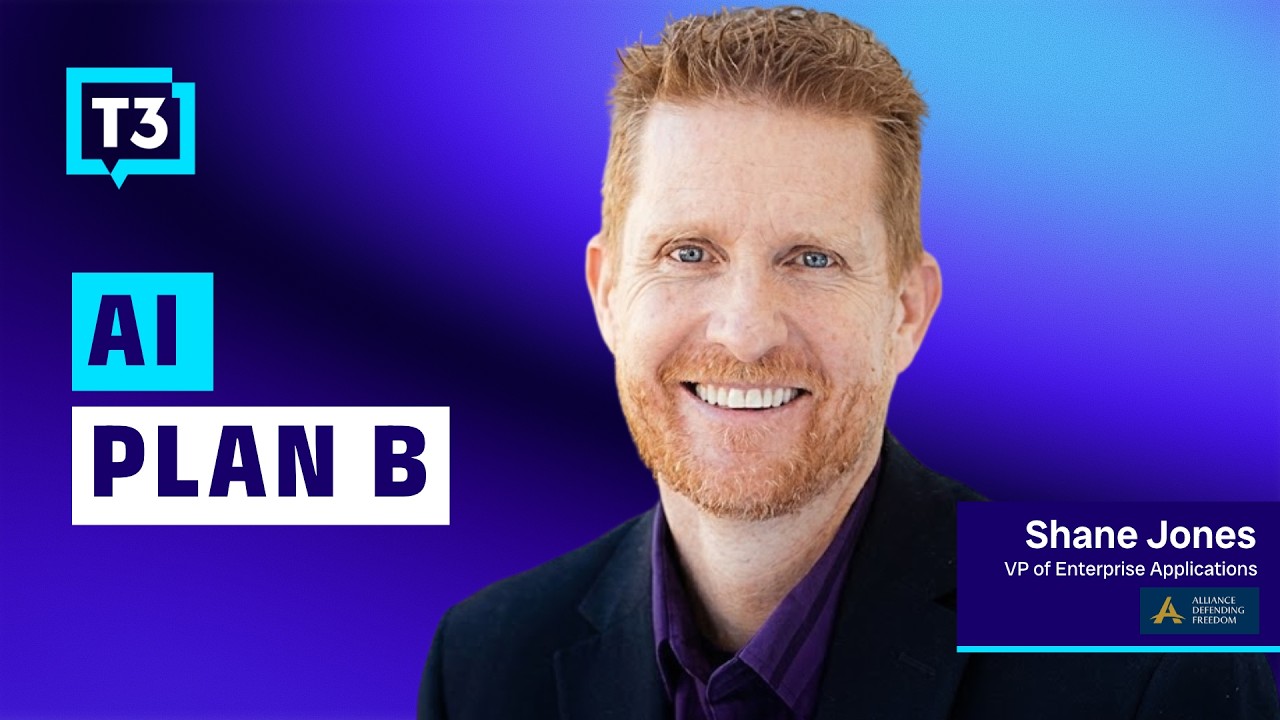
About this episode
Shane Jones is VP of Enterprise Applications at Alliance Defending Freedom, a 500-person legal nonprofit with offices in Scottsdale, Virginia, Texas, London, and Vienna. His 45-person tech team covers service desk, infrastructure, cybersecurity, and software development, with nearshore partners filling gaps. He calls it a mesh model.
On hiring, Shane says don't rush it, and he puts fit with the team and the organization ahead of skills, because skills can be taught and personality can't. His recruiters and Greenhouse use AI to summarize resumes, with a human reviewing the results. He runs engineering interviews as open-book tests and wants to see how a candidate thinks through a complex problem with whatever tools they'd normally use.
Every week he holds an hour-long one-on-one with each direct report, built on the same questions: what's top of mind, what's going well, what's frustrating, how performance looks, and what he can do for them. He also hands stretch projects to service desk staff, like inventory tracking and new hire orientation, and has sent people to Prosci change management training.
On AI, ADF ran pilots from summer to the end of 2025, using only public information, before picking platforms. Shane worries about MCP security and about PII and PCI data. He also expects token prices to climb, so ADF just bought several thousand dollars of equipment to stand up an on-prem sandbox for open-source AI. He doesn't yet know how many people it will take to staff.
- Why Shane Jones is buying on-prem hardware now to prepare for a token ceiling in 2027 and 2028
- Why every engineering interview at ADF is an open-book test where candidates use Claude and ChatGPT
- How Greenhouse summarizes resumes while a human still reviews every result
- The five questions Shane asks in every weekly one-on-one, including one he waits through silence for
- Why service desk staff at ADF own projects like new hire orientation and inventory tracking
- Why MCP worries Shane given the security breaches he's seen, and how ADF piloted AI tools with public data only
- Why developers go to Prosci change management training to fix IT's communication habits
Being a small to midsize tier company, if they increase the prices on the tokens, that's may price us out of being able to leverage some of these AI tools.
Shane JonesVP of Enterprise ApplicationsAlliance Defending Freedom
Transcript
Shane Jones 00:00
Everybody's like, "Well, MCP's great." Well, MCP isn't great if you see at all the different things out there, some of the security breaches that have happened. We did a whole bunch of pilots to figure out what AI tool or tools would be great for us. Make sure you don't put anything that's PII, just use public information and let's see what works. Being a small to midsize tier company, if they increase the prices on the tokens, that's may price us out of being able to leverage some of these AI tools. You can't be afraid. You cannot have fear. How can we keep ahead of the game?
How do we pivot to the old school one person is turning a wrench versus a machine doing it on an assembly line for them? We are on that brink of another industrial revolution except it's a technical revolution using AI. We just went down to the local IT shop here, bought several thousand of equipment to stand up our own onrem AI. How do we start buying this in preparation for the token ceiling of 2728?
Josh Anderson 01:12
Welcome to Tech Team Today where we talk with the people building and leading the engineering orgs behind today's most innovative companies. Our guest today is Shane Jones, VP of enterprise applications at Alliance Defending Freedom, a 500 person legal nonprofit with offices in Scottsdale, Virginia, Texas, London, and Vienna. His team is about 45 people covering service desk, infrastructure, cyber security, and software development with offshore partners filling in the gaps.
We talk about why he runs every interview as an openbook test, the five questions he asks in every weekly one-on-one, and why he's buying hardware now to stand up his own onrem AI before token prices climb in 2027. Onto the episode, welcome to the show, Shane. Very excited to have you. First things first, we are tech teams today after all. So, first thing we always do is make sure that our audience understands what your tech team looks like. So, I would ask you to share shape, size, if there's any specific talents or skills that make up your team, that would be wonderful to know.
Shane Jones 02:12
Yeah. Well, thanks for having me, Josh. Appreciate being here. and yeah, we have a tech team of roughly about 45 people. we're an organization of about 500 total people. We have a huge presence throughout the US, but we have an international presence as well throughout the EU as far as where our team members are located. we have two IT people overseas, one in London, one in Vienna, and then we have a remote work staff all over the country, primarily focused between Scottsdale, Arizona and Ashburn, Virginia with some presence in Texas and the DC area.
So I mean and we have anywhere from hands-on keyboard service desk people which is a team of about five to seven infrastructure and cyber security we have about another seven there we have software developers roughly three to four BAs project managers and a QA as well brought into here we are a fullervice tech team we also use expanded you know offshore services to offload some of that work that we just don't have the capability to do on site. So, it is very much a mesh model that we're working with here.
Josh Anderson 03:30
How did that come about? Was it through acquisitions or it happened natural where we're just going to go find wherever the best talent is?
Shane Jones 03:37
It's based on where we're located. as far as what that is, so our company was started in the mid 90s based out of Scottsdale, Arizona. we're a legal firm, do a lot of work on Capitol Hill. So, as we've moved as we've expanded our organization, we've moved over into the DC and Virginia area. so then there was need for support there. We have still a huge presence in Scottsdale with our operational areas, finance, HR, IT, etc. along with a big a big group of attorneys and our fundraisers.
on the other side in our DC and Virginia areas, that is where a lot of our executives are located along with some of our major attorneys to fight cases. Texas is a new location. there's just a big need and a big opportunity for us to continue fundraising. The state is extremely friendly to us from a legal perspective. So we can go in there really get you know really find those cases that mean something to ADF and so we need to have a tech presence there as well because we're continuing to grow and cultivate that office to be one of our hubs.
Over in the EU side we have London which is going to continue to grow as a hub in the you know in the international side along with a big presence in Vienna Austria.
So that is so we have one tech person in Vienna and one in London to kind of to do hands-on keyboard work to you know if there is something most of our technology lives in the US but we do have I mean all our firewalls switches all the offices have that so having somebody in those offices is extremely important so we can utilize you have 24 by7 support and when something if something goes down or when it does go down we have people there who can be readily equipped to do it quickly instead of waiting for somebody to wake up or waking somebody up in the middle of the night because a you know an ISP went down.
Josh Anderson 05:47
Yeah, makes perfect sense. Okay, so let's talk about when you expand that team and hiring was always hard. hiring in 2026 got a tad bit harder because of AI and what do you hire? How do you hire? Do you have AI be a part of the process? All the there's a million questions that are out there. So when you hire today, let's just talk about what that would look like.
Shane Jones 06:14
Yeah. So, let me I I wanted to actually go back if you don't mind as far as like how I've hired and how I've always looked at hiring in, you know, finding the right team member for the right place. Right? So, the biggest thing with hiring is not to rush the process. You need to find the right person for that position. Yes, it may be challenging at times because you have to step up and do work, but finding the wrong person to sit in that seat is just provides additional headaches later on down the road.
So, every time I actually have an interview, it's not your typical what did you what would you do in this situation? It's really flushing out, having a conversation, really getting to know what they're passionate about and how they, you know, depending on the type of position it is, whether it's a rank and file engineering type position or if it's a management position. Each one of those has different needs and the conversation can go differently based on that. So, you have to be very adaptable to find the right person.
In my head, if you just ask those typical questions you get in the old school interviews, you're not going to find the right person or you're just going to focus on maybe the wrong thing. So, I'm always about focusing on the right thing along with bringing in additional people. I'm really a big proponent of the panel interviews, bringing in the right people to, you know, go, okay, is this person the right fit for not just our team, but for the organization, right?
whether I'm here or if I was some somewhere else that's always what it has been is the fit for your team and the organization and do they have the skills I really believe that skills can be taught personality can't be so to make sure that they have that right fit into the organization your team I can't stress that enough and being in executive level positions it's hard for us to slow down sometimes to be real and So, how do we speed that up? Well, we speed that up by running resumes through AI, right? We use we use different HR products.
I will tell you, I have a great recruiting team. Shout out to them. where they, you know, they'll meet with me, sit down, figure out exactly what I'm looking for for the position, and they'll do some of the they'll do that initial interview and actually go, okay, hey, this person doesn't have the technical skills, but they have the leadership skills. Okay. Is that wi is that something I'm willing to have a discussion on? Do I need more of a leader?
Do I need a working manager to mentor and coach the team or versus just do I need a people leader to come in and be that driver to really motivate and galvanize the team to work because that's what we need depending on the position.
so the AI component really comes into play is okay let's first do the review of the resume right and then if you have multiple people that we like summarize that suck all that up a lot of our actually our tool we use is greenhouse for recruiting that has a lot of AI automatically in it so we utilize that a ton to figure out how if they do if they are a good candidate it for us to continue forward with. that hasn't changed a lot over year over the years. I don't think it's how it's been done, right?
Back in the day, we used to have have to have resumes in specific formats. So, you can have these
Josh Anderson 09:48
Things to scan in. Yes, I know I'm old, Josh.
Shane Jones 09:52
I I was Hey, listen. I was right there with you. Trust me, I I was laughing because I'm like, yep, I've been there. Yeah. So, I mean, it's just, you know, you you throw the resume into some scanner. It it takes the stuff out based on where it thinks it should have information and it spits out most of the time nothing good unless it's in the exact format it is. And we lost out on good people. Now, with the way AI is going, you don't miss out on that because it's a lot more summary.
The biggest thing is you have to have a human in the loop. You can't trust AI to do it all for you. So if there I mean based on the results of whatever AI tool you're looking at you have to review those results. You just can't shut your eyes and go okay I'm good thank you let's move on let AI do the work. That's why understanding and getting that right level of whoever's doing that research on those applicants that they utilize that in a way as a tool not as a decision point.
Whereas you go back 20 years, that was a decision point to just scan it in if it didn't make it. We have so many resumes, we're just going to get rid of it. Right now, it's actually allowing the candidates not to have to have the resume in a perfect format, but allow and allow us as hiring managers to find the right people from a bigger pond. However, the pond is also shrinking because the jobs there's just not the there's just not the talent pipeline out there. And so that's the challenge. So I've had some positions that will be open for 6 8 months at times.
because the talent pool just isn't there. And what we're looking for is very specific. we've gone back to the you know we've gone back to a very heavy return to office policy or whatever you want to call that, right? we want to go back to office. So that means we either have to transfer people to move to a location or we need to find people in those locations. I talked earlier. Texas has a great opportunity for tech people because of everything going on especially in the Dallas area where we are.
Scottsdale and the Phoenix area we don't have a lot of talent because they're all working at there's a lot of industry tech industry here. they're there, you know, those jobs are already filled. So trying to find that to come to Scottsdale is hard. Virginia and DC area the pay is you know it's a higher threshold for pay to so especially working in a nonprofit we have to be very careful with okay what makes sense. So us being a nonprofit just put something else on there. So trying to find the right people having a wider talent pool is extremely important for us to do that.
And AI is one of those things that if you use it to summarize it, we're good to go.
Josh Anderson 12:45
So the fundamental of who you hire hasn't changed. There's a lot of folks that are rethinking and rewriting the job descriptions because now AI is changing the way engineers work. But what I'm hearing from you, and I agree with it, is that the fundamental, the core of who you hire, they need to learn fast. They need to be able to be a great teammate. They need to be a bit of a leader. All those things still exist. And you know, I'm paraphrasing what you said that that those are the things that are harder to teach. I can teach someone a skill.
I can teach them how to be better at working with claude. It's harder for me to teach them how to communicate effectively as a leader and as a member. Correct.
Shane Jones 13:30
That is 100% accurate. Yeah. I mean, yeah, AI work, you know, doing, you know, job descriptions, it's absolutely great. I can go in, suck up, hey, write me a position for a director of CRM and data and analytics. Oh, you know, pull back something, go in there, take 15 minutes, clean it up, get rid of some stuff that I don't like or whatever. And that's that that's streamlined my job unbelievably, you know, in an unbelievable way. same thing with like I like we talked about earlier, right?
you know, being able to discern which candidates rise up along with getting that wider net to cast, you know, having that wider net to
Josh Anderson 14:11
Cast. Do you allow or exclude AI you? So, if you're hiring a developer there there's a whole spectrum of people that are saying, "We're trying to hire your brain, so we want you to leave the AI out and we're going to do traditional interview questions." or there are some folks that have treated like it's an open book test and we're going to let you use the tools you would normally use. Do you have a strong stance there or are you still working to figure out
Shane Jones 14:41
What's right for you guys? I've always been one for the open book test, especially with the the engineering side. because let's be real, Google's been around forever. I've used Google forever, right? I mean, back in the late 90s, early 2000s, it's like, hey, we're going to Google it now. we're going to clot it or we're going to chat GPT it or whatever. It's just a different way to look at it. And I've always gone into this going, the tools are available.
Why are you testing me on something that maybe and a lot of these tests that I've been a part of or I've seen are really abstract and aren't real world type of scenarios that you're trying to work walk your way into. So, I'm more, hey, we have a test. Use all the tools available. I want to know how your brain thinks and processes a complex problem and what tools that you think you need you need and how to utilize that to get to the final answer.
This isn't I mean I don't look at this as college or you know anything where you close your book and go hey you can't use anything you have to memorize this short-term memory does nothing for me. that repetitive nature to really those thought individuals help us not just with the tactical items, but it helps us as leaders understand how we can pull those individuals in for strategy, right?
They may not know we're pulling them in for strategy, but that strategy aspect of we see a person who can use abstract thinking that just allows us to get better as an entire team versus okay, I know this programming language. I can go into I can write this program. Here you go. that doesn't allow us when we get new requests or as we branch out to new internal software development projects or we switch to a new language because it's better or a new version of the language because it's better and having to relearn that.
So that's where that's why I'm like I'm I'm all about abstract and let them use the tools that are at their fingertips.
Josh Anderson 16:43
So you opened a door that is the next topic I want to talk about is coaching and training the next generation of leaders. That that's a that's one of those things that when you figure that out your organization becomes self sustaining because you're growing the next set of leaders and that's again a lot of people talk about that but do you have any approaches theories or anything like that that you can share with our
Shane Jones 17:07
Folks? So yes there's a lot to go in here and as a well there really is. It's and as a leader you have to be intentional about it. as you go up in the chain. So as as a firsttime supervisor manager, you really want to stay in touch with all your teams, right? You really want to be there in in the, you know, in the weeds with them fighting whatever battle they're fighting. Then as you get away from that, it feels like you may lose a lot of connection with your directs. So like your manager may have a supervisor underneath of them. Okay.
Well, I'm going to put a lot of effort into the supervisor, right? Or maybe some effort, but I still have now I'm a manager, so I'm doing multiple things. So I may not meet with my supervisor as much as I was meeting with my one-on- ones as a supervisor. Director, same thing, right? As a VP, very similar. I don't do that. I try to I I am very intentional with how I meet and when I meet with my teams. So, at a minimum, I meet with all my directs on a weekly basis for an hour.
My one-on- ons are driven by them, so I know exactly where they stand. So, I go through it's I go through basically it's what's important to you. I call it top of mind. So, what's important? You know, what's gone on the last week that I may not know about because I'm doing a lot of other stuff. And yes, we're talking throughout the week, but I need to know what's important to you that you may not have you may I may not know about. Then the next question is really hard depending on what season you're in as a business. What's going well?
that I've been we've been silent in in our in our one-on- ones for a couple minutes because I won't move off of it. I want people to say, well, this is what's going well. Give me one thing. I don't expect everything. What was one mini success that you've had? It's celebrating the successes. Then we go into, okay, where are some frustrations been? Then it's we have a performance discussion. How do they think they're performing? Where do I think they're coming in with performance gaps? Right? So, it's and it's not it's not a bad thing.
It's how do we teach them to step up in a way that hey you missed this communication right I think that you didn't really take a step back and you know breathe before you reacted this situation if you would would it have come with some a different result and then the la and then then we go into we set up yearly goals with the team and monthly we go over those goals and a lot of and there's like five different goals there's three to five different goals that we talk through, but they're all measurable and and it's all for growth, not just I mean, for the most part, they're all for like team member growth.
It's not just, oh, you know, you need to write 400 line, you know, 4,000 lines of code in the next year or whatever that looks like, right? It's like, no, it's how, you know, it's more thoughtprovoking goals on how can you push that envelope? How can we push you to be a better team member, better employee? You know we've sent people you know we've actually sent people to various communication and we've sent them to Prosci for change management and understand how we communicate when you need to communicate. the biggest aspect of it that I think we fail at is communication.
we don't like to communicate with people. It's like just trust us you know go away in your corner and we'll we'll we'll do the ones and zeros and we'll keep you know if if it's not up and running it will be soon. Just go away. that's not the reality of the situation anymore. We're not just programmers in a dark dungeon getting Mountain Dew and Pizza Squid through the door to us and just bang on the keyboard. That was the good old days. You're telling me now we got to talk to people and work with people and do all this stuff.
so with that that's and then we to then I asked them flat out what can I do for you? that last question helps me shape on where I can grow them right as far as where they're struggling, how can we, you know, improve processes. I believe empowerment is also key into growth and giving them stretch projects to do. even on my service desk team, they're just not I don't look at them as just service desk team members, you know, that just go, "Oh, I'm going to I'm going to get a ticket in. I'm going to solve that." We've given them projects to do.
You know, I you know, we're we've given a couple guys projects for okay, how are we going to track our inventory better, right? And it's their responsibility to go, okay, well, we have the system. Let's figure out how we refine it. others is how can we do new new hire orientation better, right? I'm having the service desk team do that. It's not coming from me. It's not coming from our managers. that's coming from the rank and file to start getting them to think a little bit differently in how they go about their business.
And if they have actually skin in the game, it's not just, you know, management passing it down. It's them being involved. If they're involved, then we can see where their skills are and we can continue to grow and cultivate those skills to come back and go, okay, you are ready for the a supervisor or a lead or supervisor management position. Okay. And then if they when they get that position, my expectation for all my managers, the expectation for myself is I give them a list of expectations. This is what I expect out of this position. The job description is a job description.
Let's just be let's just be real. You know, there's one line in the job in every job description that is the only thing that matters. Other duties is assigned. That's just the nature of what we do, right? We wear multiple hats. It is moving. so quickly. Not one person, we don't have that those that siloed effect anymore. And if you have that siloed effect, more than likely you're going to be failing.
Josh Anderson 23:04
I would like to jump on the other duties assigned and talk about AI and how I am sure there are other duties that have been assigned to you to help figure out how AI should be leveraged securely and effectively across the entire organization. Even though you have your own job as a technical leader, this falls on so many of our shoulders of like, hey, we need the answer for the whole org. Where does that sit with you
Shane Jones 23:32
Guys? Yeah. So, we are in a I believe we're ahead of the curve for a lot of the nonprofits out there and organizations like us utilizing AI. the good thing is is we do have a vice president of AI and automation that is my peer that I work really closely with. However, it is it is another it is one of those additional duties that are have been assigned to really under you know work with him. I mean he's putting the strategy together for how AI is utilized right what we can utilize it for.
some of the times that we have to keep you know we have to pull stuff back because of security concerns right I mean we deal with a lot of PII we deal with PCI data there's a lot of stuff that you know data that is very confidential to what we do so how do we put how do we utilize these AI tools safely efficiently and effectively I mean everybody's like well MCP is great well MCP isn't great if you see all the different things out there on the you know on some of the security breaches that have happened with various m you know various MCPs and just AI tools in general on what's going on it's it's a scary world as far as what is being done so we take a very much data first centric approach with how we're implementing AI what we did to start this process I believe it was end of 25 yeah end of 25.
So basically summer 25 to end of 25 we did a whole bunch of pilots to figure out what AI tool tools would be great for us. my one of my one of our project man it was a it was a it was a true project.
So one of our project managers managed the project in conjunction with our VP of AI and automation and we worked with small pockets of various organizations where they you know and gave them opportunities to go hey you want to be part of this pilot this is an addition to your current job we want to know what you can do make sure you don't put anything that's PII just use public information you know whatever you're doing and let's see what works so that's essentially how we started to get into AI but as it's so then we have a policy basically we chose a couple different AI platforms depending on the line of business we're in because so we have our legal team who utilizes one and the rest of the organization uses another platform for the most part and then what we've done is we've slowly looked at okay what are the connectors and these the connectors are new so we're trying to figure out, okay, yes, all these people now have all these great ideas from our business teams.
Like, how do we want to use AI and leverage AI? Well, we need to take a very security first approach on it to go, okay, what makes sense? Because we still have a duty from an IT perspective to protect all of the organization to be successful and to keep the data safe.
I don't expect our business users to think totally in that manner like well let me just connect to the you know to our ITSM environment so we I can get this okay but there's that public connection what what's the risk to connect into that right so we're constantly looking looking over what that risk is and then fast forward because of the token you know the the upcoming potentially issue with tokens and how those are going to be.
We just don't know, let's be real, what you know, the next one, you know, we'll call it 12 to 24 months looks like for all of these various AI organizations. How are we going to sustain that? Being a small to midsize tier company, if they increase the prices on the tokens, that's may price us out of being able to leverage some of these AI tools. And so in conjunction with a lot of our executive team along with the VP of AI and automation, we're in the process of standing up a sandbox environment, an onprem sandbox environment so we can develop our own open-source AI.
So if this does happen, planning for 2728 that we actually have a sustainable environment that we can flip over to. We know there's a there the equipment isn't available. you know the hardware isn't overly available right now. So even trying to get some of our switches and firewalls ordered for you know just replacements that we have we're looking at six to 6 to 15 months depending on what we're trying to order for the hardware. And when you're trying to deal with compute and RAM and it's you're still 12 to 18 months on some of these things.
So, we're really going into this looking over the next quarter of this year to figure out, okay, what is our plan for this? And then how do we leverage, you know, how do we start buying this in preparation for the token ceiling of 2728? Yeah, that's a that's a hurdle that I think is looming out there for many folks. And one of the things we talked about before we hit the record button was we're hiring for we're we're hiring for new skills, but some of those skills are so new almost nobody has them.
So, as you're talking about building a model that's just for you, how are you staffing that or how are you thinking about you're going to staff that? We don't know. fair answer. hey, I'd love to lie and say, "Oh, yeah, we have everything planned." But it's really going to come out in how the sandbox environment is going to play out, right?
Because I mean in essence we have right now we have roughly 500 total team members across the globe and if you know if we have to have our own onrem environment and on-rem could be in the cloud could be it doesn't I mean it could be in some you know server you know server farm that we just own space in maybe not in one of our locations right so but what does that mean I don't know what that means yet and I don't know how many people we're going to need to staff I know we're going to need some pe we're going to need more.
What do I know the size of it? How big it's going to be? I don't know yet until we get through the next hopefully 3 months and we survive that in the next 3 months and have a really
Josh Anderson 30:12
Good plan on what that looks like and what our compute power is going to need to be to roll this out. Yeah, I think that's the real challenge for leaders today. I know the job is hard. It's always been difficult. It's always been challenging. But it just became more challenging because there are increased expectations for the role yet there are minimal definitions of what success with those new expectations look like.
So I think you've done a really good job of saying I am required in my additional roles and duties as as assigned to weigh into the unknown and I have to lead an entire organization in this somewhat murky future but also make sure we're checking all the boxes especially in a very secure oriented position that you're in. So, just kind of talk through like how you're how you're sorting all that out. And I know there's like no perfect answer here. I just want for our viewers and
Shane Jones 31:12
Listeners to just see that this is the job in 2026. You can't be afraid. You cannot have fear. I'm going to go back to when the Oh, what is it, man? Henry Ford and the line. Well, whatever that was, you know, the assembly line, right? When Henry Ford came in and built the assembly line, right? You know, they thought people were going to be out of jobs. You had to have thought leaders to try to figure out, okay, how do we make sure everybody's still doing the right things at the right point on the line?
but you had to have those lead those really thought leaders to really drive. Okay, how do we use this effectively? How can we keep ahead of the game? How do we pivot to the old school, you know, one person is turning a wrench versus a machine doing it on an assembly line for them, right?
you go into now I really look like we are on that brink of another industrial revolution except it's a technical revolution using AI and those people who are going to come up to the top are the going to be thought leaders who are not afraid and who are going to be willing to make a decision and then pivot when it fails. if I sit here and say I'm successful because I've never made a mistake in my life, well, I would be completely lying because the only way I've learned in my life is by the mistakes I've made and how to pivot and do it.
Now, can we fail faster? Yes. That's the big thing. We want to make sure that we as executives, we as leaders and our teams know, okay, failure is not bad. Failing slow and expensive is failing fast and quick. you know, failing fast and cheap is not bad. So, and then it's how do you pivot? How do you continue to grow the organization? So, when it comes to AI, we're do we're being extremely intentional by trying to figure out, okay, what's it what's this sandbox environment for?
you know, we just went down to the local IT shop here, bought, you know, several thousand dollars of equipment to stand up our own onrem AI that's that's that we're trying to work through to go, okay, what makes sense, right? And then we can't be afraid to do that. We can't go, okay, well, I'm going to stop to deal with this. It's but it's also working with our cyber security engineers, our architects, our infrastructure architects to make sure what we're doing is safely being done and it's not going to put the organization at risk.
So bringing the right people to the table is extremely important, but also having a leader who isn't afraid to try something new and to fail and then to pivot from that. That's where we need to be. We can't have us being these old school leaders that just stick our head in the sands and go, "You guys go do it. If you fail, you're fired." That's not that's not where the industry is anymore.
It's we have to be very flexible in how we are managing our team and especially when it comes to AI, how to empower them to utilize AI and not be afraid and but just put the right guard rails around them. Yeah. I always talk to folks about the word leader and it means you're outfront and I think you're doing a really good job of talking about in this moment right now in 2026 where there is so much in question as a leader we're going to be successful if we can be out front and being out front means you're the first
Josh Anderson 34:40
One that steps in a puddle or has to jump over that log or whatever it is and you have to be willing and ready to make all that happen. So I think that's a fantastic message that you're sending.
Shane Jones 34:50
Thank you.
Josh Anderson 34:51
Okay, so we've we've tackled all the things except for the last bit which is what I call the leadership read me where we learn about you. We understand what it means to be you as a leader. So these are five four to five questions that you've never heard, but don't worry, they're all safe. there's no gotcha questions. first one and one that's near and dear to my heart but unfortunately does not land on my side very often. There's a image format that is widely used on the internet that is spelled GIF but is pronounced a couple of different ways. How do you pronounce it?
Can I go Jify? You can call whatever you want. it's a soft G or a hard G. Yeah, I call it a GIF. Oh, take on it. Sorry. Yeah, I am clearly in the minority of the soft G on GIF. cuz I asked that of every person that's on this podcast and it's about 80 nearing 90% now that are the hard G. So, I'll just remain the stalwart, you know hard-headed GIF person. Okay.
Shane Jones 36:07
Jeff Gif's a peanut butter. Josh, come
Josh Anderson 36:09
On. I know. I know. Listen, I've had this argument for decades. Trust me, for decades, I've heard it all and and all of the arguments are very solid and they make a ton of sense, but in my mind, it's still a GIF. And I know [snorts] many people think I'm wrong, but that's okay. okay. So, let's talk about leadership. And is there one piece of leadership content, it could be a book or a quote or a movie or a podcast or anything that you like to fall back on or you find yourself quoting when you're coaching future leaders?
I have a I have a couple quotes that I've learned over my career. One is seek to understand. and actually that came from my current exec. He's like seek to understand. I've always looked at okay search clarity through the ambiguity. those two things as a leader if you can seek to understand or seek clarity amongst the ambiguity we live in an ambiguous world. Both both folks are roughly mean the exact same thing. it's always about trying to find that clarity and where we can drive you know where and then we can drive once we have that.
But we also have to be able to make decisions in an ambiguous world because it's our job as leaders to deal with the ambigu ambiguity and then help our team work with clarity. Agreed. Agreed. That is that is the job is like continuously clearing the fog for both yourself and for the teams. Okay. So let us roll the clock back to the very first product that you ever
Shane Jones 37:48
Shipped either as an individual or a
Josh Anderson 37:50
Member of the team. What was the technology that you built that product on? the first thing I ever did was I was using Notepad to develop a CDT HTML for a Navy base. What? Wait a minute. What? So you so because I really couldn't get front page working the way I wanted it to. This was back in the late 90s.
so I learned how to code HTML page, you know, like websites through Notepad using just typically and I had a big old book on all different HTML commands that I used and I wrote a entire CBT for the Air Force local Air Force base here in Phoenix for for one of for one of their and they gave me all the training material, everything they wanted to see. Suck it up and there there it was. That was the technology right there. Oh yeah. And the problem with front page was it threw all this like extra code in there to try and do some of the magic.
So sure it would produce something, but then it also produced a bunch of I guess the first AI slop, right? It was like there was just this like mess of stuff that was in there. It's like I don't need that. But Front Pages says yes, you do. so yeah, I was I was in that same time time frame as well and editing code in Notepad was a thing. So I was right there with you. I don't you you asked me the question. I really didn't want to be honest, but I had to. That's okay. That's okay. I get Listen, I was there with you.
I was I was doing some of the same tech at the same time. So yeah, those were interesting days for sure. okay. So let's talk about today and your preferred tech not tech stack but operating system of choice Windows, Mac, Linux or some other flavor. It depends on it depends on the need. I'm not a Mac guy. However, the way the Mac portfolio is going, it's actually the Macs last longer. They're they're competitive in price if not cheaper than some of the PC models.
so we are looking at being a more Mac centric environment or yeah I mean right now we have about 50 Macs compared to 500 PC you know 450 500 PCs we have a lot of people clamoring for Macs so it's okay and it makes sense from a cost perspective and a longevity perspective to go that way now if you want to talk about you know what I prefer for all for security for growth and everything that's your that's a Linux environment but I'm not going to get there. Yeah, agreed.
I I I once ran a 100 personnet shop and we pivoted to MacBooks for many of those reasons with. NET and Windows being run in a VM and and and our support costs went down and lifetime of those machines and that was
Shane Jones 41:00
You know a decade or so ago but certainly agree in line with that. Okay. Well, Shane, we are officially at the end. anybody that's listened and wants to connect with you, is the best way to do that on LinkedIn or is there any other source we should point them at?
Josh Anderson 41:17
No, go ahead and message me on LinkedIn. my account's out there, so please hit me up.
Shane Jones 41:23
Okay, good deal. All right, Shane, thanks so much for being a a wonderful
Josh Anderson 41:27
Guest, and you've done it, my friend.
Shane Jones 41:30
Thanks a lot, Josh. I appreciate the
Josh Anderson 41:31
Time. Take care. That was Shane Jones, VP of enterprise applications at the nonprofit Alliance Defending Freedom. Tech teams today is brought to you by Revelo. If you're looking to build out your engineering team with worldclass vetted talent from Latin America that's time zone aligned and ready to ship, check us out at revelo. com. I'm Josh Anderson. Thanks for being here and I'll see you next time.
More episodes
Leading an engineering team? Come tell us what you’ve learned.
If you lead an engineering or talent team and have lessons that only come from doing the work, we want to hear them. Josh hosts a relaxed 45-minute conversation about the decisions that shaped your team. Here is what you get:
- 01A real conversation, not a scripted Q&A.
- 02A produced episode page with video, transcript, and your profile, plus short clips cut for LinkedIn.
- 03An audience of engineering leaders working through the same problems you are.