


Hire the best Erlang developers in Latin America
















400k+
ENGINEERS
14 days
to hire
100+
COVERED
30-50%
US hires
Why hire Erlang developers through Revelo?
Rigorously vetted senior developers from Latin America who work in your timezone, ready to contribute from day one.
Interview only the best Erlang developers
A shortlist of three to five pre-vetted candidates, hand-picked by in-market recruiters. You decide who to interview, you decide who to hire.
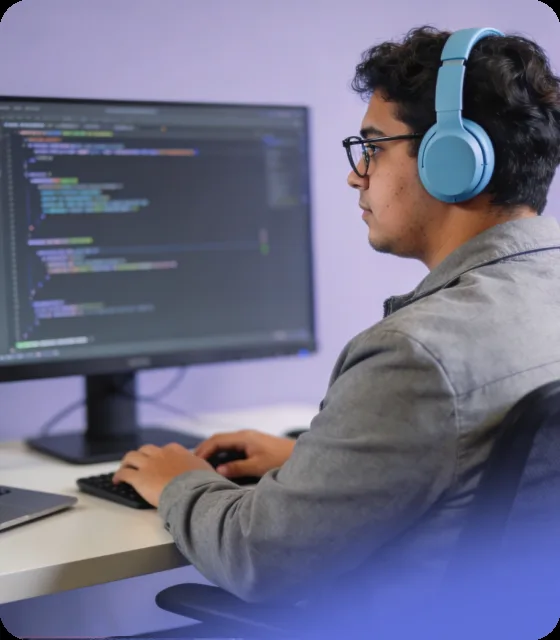



One platform for talent, payroll, taxes and compliance
Your team runs legally across 18 countries in Latin America. Manage your engineers without managing the infrastructure underneath them.




Local recruiting experts invested in your hire
In-market recruiters and account managers cover sourcing, offer strategy, and onboarding. They stay with you until your engineer is up and running.


Your team, your terms
Month-to-month engagements mean you're never locked into headcount you don't need. Scale up for a big push, pull back after launch.





Hire the top 1% of Erlang developers in Latin America
Hire vetted senior developers, matched to your stack, your timezone, and your budget.


Hire Erlang developers who can deliver this and more
Here's what you get when you hire nearshore Erlang developers with Revelo.
Hire Erlang developersRevelo's Erlang engineers have shipped production systems across distributed infrastructure, real-time platforms, and high-availability backends. Here's where they typically plug in.
Distributed System Architecture
Revelo's Erlang developers design and build clustered systems from the ground up, structuring node communication, partition handling, and state distribution to match your availability requirements.
Real-Time Messaging Infrastructure
They build message brokers, chat backends, and pub-sub pipelines that handle high volumes of concurrent connections without degrading under load, using Erlang's process model as the foundation.
Fault-Tolerant Backend Services
They wire OTP supervision trees into existing services so failures are isolated, logged, and recovered automatically, reducing the blast radius of production incidents.
Telecom and IoT Protocol Implementation
Erlang was designed for telecom signaling, and Revelo's engineers can implement or extend protocol stacks (SIP, DIAMETER, MQTT) for telecom and connected-device applications.
Legacy Erlang Codebase Maintenance and Migration
They step into existing Erlang codebases, assess technical debt, and execute incremental rewrites or migrations to modern OTP patterns, keeping production stable throughout.
Hire Erlang developers in 4 simple steps
Get from "we need someone" to your first day together in weeks, not months.
Tell us what you're building and what kind of Erlang developers you need: skills, experience level, team dynamics.
Three to five matched, pre-vetted candidates: identity-checked, skills-tested, human-screened. No wading through hundreds of profiles.
Run your own technical interviews. You decide who to interview and who to hire. Full control, no gatekeeping.
Make the offer. Revelo handles payroll, benefits, taxes, and compliance so you can focus on building. Your engineer ships code from day one.
10+ years making it easier to hire elite nearshore Erlang developers
Interview pre-vetted candidates who are fluent in English and work in your timezone.
Start hiring
Why hire Erlang developers based in Latin America?
Work synchronously with Erlang developers in the same or overlapping US time zones. Real-time collaboration, no async tax.

"Revelo tries to understand the problem and the best solution. They're not just a traditional vendor. The way I think about them, they're more of a strategic partner."


"If I look at different companies, Revelo just feels more like we're an extension of the same company. And that is an incredible difference between different vendors."


"They're part of the team. They're attending the standup, they're there with their camera on, talking about problems. They really fit in the culture that we are trying to build here."





What are Erlang developers?
An Erlang developer builds distributed, fault-tolerant systems where uptime and concurrency are non-negotiable. They write backend services in Erlang, a language designed from the start for telecom-grade reliability, and they own the architecture decisions that keep those systems running under load.
Day-to-day, that means designing supervision trees, managing message-passing between lightweight processes, and engineering systems that recover from failures without human intervention. Erlang developers typically work alongside infrastructure and backend teams, and they often reach into the OTP (Open Telecom Platform) library to build production-grade applications faster.
What separates a strong Erlang developer from a competent one: real production experience with the BEAM virtual machine, a track record of designing systems that handle millions of concurrent connections, and the judgment to know when Erlang is the right tool and when it carries more overhead than the problem warrants.
Why hire Erlang developers?
Erlang developers build the systems that can't go down. If your product handles real-time messaging, financial transactions, or telecommunications routing, a gap in Erlang expertise shows up directly in your reliability metrics and your on-call rotation.
The hiring problem is real: Erlang is a niche discipline. Most US-based senior engineers with BEAM production experience either work at WhatsApp, Ericsson, or similarly large operators, or they command salaries that push them out of reach for a mid-market engineering team. The talent pool is genuinely thin onshore.
Latin America's talent pool includes engineers who built their Erlang and BEAM experience on telecom infrastructure projects in Brazil, Colombia, and Argentina. Through Revelo, you get a shortlist of vetted candidates within 72 hours and can complete a hire in under 14 days on average. The all-in cost runs 30–50% below comparable US hiring, and you're working with engineers in the same time zones as your existing team.
What does it cost to hire Erlang developers?
For a senior-level Erlang developer, engineer compensation based in Latin America typically runs between $54,000 and $84,000 annually. The all-in cost through Revelo, which covers compliance framework, benefits administration, and Revelo's margin, lands higher but still well below comparable US hiring.
In the US, senior software developers earn well into six figures, with specialized backend disciplines like Erlang pricing toward the higher end given the small talent pool.
The figures below reflect Revelo Salary Guide data for software developers across the region (US-remote placement data, 2024-2026). Erlang specialists, as a niche backend discipline, sit at the upper end of these bands.
| Level | US Salary Range (Glassdoor 2026) | LATAM Salary Range (Revelo Salary Guide) |
|---|---|---|
| Junior | $80,356–$148,681 | $36,000–$60,000 |
| Mid-Level | $95,782–$156,181 | $48,000–$70,000 |
| Senior | $141,723–$220,394 | $54,000–$84,000 |
These are engineer compensation figures. The all-in cost through Revelo (which folds in benefits and compliance administration, and Revelo's margin) runs higher but still lands well below US hiring costs. Visit revelo.com/pricing for a role-specific quote.
Why hire in Latin America?
Latin America's Erlang talent pool grew out of real telecom infrastructure work. Countries like Brazil, Colombia, Argentina, and Mexico built out mobile and landline networks over the past two decades using Ericsson equipment and software, and engineers working in that sector developed Erlang skills on production systems. The depth here traces back to the region's industrial history, not a bootcamp trend.
Timezone alignment is especially important for Erlang work. Distributed systems need active monitoring, and incident response can't wait for a morning handoff. Major LATAM engineering hubs sit within 0–2 hours of US Eastern, which means your Erlang engineers are online during your core hours, reachable on Slack, and able to join a production incident call in real time.
English fluency among tech professionals in the region is consistently strong, and engineers based in Latin America who have worked on US-remote teams understand how to operate inside a distributed product organization. Communication overhead stays low.
How to evaluate Erlang developers
Start with concurrency architecture. Ask the candidate to walk you through how they've structured supervision trees in a production system. A strong answer names the specific OTP behaviors they used (GenServer, Supervisor, Application) and explains the failure recovery strategy. A weak answer stays at the conceptual level without connecting to a real system they shipped.
Next, probe BEAM internals. Ask how the scheduler handles process prioritization and what happens to a long-running computation in terms of preemption. Candidates who've debugged performance problems in production know this cold. Candidates who've only used Erlang in tutorials typically can't move past surface-level answers.
Finally, test distributed systems judgment. Give a scenario: two nodes in a cluster lose connectivity mid-transaction. Ask how they'd design for that failure mode and what trade-offs they'd accept. Strong candidates reason through CAP theorem implications and explain what they'd sacrifice. This question separates engineers who've run Erlang in production from engineers who've read about it.
Why expertise matters
Why Erlang Wins for Concurrency and Fault Tolerance
Erlang's process model runs millions of lightweight processes inside a single VM, each isolated from the others. A crash in one process doesn't propagate. The OTP supervision framework restarts failed components automatically, so systems built on Erlang absorb failures by design. For products where five-nines uptime is a real requirement, that built-in recovery pattern is difficult to replicate in other languages.
Erlang vs Elixir: Which Should You Hire For?
Erlang and Elixir both run on the BEAM virtual machine and share the same concurrency and fault-tolerance guarantees. The hiring decision turns on your codebase and team, not the runtime. The table below summarizes the practical differences.
| Factor | Erlang | Elixir |
|---|---|---|
| Syntax | Prolog-influenced, terse | Ruby-influenced, more readable |
| Community and tooling | Decades of production use in telecom | Younger, faster-growing community |
| Talent pool | Smaller, deeper telecom and systems specialization | Larger, broader web and API development background |
| Typical use cases | Telecom network elements, legacy BEAM systems, protocol stacks | Web APIs, real-time apps, Phoenix-based backends |
| Interoperability | Native; Elixir compiles to the same BEAM bytecode | Can call Erlang libraries directly |
| Hire when | Maintaining or extending an Erlang codebase, or building telecom-grade infrastructure | Starting a new BEAM project with a broader hiring pool |
If your codebase is already in Erlang, hire an Erlang developer. If you're starting fresh and concurrency is a requirement but telecom-specific protocol work is not, Elixir broadens your candidate pool without sacrificing the BEAM's reliability guarantees.
Common Use Cases
Erlang appears most frequently in real-time messaging platforms, financial transaction processing, telecom network elements, IoT device management, and online gaming backends where session state needs to survive server restarts. It's also the runtime underneath RabbitMQ, one of the most widely deployed message brokers in enterprise infrastructure.
Companies Shipping Erlang in Production
WhatsApp scaled to over a billion users on an Erlang backend before and after the Meta acquisition. Ericsson uses it throughout its core network equipment. Discord runs significant portions of its backend on Elixir, which compiles to BEAM bytecode and inherits Erlang's concurrency model. Klarna runs Erlang services in its payment processing stack.
When Erlang Is the Wrong Choice
Erlang carries a steep learning curve and a small global talent pool. If your concurrency requirements are modest or your team has no existing BEAM experience, the onboarding cost outweighs the reliability benefits. For CPU-bound workloads like data processing or machine learning inference, other runtimes serve those workloads more efficiently. Choose Erlang when uptime and massive concurrency are load-bearing requirements.
Benefits of working with Erlang developers
Revelo's Erlang engineers have shipped production systems across distributed infrastructure, real-time platforms, and high-availability backends. Here's where they typically plug in.
Distributed System Architecture
Revelo's Erlang developers design and build clustered systems from the ground up, structuring node communication, partition handling, and state distribution to match your availability requirements.
Real-Time Messaging Infrastructure
They build message brokers, chat backends, and pub-sub pipelines that handle high volumes of concurrent connections without degrading under load, using Erlang's process model as the foundation.
Fault-Tolerant Backend Services
They wire OTP supervision trees into existing services so failures are isolated, logged, and recovered automatically, reducing the blast radius of production incidents.
Telecom and IoT Protocol Implementation
Erlang was designed for telecom signaling, and Revelo's engineers can implement or extend protocol stacks (SIP, DIAMETER, MQTT) for telecom and connected-device applications.
Legacy Erlang Codebase Maintenance and Migration
They step into existing Erlang codebases, assess technical debt, and execute incremental rewrites or migrations to modern OTP patterns, keeping production stable throughout.
What Is an Erlang Developer?
An Erlang developer builds distributed, fault-tolerant systems where uptime and concurrency are non-negotiable. They write backend services in Erlang, a language designed from the start for telecom-grade reliability, and they own the architecture decisions that keep those systems running under load.
Day-to-day, that means designing supervision trees, managing message-passing between lightweight processes, and engineering systems that recover from failures without human intervention. Erlang developers typically work alongside infrastructure and backend teams, and they often reach into the OTP (Open Telecom Platform) library to build production-grade applications faster.
What separates a strong Erlang developer from a competent one: real production experience with the BEAM virtual machine, a track record of designing systems that handle millions of concurrent connections, and the judgment to know when Erlang is the right tool and when it carries more overhead than the problem warrants.
Why Hire Erlang Developers?
Erlang developers build the systems that can't go down. If your product handles real-time messaging, financial transactions, or telecommunications routing, a gap in Erlang expertise shows up directly in your reliability metrics and your on-call rotation.
The hiring problem is real: Erlang is a niche discipline. Most US-based senior engineers with BEAM production experience either work at WhatsApp, Ericsson, or similarly large operators, or they command salaries that push them out of reach for a mid-market engineering team. The talent pool is genuinely thin onshore.
Latin America's talent pool includes engineers who built their Erlang and BEAM experience on telecom infrastructure projects in Brazil, Colombia, and Argentina. Through Revelo, you get a shortlist of vetted candidates within 72 hours and can complete a hire in under 14 days on average. The all-in cost runs 30–50% below comparable US hiring, and you're working with engineers in the same time zones as your existing team.
What Does It Cost to Hire an Erlang Developer?
For a senior-level Erlang developer, engineer compensation based in Latin America typically runs between $54,000 and $84,000 annually. The all-in cost through Revelo, which covers compliance framework, benefits administration, and Revelo's margin, lands higher but still well below comparable US hiring.
In the US, senior software developers earn well into six figures, with specialized backend disciplines like Erlang pricing toward the higher end given the small talent pool.
The figures below reflect Revelo Salary Guide data for software developers across the region (US-remote placement data, 2024-2026). Erlang specialists, as a niche backend discipline, sit at the upper end of these bands.
| Level | US Salary Range (Glassdoor 2026) | LATAM Salary Range (Revelo Salary Guide) |
|---|---|---|
| Junior | $80,356–$148,681 | $36,000–$60,000 |
| Mid-Level | $95,782–$156,181 | $48,000–$70,000 |
| Senior | $141,723–$220,394 | $54,000–$84,000 |
These are engineer compensation figures. The all-in cost through Revelo (which folds in benefits and compliance administration, and Revelo's margin) runs higher but still lands well below US hiring costs. Visit revelo.com/pricing for a role-specific quote.
Why Hire Erlang Developers in Latin America?
Latin America's Erlang talent pool grew out of real telecom infrastructure work. Countries like Brazil, Colombia, Argentina, and Mexico built out mobile and landline networks over the past two decades using Ericsson equipment and software, and engineers working in that sector developed Erlang skills on production systems. The depth here traces back to the region's industrial history, not a bootcamp trend.
Timezone alignment is especially important for Erlang work. Distributed systems need active monitoring, and incident response can't wait for a morning handoff. Major LATAM engineering hubs sit within 0–2 hours of US Eastern, which means your Erlang engineers are online during your core hours, reachable on Slack, and able to join a production incident call in real time.
English fluency among tech professionals in the region is consistently strong, and engineers based in Latin America who have worked on US-remote teams understand how to operate inside a distributed product organization. Communication overhead stays low.
How to Evaluate Erlang Candidates
Start with concurrency architecture. Ask the candidate to walk you through how they've structured supervision trees in a production system. A strong answer names the specific OTP behaviors they used (GenServer, Supervisor, Application) and explains the failure recovery strategy. A weak answer stays at the conceptual level without connecting to a real system they shipped.
Next, probe BEAM internals. Ask how the scheduler handles process prioritization and what happens to a long-running computation in terms of preemption. Candidates who've debugged performance problems in production know this cold. Candidates who've only used Erlang in tutorials typically can't move past surface-level answers.
Finally, test distributed systems judgment. Give a scenario: two nodes in a cluster lose connectivity mid-transaction. Ask how they'd design for that failure mode and what trade-offs they'd accept. Strong candidates reason through CAP theorem implications and explain what they'd sacrifice. This question separates engineers who've run Erlang in production from engineers who've read about it.
Why Erlang Expertise Matters
Demand for BEAM engineers has expanded well beyond telecom. Real-time messaging platforms, financial clearing systems, IoT device management layers, and multiplayer gaming backends have all pulled Erlang (and Elixir, which runs on the same VM) into production. The hiring market for this skill has tightened because the use cases grew faster than the engineering population did.
For a mid-market company, the staffing gap has direct business consequences. A backend team that can't maintain its Erlang services in-house ends up dependent on one or two individuals who hold all the institutional knowledge. When one of them leaves, the system effectively becomes unmaintainable. That's the risk sitting underneath every under-staffed Erlang codebase.
The supply-demand imbalance also means that US-based Erlang engineers carry significant negotiating power. Mid-market companies routinely lose candidates to larger operators who can pay more and offer stronger equity. Building Erlang capacity through a nearshore model lets engineering leaders close positions without competing in an auction they're likely to lose.
How Revelo Vets Erlang Developers
Every Erlang candidate in Revelo's network passes a five-stage screen before you see their profile, and only about the top 2% of applicants clear it. Erlang candidates are pre-vetted before you ever start a search, so your 72-hour shortlist contains only engineers who've already passed.
The first stage is a profile and AI-assisted review covering work history, project scope, and depth of BEAM production experience. Candidates who clear that move into an English fluency evaluation, assessed for professional communication at the level a US product team expects.
The Erlang-specific technical screen comes next. A senior reviewer probes OTP fundamentals, distributed system design, and BEAM runtime behavior. Candidates then complete a hands-on challenge (a real concurrency or fault-tolerance problem) evaluated for both correctness and design judgment, alongside a soft-skills assessment focused on remote collaboration.
The final stage is a live interview with a senior Revelo technical reviewer who specializes in backend and systems engineering. Candidates who pass all five stages enter the active network. When you start a search, Revelo delivers a tailored shortlist, including candidate profile videos, within 72 hours.
Benefits of Building With Erlang
Why Erlang Wins for Concurrency and Fault Tolerance
Erlang's process model runs millions of lightweight processes inside a single VM, each isolated from the others. A crash in one process doesn't propagate. The OTP supervision framework restarts failed components automatically, so systems built on Erlang absorb failures by design. For products where five-nines uptime is a real requirement, that built-in recovery pattern is difficult to replicate in other languages.
Erlang vs Elixir: Which Should You Hire For?
Erlang and Elixir both run on the BEAM virtual machine and share the same concurrency and fault-tolerance guarantees. The hiring decision turns on your codebase and team, not the runtime. The table below summarizes the practical differences.
| Factor | Erlang | Elixir |
|---|---|---|
| Syntax | Prolog-influenced, terse | Ruby-influenced, more readable |
| Community and tooling | Decades of production use in telecom | Younger, faster-growing community |
| Talent pool | Smaller, deeper telecom and systems specialization | Larger, broader web and API development background |
| Typical use cases | Telecom network elements, legacy BEAM systems, protocol stacks | Web APIs, real-time apps, Phoenix-based backends |
| Interoperability | Native; Elixir compiles to the same BEAM bytecode | Can call Erlang libraries directly |
| Hire when | Maintaining or extending an Erlang codebase, or building telecom-grade infrastructure | Starting a new BEAM project with a broader hiring pool |
If your codebase is already in Erlang, hire an Erlang developer. If you're starting fresh and concurrency is a requirement but telecom-specific protocol work is not, Elixir broadens your candidate pool without sacrificing the BEAM's reliability guarantees.
Common Use Cases
Erlang appears most frequently in real-time messaging platforms, financial transaction processing, telecom network elements, IoT device management, and online gaming backends where session state needs to survive server restarts. It's also the runtime underneath RabbitMQ, one of the most widely deployed message brokers in enterprise infrastructure.
Companies Shipping Erlang in Production
WhatsApp scaled to over a billion users on an Erlang backend before and after the Meta acquisition. Ericsson uses it throughout its core network equipment. Discord runs significant portions of its backend on Elixir, which compiles to BEAM bytecode and inherits Erlang's concurrency model. Klarna runs Erlang services in its payment processing stack.
When Erlang Is the Wrong Choice
Erlang carries a steep learning curve and a small global talent pool. If your concurrency requirements are modest or your team has no existing BEAM experience, the onboarding cost outweighs the reliability benefits. For CPU-bound workloads like data processing or machine learning inference, other runtimes serve those workloads more efficiently. Choose Erlang when uptime and massive concurrency are load-bearing requirements.
Frequently asked questions
Everything you need to know about hiring Erlang developers through Revelo.
How much does it cost to hire Erlang developers through Revelo?
All-in monthly costs run roughly $4,600–$5,600 for junior, $5,800–$7,500 for mid-level, and $7,200–$10,700 for senior developers: engineer compensation, PEO coverage, and Revelo's margin combined. No placement fee, no surprise invoices.
How quickly can I hire Erlang developers through Revelo?
You'll see a curated shortlist of matched, pre-vetted candidates within 72 hours, and most companies make a hire within 14 days of sharing their requirements.
What is Revelo's vetting process for Erlang developers?
Every candidate is identity-checked, skills-tested, and human-screened: technical assessments matched to their stack, soft-skills and English-fluency interviews, and review by in-market recruiting experts before they ever reach your shortlist.
What engagement models does Revelo offer for Erlang developers?
Month-to-month, full-time engagements, with no long-term lock-in. Scale up for a big push or pull back after launch as your roadmap evolves, with a 14-day risk-free trial on every hire.
What happens after I hire Erlang developers through Revelo?
Revelo handles payroll, benefits, taxes, and compliance across 18 countries, and your dedicated account manager stays with you through onboarding and beyond. Your engineer ships code from day one.
How quickly can I hire an Erlang developer through Revelo?
Revelo delivers a tailored shortlist of vetted Erlang candidates within 72 hours of receiving your requirements. Most clients complete the full hiring process, including interviews and offer, in under 14 days on average. Candidate profile videos are included so you can assess communication style before scheduling a live interview.
What does it cost to hire an Erlang developer through Revelo?
Engineer compensation for senior-level Erlang developers based in Latin America typically runs between $54,000 and $84,000 annually, with Erlang specialists sitting toward the upper end of that range. The all-in monthly cost through Revelo (which adds compliance framework, benefits administration, and Revelo's margin) runs higher but remains well below US hiring costs. See the salary table above for a full breakdown by level, or visit revelo.com/pricing for a role-specific quote.
How does Revelo vet Erlang developers?
Every Erlang candidate passes a five-stage screen covering profile review, English fluency, a technical deep dive on OTP and BEAM internals, a hands-on concurrency challenge, and a live senior interview. Roughly the top 2% of applicants clear all five stages. The network is pre-vetted, so your 72-hour shortlist contains only engineers who've already passed.
What engagement model does Revelo use?
Revelo acts as Agent of Record for the independent contractors it engages on behalf of clients. Under this model, the expert remains an independent contractor, not a Revelo or client employee. Revelo uses commercially reasonable efforts to structure the engagement, including the contractual framework and payment mechanics, in a manner intended to comply with applicable tax and labor law. Revelo places engineers as full-time, dedicated team members, structuring compliant local contracts, invoicing, payment, and benefits administration across 18 Latin American countries. There are no long-term contracts and no cancellation penalties. A refundable security deposit equal to one month of the engineer's payment is collected at onboarding and credited against your final invoice.
What if the first hire doesn't work out?
Revelo offers a 14-day risk-free trial. If the engineer isn't the right fit within those first 14 days, you pay nothing and Revelo backfills the position. After that window, you can still exit month-to-month with no penalty. 89% of Revelo's placed engineers stay with clients 3 or more years, and client retention runs above 95%. Start your search at Revelo.
Our Erlang developers know these tech stacks and more
Our talent is experienced in these libraries, APIs, platforms, frameworks, and databases.
Ready to hire Erlang developers?
See a curated shortlist of pre-vetted candidates in 72 hours. Only pay if you hire.