

Remote Teams
Filter By:

The CTO's Checklist for Vetting a Nearshore Staff Augmentation Partner
Scaling your engineering team without overpaying starts with vetting a nearshore staff augmentation partner the right way—and this post gives you a concrete checklist to do exactly that. With US senior developer salaries reaching $220K and quality nearshore hiring delivering 30–50% cost savings with 14-day fill times, the partner you choose determines whether those numbers actually materialize. Work through these criteria before you sign anything, and you'll avoid the most common—and most expensive—mistakes.

How to Assess Technical Skills of LATAM Developers
Knowing how to assess technical skills of LATAM developers is the difference between a hire that accelerates your roadmap and one that sets it back by months. This guide walks through a practical five-stage assessment framework—covering automated screening, live coding, take-home projects, system design interviews, and communication evaluation—built for engineering leaders who need confidence before day one. You'll also find salary benchmarks, comparison tables, and context on why nearshore staff augmentation has become a serious hiring strategy for US engineering teams.

AI Won’t Fix Your Hiring Problem: Why Leaders Still Need Human-Centered Teams
AI tools boost productivity, but they don’t replace great engineers. Learn why U.S. leaders are hiring adaptable, AI-ready developers from LATAM to build resilient teams.

The Best Companies to Hire Developers in Argentina (2026)
Want to hire developers in Argentina but not sure which vendor actually fits your team's situation? This guide maps 8 companies to specific engagement types, from long-term embedded hiring to short-term contractor work, with candid limitations for each. Senior engineers based in Argentina average $70,000 per year in US-remote placements, roughly 40 cents on the dollar compared to US equivalents, and Buenos Aires runs UTC-3 year-round for near-complete overlap with US East Coast teams.

How to Hire .NET Developers Nearshore: Skills and Vetting Guide
If your senior .NET search keeps stalling at six months and your budget can't compete with hyperscalers, hiring .NET developers nearshore is how mid-market engineering teams are closing that gap fast. This guide covers the modern .NET skill stack you actually need in 2026, how to vet for version currency and real production depth, and what the all-in costs look like by country and seniority. Senior engineers through a nearshore staff augmentation model run 30–50% below comparable US rates, with a vetted shortlist in 72 hours and an average hire time of 14 days.

How to Hire Remote Developers in Brazil: Costs, Compliance, and Process
Hiring remote developers in Brazil gives US engineering teams access to a talent pool of 760,000+ ICT professionals, with senior all-in costs running $91,200–$127,200 per year compared to $141,723–$220,394 for a US senior hire. This guide covers how to structure the hire, what compliance requirements actually cost you, how to evaluate candidates remotely, and where teams get tripped up on CLT and LGPD. If you want the fastest path from requirement to placed engineer, Revelo delivers a vetted shortlist in 72 hours and averages a completed hire in 14 days.

How to Hire Angular Developers Nearshore in 2026
Trying to hire Angular developers nearshore but not sure where to start? This guide breaks down why US engineering teams are building Angular talent pipelines in Latin America, covering salary benchmarks, country comparisons, and vetting frameworks that actually hold up past the six-month mark. The short version: 30–50% cost savings, same time zones, and a faster path to production-ready engineers than domestic hiring can offer right now.

What to Look for When Hiring a Senior Full-Stack Developer in 2026
Hiring a senior full-stack developer in today's market means competing for a thin slice of genuinely senior talent while average engineering vacancies stretch past 40 days. This guide breaks down exactly what to look for in 2026—from architectural judgment to team fit—and how to structure an evaluation process that filters out impressive-looking candidates who can't actually deliver. It also covers how nearshore staff augmentation can compress your hiring timeline without cutting corners on quality.

How to Evaluate Cultural Fit When Hiring Nearshore Engineers
Evaluating cultural fit for nearshore engineers is one of the most overlooked—and highest-stakes—parts of distributed team hiring. This guide breaks down a practical framework for assessing soft-skill alignment when hiring engineers based in Latin America, including what to look for, how to test it, and where cultural strengths genuinely hold up under scrutiny. If you're building a nearshore team and want to hire fast without sacrificing fit, this is where to start.
Hire Flutter Developers from LATAM — Nearshore Talent, US Time Zones
Hiring Flutter developers nearshore has become the go-to strategy for US engineering teams that can't compete with hyperscaler compensation packages — and Latin America is where the strongest opportunity sits. This guide breaks down salary benchmarks, country-by-country talent comparisons, and the real hiring process timelines (including 72-hour shortlists and 14-day placements) so you can build a Flutter team that ships without the six-figure overhead. Whether you're weighing Mexico, Brazil, Colombia, or Argentina, here's everything you need to make a confident, CFO-approved decision.

How to Hire Ruby on Rails Developers Nearshore for SaaS and API Development in 2026
Hiring Ruby on Rails developers in the US means competing against hyperscalers and well-funded startups for a shrinking talent pool — at salaries exceeding $220K for senior engineers. This guide breaks down how nearshore staff augmentation through Latin America gives engineering leaders a faster, more cost-effective path to pre-vetted Rails talent working in their time zones. From salary benchmarks and country comparisons to vetting criteria and team-building steps, here's everything you need to hire with confidence.
How to Hire TypeScript Developers: Skills, Rates, and Vetting Criteria
Hiring TypeScript developers in 2026 means competing against hyperscalers offering $200K+ salaries and equity packages most growing companies simply can't match. This guide breaks down the skills that matter, realistic salary benchmarks across markets, vetting criteria that cut through resume padding, and why US engineering teams are increasingly turning to pre-vetted engineers based in Latin America to close the gap. If you need qualified TypeScript talent without the impossible price tag, this is where to start.

How to Hire Cloud Engineers Nearshore: Skills and Vetting Criteria for 2026
Hiring cloud engineers nearshore in 2026 means navigating a market where hyperscalers are locking up US-based senior talent with $300K+ compensation packages most companies simply can't match. This guide breaks down exactly how to build a defensible nearshore cloud hiring strategy — from LATAM salary benchmarks and certification requirements to vetting frameworks and distributed team onboarding. If you're an engineering leader under pressure to scale cloud infrastructure without blowing your headcount budget, this is the playbook you need.

How to Hire React Native Developers Nearshore in 2026
Hiring pressure is real: US React Native salaries now exceed $126K, and top mobile talent keeps getting poached by hyperscalers you can't outbid. This guide makes the case for why companies choose to hire React Native developers nearshore — and delivers a market-by-market breakdown of Latin America's talent pools, salary benchmarks, and hiring timelines so you can move fast without guessing. If you're ready to close a 30–50% cost gap without sacrificing technical quality or timezone alignment, this is where to start.

How to Hire Golang Developers Nearshore Without a Lengthy Recruiting Process
Hiring Golang developers nearshore has become a strategic priority for US engineering leaders who can't compete with hyperscaler salaries — and this guide gives you the data to act on it. You'll find country-by-country salary benchmarks, a candidate evaluation framework, and a clear comparison of Latin America's top Go talent markets. If you need senior Go engineers working your time zone without a six-month recruiting cycle, this is your starting point.
How to Hire AWS Engineers Nearshore: A 2026 Guide for CTOs
Hiring AWS engineers nearshore is one of the most effective ways for US companies to close cloud talent gaps without overpaying or compromising on quality — but it requires the right strategy. This guide breaks down the real cost comparisons, country-by-country options, vetting criteria, and onboarding steps you need to build a high-performing nearshore AWS team. If hyperscalers keep outbidding you for certified cloud talent, here's the practical playbook to stop losing that race.

What Is Offshore Software Development? A Honest Overview (Including the Tradeoffs)
Offshore software development has been a go-to cost strategy for decades, but the model has evolved—and so have the tradeoffs. This guide breaks down what offshore software development actually means in 2025, where it delivers real value, and where it creates friction for US engineering teams. If you're weighing your options, here's why more VPs of Engineering are shifting toward nearshore staff augmentation to capture 30–50% labor cost savings without the time zone headaches.

How to legally employ software developers in Latin America in 2026
Hiring nearshore software developers in Latin America has become one of the smartest moves US engineering teams can make — but doing it right requires knowing the legal, compliance, and structural differences across Brazil, Mexico, Colombia, and Argentina. This guide breaks down how to access a pool of 400K+ pre-vetted engineers at 30–50% lower cost than equivalent US hires, without exposing your company to misclassification risk or payroll liability. If you're a VP of Engineering ready to build a faster, leaner team in 2026, this is where to start.

Nearshore vs Offshore Outsourcing: Practical Guide for Engineering Leaders (2026)
Nearshore vs offshore outsourcing: a practical comparison for engineering leaders covering real costs, time zone impact, when each model works best, and how to evaluate partners. Updated for 2026.

Deel vs. Revelo: Hiring Infrastructure vs. Vetted Engineering Talent
Comparing Deel vs Revelo engineering talent solutions isn't just a pricing exercise — it's a question of whether you need global payroll infrastructure or a vetted network purpose-built for finding skilled software engineers fast. This article breaks down what each platform actually does, where each one excels, and how to decide which belongs in your hiring stack. If your real problem is keeping your product roadmap moving, the distinction matters more than you might think.

LATAM vs Eastern Europe vs Asia: Why Latin America Wins for US Remote Engineering Teams in 2026
Trying to hire remote software developers in 2026 means navigating a global talent market where the wrong regional bet can cost you more than the salary savings you were chasing. This article breaks down Latin America, Eastern Europe, and Asia head-to-head across timezone overlap, talent depth, legal infrastructure, and speed-to-productivity — so you can make a decision your CFO and board will stand behind. The data is clear on where US engineering teams are winning right now, and it starts with nearshore.

Best LATAM Time Zones for Nearshore Teams
Understanding the best LATAM time zones for nearshore teams is the first step to building a distributed engineering team that collaborates in real time—not on delayed Slack threads. This guide breaks down how Mexico, Colombia, Brazil, Argentina, and neighboring countries align with US business hours, what their talent pools look like, and how to match the right region to your team's workflow. With 400,000+ pre-vetted engineers based in Latin America and 30–50% cost savings versus US hiring, the question isn't whether LATAM works—it's which part of LATAM works best for you.

Improving Communication in Distributed Engineering Teams
Improving communication in distributed engineering teams isn't just a culture fix — it's a structural challenge with real financial consequences, including an estimated $62,000 per developer annually in lost productivity. This guide breaks down the root causes most engineering leaders misdiagnose, and delivers practical frameworks for building alignment and trust across time zones. If you're managing a remote or nearshore team, this is where to start.

How to Hire Developers in Mexico: Salary Guide, Talent Landscape & What You Need to Know in 2026
Thinking about how to hire developers in Mexico but not sure where to start? This 2026 guide covers everything US engineering leaders need to know — from real salary benchmarks and legal frameworks to where top talent clusters and how to build a Mexican engineering team that actually ships. Get the full picture on why Mexico has become the go-to nearshore destination for US companies that need timezone-aligned, pre-vetted engineering talent fast.

How to Lead Nearshore Engineering Teams in LatAm
Learning how to lead nearshore engineering teams in LatAm is one of the highest-leverage moves a US engineering leader can make right now — but the "how" matters as much as the "who." This guide breaks down everything from timezone alignment and onboarding structure to Agile practices and compliance, so your nearshore team becomes a genuine force multiplier. Backed by real data — 400K+ vetted engineers, 30–50% cost savings, and roles filled in under 14 days — it's a practical playbook for VPs who need results, not theory.

Timezone Overlap: Why It Matters for Remote Teams
Timezone overlap isn't just a scheduling detail — it's a measurable driver of engineering velocity, and ignoring it can silently cost your team weeks of compounded delays across a single sprint. This article breaks down the real productivity math behind schedule misalignment, how much overlap your team actually needs, and how to turn it into a structural hiring advantage. If you're evaluating nearshore talent from Latin America, you'll see exactly why the timezone fit is one of the hardest edges to replicate elsewhere.
Time Zone Overlap vs Opposite Time Zones for Remote Teams
Understanding what time zone overlap means for remote teams is more than a scheduling consideration — it's a structural decision that directly impacts how fast your engineering team ships, communicates, and collaborates. This guide breaks down how overlap hours work in practice, why nearshore engineers based in Latin America offer some of the strongest time zone alignment available, and what steps distributed engineering leaders can take to turn geographic flexibility into a competitive advantage.
How to Hire Front-end Developers: A Complete Guide
Trying to hire front-end developers in 2026 means competing against every well-funded company chasing the same React engineers who can ship production-ready code without babysitting. This guide covers what to screen for, what to pay (mid-level US salaries run $104K–$141.5K), and how to run a hiring process that doesn't drag on for weeks. It also breaks down why nearshore talent is helping teams cut hiring costs by 30–50% without sacrificing technical depth.

How to Hire Software Developers in Peru: Salaries, Legal Models, and Practical Tips for 2026
Everything US companies need to know about hiring software developers in Peru: real salary benchmarks, legal hiring models, employer cost breakdowns, top cities for tech talent, and practical tips for building your Peruvian engineering team.

How to Build a Remote Software Development Team in 2026
7-step guide to hiring, onboarding, and scaling nearshore development teams from Latin America—pre-vetted talent, compliance, tools, and best practices.

Hiring Great Nearshore Software Engineers in 2026: 12 Key Steps
A 12-step guide to hire developers faster and cheaper using nearshore talent, structured assessments, and EOR payroll for compliant, efficient onboarding.
10 Benefits of Hiring Developers from Latin America in 2026
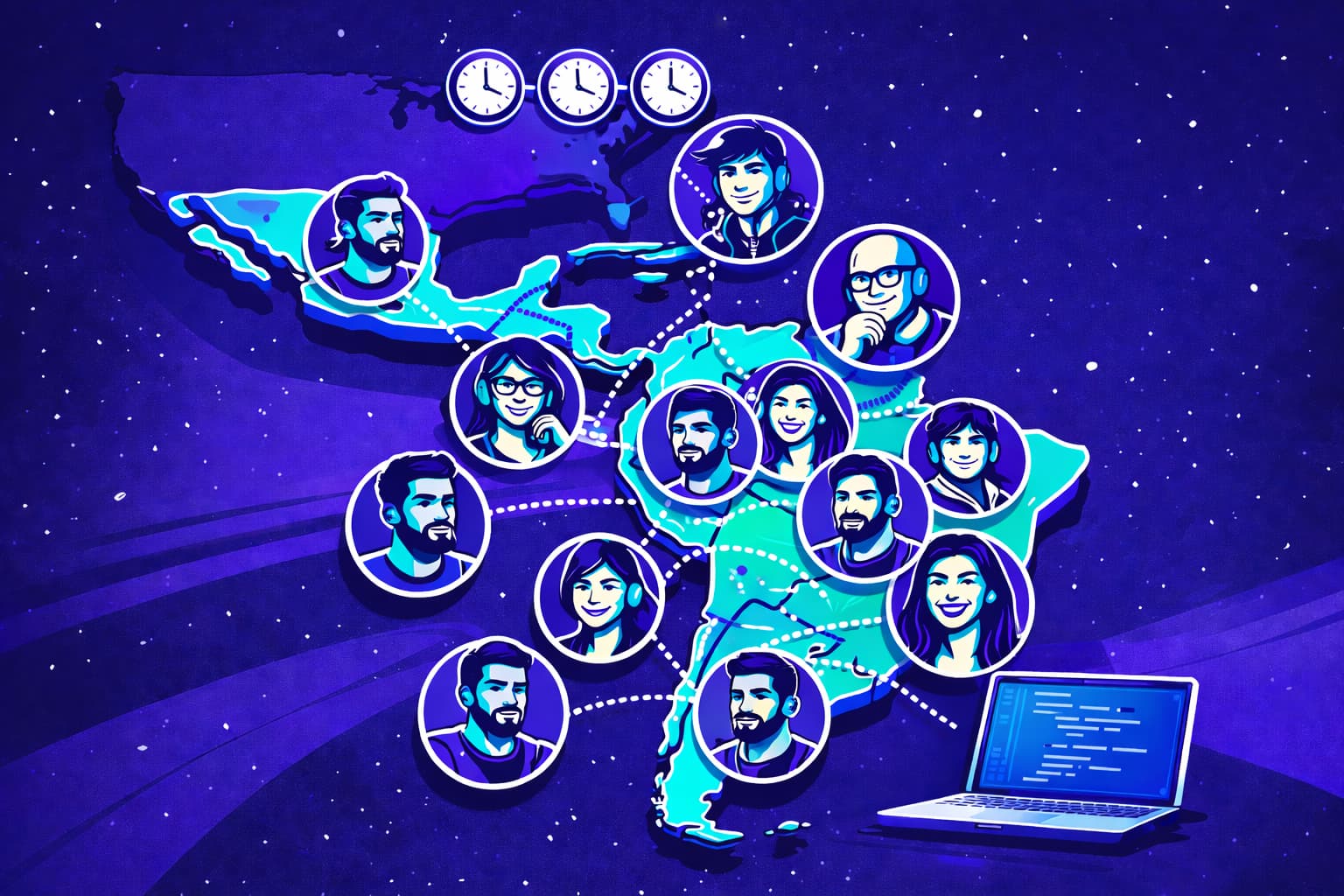
Hire Latin American developers to cut costs and speed workflows: aligned time zones, strong English, modern tech skills, scaling, and simplified compliance.
.jpeg)
Nearshore vs Offshore Development: Key Differences in 2026
Compare nearshore and offshore software development by time zones, communication, costs, and best use cases to choose the right model.

The Future-Proof Engineer: Why Adaptability Outlasts Any Tech Stack
Discover why adaptability—not just technical skill—is the key to future-proof engineering teams. Learn insights from engineering leaders on unlearning and resilience.
What I’ve Learned from Talking to Top Engineering Leaders in 2025
Discover the top 7 takeaways from conversations with engineering leaders in 2025—from AI adoption and ROI ambiguity to building strong remote culture and helping junior engineers thrive. Insights by Lucas Mendes, CEO of Revelo.

What Makes Great Engineering Teams?
Revelo CEO Lucas Mendes shares key takeaways from his conversation with Joshua Krohn, SVP of Engineering at Flash Parking, on team scaling, hiring, and AI.

Building High-Performance Engineering Teams in the AI Era
Discover how AI is reshaping software engineering—and what leaders must do to build high-performing, AI-enabled teams. Insights from Rafael Timbo, CTO at Revelo.
.avif)
Are Your Engineering Team Metrics Stuck in 2019?
Are you still measuring engineering success with outdated metrics? Learn what KPIs actually matter in 2025—from velocity and DORA to AI-driven productivity, time to value, and developer experience. Recap insights from Dropbox, Vibrant, and ProcessMaker.

From IC to Engineering Leader: How Ryan Cooley Scaled His Career Without Job-Hopping
How do you move from writing code to leading an engineering team—without job-hopping? Ryan Cooley shares his journey, AI insights, and real engineering metrics.
.avif)
Trust Yourself: Lessons from Deepwater Horizon to Health Tech
Discover how Heather Townsend's journey from Deepwater Horizon to co-founding Cabana teaches powerful lessons in leadership, adaptability, and trusting your instincts. A must-read for tech leaders navigating AI, remote work, and entrepreneurship.

Building World-Class Engineering Teams: From Startups to Big Tech
In this recap of Tech Teams Today, Revelo Co-Founder Lachlan de Crespigny breaks down key insights from his conversation with Julian Ramirez, Senior Engineering Manager at Dropbox. Julian shares his experiences scaling teams, embracing remote work, navigating AI’s impact on engineering, and tackling challenges at startups, mid-sized companies, and large enterprises.

Rethinking Code Ownership in a Remote-First World
As hybrid and remote engineering teams redefine collaboration, traditional code ownership is evolving. Learn how to foster accountability, leverage AI in code reviews, and implement best practices for distributed teams.

Check Your Ego at the (Virtual) Door: Leading with Humility in Remote Work
In a remote world, leadership isn't about ego—it’s about trust, humility, and empowering your team. In this post, Lucas Mendes, CEO of Revelo, shares insights on how engineering leaders can build stronger, more connected teams by leading with humility.

Engineering and Product Alignment: The Secret to Rapidly Scaling Remote Teams
Learn how tight alignment between engineering and product teams accelerates remote team scaling. Discover strategies for shared goals, collaboration tools, and effective communication.

Beyond Local Talent: How Engineering Leaders Can Solve Burnout and Attrition With Global Teams
Burnout and attrition are crushing U.S. engineering teams. Learn how hiring software engineers in LATAM helps leaders reduce turnover, balance workloads, and scale sustainably.

Calm Leadership at Scale: Building High-Trust Tech Teams
On this episode of Tech Teams Today, we unpack what it really takes to scale high-performing engineering teams. From promoting ICs at the right time to balancing speed with security, this recap shares leadership insights you can apply today.

How Tubi Scaled Super Bowl Streams to 15M+ Without Downtime
How Tubi streamed the Super Bowl to 15M+ users with zero downtime—engineering lessons from Arun Shankar, Director of Engineering at Tubi.

Engineering Leadership That Scales: Lessons from Slack, LinkedIn, and Beyond
Fractional CTO Jim Meyer shares tactical leadership lessons from Slack, LinkedIn & Salesforce—on culture, tech debt, AI, and scaling hybrid teams.

Build your dream dev team today
Find, hire & pay top engineers in Latin America, working for you full time.
